

Reviewed · WALKING TOURS
Bucharest: private and exclusive Italian walking tour
Bucharest becomes much easier to understand when someone connects its grand boulevards, Orthodox churches, royal buildings, and 1989 revolution sites. This private Italian walk brings those pieces together, from the Old Town’s small lanes to the Romanian Athenaeum. I especially like the private format, which lets the guide adjust the pace, and the focus on both famous sights and less obvious corners.
I also like that the route is led by a certified Italian-speaking guide, with Giuseppe, Beppe, and Filippo Di Cataldo named in the available guest feedback. The main caution is physical: it is a walking tour with many stops and a fair amount of pavement, even though the activity is marked wheelchair accessible. It is also listed as unsuitable for people with mobility impairments, so check your needs before booking.
Key points to know before booking
- A private Italian tour: You have the guide to yourself rather than joining a large mixed group.
- A strong first-time route: The walk covers the Old Town, Calea Victoriei, and Revolution Square in one outing.
- History with local detail: Expect architecture, political history, religious sites, and friendly anecdotes rather than only photo stops.
- A flexible pace: The guide can adapt the walk to your interests and timing within the 2.5-hour format.
- Several indoor visits: Stavropoleos Monastery, the New Saint George Church, and the Romanian Athenaeum add variety to the streets.
- Good value for a small private party: At $53 per person, the price makes more sense when shared by two or more people who want Italian guidance.
Why this walk gives Bucharest a clear shape
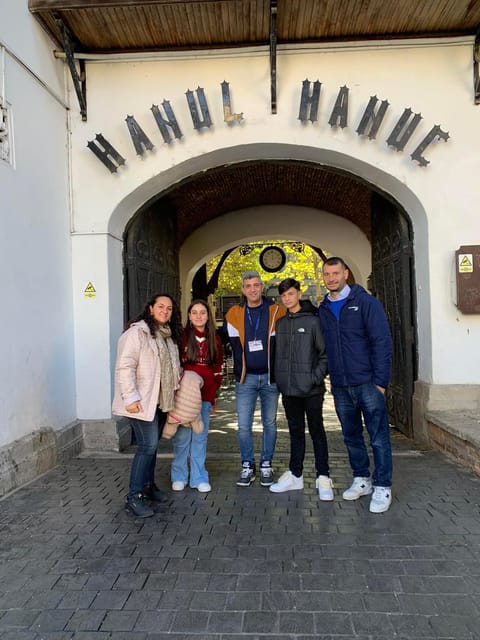
Bucharest can feel confusing at first. Its center mixes Ottoman-era traces, Orthodox churches, French-inspired architecture, communist-era scars, modern shops, and lively restaurants. A short walk can carry you from a quiet monastery courtyard to a boulevard lined with grand public buildings.
That mix is the real point of this tour. You are not only checking off Bucharest sights. You are following a rough timeline through the city. The Old Town introduces religious, commercial, and civic life. Calea Victoriei shows the city’s polished side. Revolution Square brings the story into the late twentieth century and the fall of Nicolae Ceausescu’s dictatorship in December 1989.
The guide’s role matters here. The tour promises explanations in Italian, not simply directions from one monument to the next. Giuseppe, also referred to as Beppe in the feedback, is praised for explaining both the city and its history with enthusiasm. Filippo Di Cataldo is also named by one guest. Since the supplied information does not clearly say whether these names refer to one guide or several, confirm the assigned guide when you book.
More Walking Tours in Bucharest
- Bucharest: City Highlights Guided Walking Tour
★ 4.9 · 1,482 reviews - Bucharest Highlights Walking Tour
★ 5.0 · 469 reviews - Bucharest: Ghost Stories & Romanian Mythology Walking Tour
★ 4.9 · 287 reviews
Starting at Caru’ cu Bere on Stavropoleos Street
Meet in front of Caru’ cu Bere at Stavropoleos Street 5, where the guide will carry professional identification. This is a sensible starting point because you begin in the heart of the Old Town, close to several of the route’s first stops.
Caru’ cu Bere is not just a place to grab a meal. The restaurant is one of the best-known historic interiors in central Bucharest, and the tour includes about 10 minutes of guided attention here. You can expect the guide to explain why this building matters and point out details you might miss if you simply walked in for lunch.
Food and drinks are not included. That is useful to remember because Caru’ cu Bere is an obvious temptation at the start or end of the walk. You can plan a separate meal, but the tour itself is focused on sightseeing rather than dining.
Stavropoleos Monastery and the quiet side of the Old Town
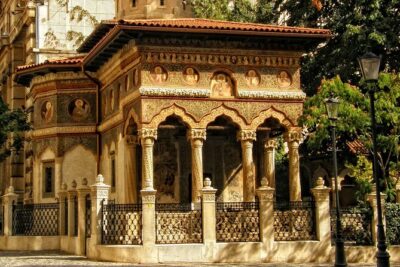
The next stop is Stavropoleos Monastery, with about 15 minutes set aside for a visit and explanation. This Orthodox complex is one of the most atmospheric places in central Bucharest. Its scale is modest compared with the city’s major palaces, but that is part of its appeal.
The monastery gives you a pause from the commercial side of Lipscani Street. Look for the decorative details and the sense of enclosure created by the courtyard. Your guide can also help explain the place within Romania’s religious and cultural life.
Church visits require practical courtesy. Dress respectfully and follow any instructions at the entrance. The route includes more than one religious building, so this is a useful part of the tour for anyone interested in architecture, faith, or quiet historic spaces.
Manuc’s Inn and the city’s trading past
Manuc’s Inn receives another 15-minute guided visit. The inn is an important reminder that Bucharest was shaped by merchants, travelers, and trade as much as by rulers and political events.
This stop helps the Old Town make sense. Instead of viewing the area as a collection of bars and souvenir shops, you begin to see its older function as a commercial quarter. The route also includes another short guided stop of about five minutes before moving on, giving the guide room to point out a smaller detail that might otherwise slip past you.
The advantage of a private guide becomes clear here. If you are curious about the city’s trading links, building styles, or daily life, you can ask. A fixed group tour often has to keep moving, while a private walk has more room for questions, within the time available.
A different sort of day out, same corner of Romania:
- Bucharest: Palace of Parliament Tickets and Guide
★ 4.3 · 3,182 reviews - Bucharest: Palace of Parliament Tickets and Guided Tour
★ 4.4 · 1,877 reviews - Bucharest: Parliament Palace Skip-the-line Ticket
★ 4.2 · 1,518 reviews - Taste Bucharest: A Food Lover’s Tour of Markets & Neighbourhoods
★ 5.0 · 689 reviews
New Saint George Church and Cărturești Carusel
The New Saint George Church is scheduled for a 15-minute visit. Like Stavropoleos Monastery, it adds an interior stop to a route that might otherwise be entirely outdoors. These visits also show that Bucharest’s historic center is not only about grand secular buildings.
After the church, you stop at Cărturești Carusel for about 10 minutes of photographs. This bookstore is known for its bright, elegant interior, with sweeping balconies and a large central space. It is a modern commercial attraction, but it fits the tour’s larger theme: Bucharest keeps placing old streets and new uses side by side.
You should treat this as a photo stop rather than a long browsing session. The schedule is full, and the walk still has several major areas ahead. If you want to shop or spend time with the books, return later.
Lipscani Street and the Old Town’s two faces
The Old Town segment lasts about 10 minutes as a formal guided portion, though you are already moving through it from the start. Lipscani Street is the best-known lane in this district and is closely tied to Bucharest’s nightlife.
During the day, the area can feel more relaxed, giving you a better chance to study the facades and narrow passages. At night, restaurants and bars change the mood. The tour helps you look beyond that nightlife layer and notice the National Bank, churches, inns, passages, and old commercial buildings around it.
The Old Town is not perfectly tidy or uniform. That is part of the honest picture. Some buildings are carefully restored, while others show wear. I prefer seeing the area this way because it reflects Bucharest’s uneven changes rather than presenting a polished historic quarter with all the rough edges removed.
The National Bank and Pasajul Villacrosse
The National Bank of Romania receives about 10 minutes of guided attention. Its presence adds a civic and financial dimension to the walk. You are no longer looking only at restaurants and churches. The guide can place the building within Bucharest’s development as a national capital and explain the importance of the institution.
Pasajul Villacrosse follows, with another 10-minute explanation. This covered passage is one of the more distinctive urban spaces on the route. Its curved form and café setting offer a pleasant change from the open streets, and it gives you another view of how Bucharest’s historic center was built for movement, trade, and social life.
These two stops are easy to overlook if you explore without a guide. They do not have the instant name recognition of the Athenaeum or Revolution Square, but they make the walk more rewarding. You learn to look at how a city works, not only at its most photographed buildings.
Calea Victoriei, Bucharest’s grand central boulevard
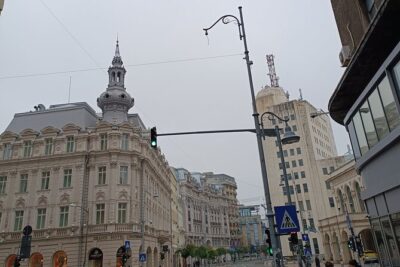
The route then moves onto Calea Victoriei, with about 15 minutes for guided walking. This is described as Bucharest’s most elegant boulevard, and it is the place where the city’s formal side comes forward.
You will see historic buildings, high-fashion stores, and fine bistros along this stretch. The street is useful for understanding Bucharest’s changing ambitions. It has the scale and appearance of a capital avenue, but it also carries the marks of different political periods and changing tastes.
The short timing means you should not expect a complete tour of every building on Calea Victoriei. Instead, think of this as a guided introduction that links the Old Town to Revolution Square. If a particular building catches your eye, ask about it. The private format is most useful when you use the guide’s knowledge to follow your own interests.
The Umbrellas Street and the move toward Revolution Square
The Umbrellas Street is a 10-minute photo stop. Its colorful overhead umbrellas offer a playful contrast to the formal architecture elsewhere on the route. This is one of the lighter moments in the walk, and it gives you a chance to take photographs without a long historical explanation.
From there, the tour continues toward Revolution Square. The change in atmosphere is noticeable. You move from intimate lanes and retail streets to a broad civic setting associated with Romania’s modern political history.
The route works well in this order. The earlier stops establish Bucharest as a city of churches, merchants, restaurants, and grand institutions. Revolution Square then gives those layers a sharper political context.
Revolution Square and the events of December 1989
Revolution Square receives about 20 minutes, the longest guided stop on the route. That is appropriate. This is the key place for understanding the end of Ceausescu’s dictatorship in December 1989.
The square is not important only because of one event. Its surrounding buildings also represent different periods of Romanian history. The Royal Palace, the National Library, the Romanian Athenaeum, and other nearby structures create a visual record of the country’s changing public life.
A good explanation here should help you connect architecture with power. Buildings are not simply attractive backdrops. They show who wanted to project authority, culture, wealth, or national identity at different times.
The political subject can be heavy, but it is central to understanding modern Bucharest. The guide’s ability to explain the story in Italian is especially valuable if you are more comfortable discussing complex history in that language. You can also ask questions about what you are seeing instead of trying to piece together the events from plaques or guidebooks.
The Romanian Athenaeum as the final major stop
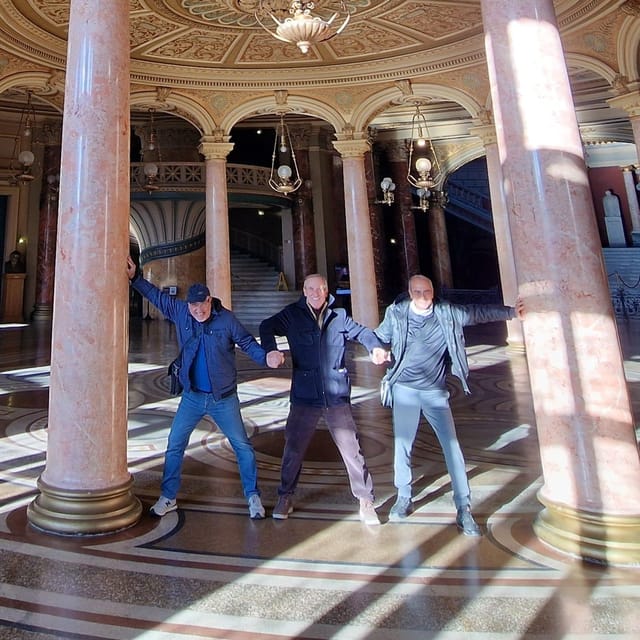
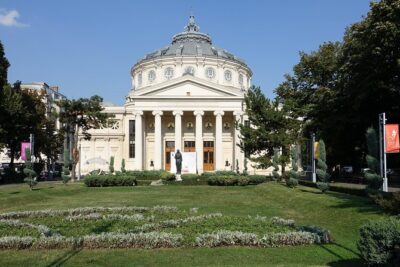
The Romanian Athenaeum receives about 15 minutes of guided attention. It is one of Bucharest’s best-known cultural buildings and a fitting final highlight.
The Athenaeum gives the tour a different ending from Revolution Square. After hearing about dictatorship and political change, you finish with a building linked to music, culture, and national pride. Its exterior is impressive, and the guide can explain why it matters within Romania’s cultural life.
The tour returns to Strada Stavropoleos 5, the original meeting point. That makes the walk easy to pair with a meal in the Old Town or with your next central Bucharest activity. No transport is involved, so you are not losing time to transfers.
Is $53 per person good value?
At $53 per person, this is not the cheapest way to walk around Bucharest. You can see many of these streets without paying for a guide. The question is what you want from the visit.
For a private group, the price pays for a dedicated Italian-speaking guide, a planned route, explanations at major stops, and the ability to ask questions. It becomes better value when two or more people in your party share the experience and care about history or architecture.
The route also packs a lot into 2.5 hours. You visit churches, an inn, a bookstore, a bank, a passage, a boulevard, a political square, and a major cultural building. That is efficient, but it also means the walk can feel full. You will get an introduction to many places rather than a long visit inside each one.
I would choose this tour over a general group walk if Italian is your preferred language or if you want the guide to adjust the discussion to your interests. I would not choose it if you want a slow, unstructured stroll with lots of time for shopping, meals, or sitting in cafés.
Pace, comfort, and access
Wear comfortable shoes. The route covers the Old Town and central boulevards on foot, with repeated stops and some time outdoors. Weather may affect your comfort, so bring suitable clothing for the day.
The activity information describes the tour as wheelchair accessible, but it also says it is not suitable for people with mobility impairments. Those statements may reflect different conditions at individual stops or the demands of the walking route. If you use a wheelchair or have limited mobility, contact the provider before booking and ask for a clear description of surfaces, entrances, and rest opportunities.
The tour is listed as unsuitable for people with hearing impairments. The guide speaks Italian, and some content may be presented in its original language. Alcohol, drugs, and explosive substances are not permitted, which is hardly a surprise on a city walking tour.
Cancellation is free up to 24 hours before the start for a full refund. You can also reserve now and pay later, which helps if your Bucharest schedule is still changing.
Who should book this Italian walking tour?
This tour suits you best if:
- You want a private experience rather than a large group.
- You understand Italian and prefer history explained in that language.
- You are visiting Bucharest for the first time.
- You want a compact introduction to the Old Town and central boulevards.
- You enjoy architecture, churches, political history, and local anecdotes.
- You prefer a guide who can adjust the pace and answer questions.
It may not suit you if you want extensive interior visits, a food tour, or a very slow route. Food and drinks are not included, and the 2.5-hour schedule leaves limited time for lingering.
The strongest praise attached to this experience focuses on the guide’s passion, precision, and ability to make the city meaningful even in bad weather. One account describes an intense rainy day that still became memorable because Giuseppe kept the explanation engaging and adapted to the conditions. That tells you something useful: the guide is a major part of the value, not a minor extra.
Should you book it?
Book this tour if you want Bucharest explained in Italian by a private certified guide, with a well-planned route through the city’s central historic and political sights. The strongest reasons are the flexible format, the range of stops, and the chance to connect the Old Town with Calea Victoriei and the 1989 revolution.
Skip it if you prefer to explore alone, need frequent rest, or want a tour built around food and nightlife. For Italian-speaking visitors who want context rather than a quick list of monuments, $53 per person is a fair price for a focused introduction to Bucharest.
FAQ
How long does the Bucharest Italian walking tour last?
The tour lasts 2.5 hours.
What language is the tour conducted in?
The live tour guide speaks Italian.
Is this a private tour?
Yes. The activity is offered as a private and exclusive tour for your group.
Where does the tour start?
The meeting point is in front of Caru’ cu Bere at Strada Stavropoleos 5, 030081, Bucharest. The guide will be identifiable by a professional identification card.
Which Bucharest sights are included?
The route includes Caru’ cu Bere, Stavropoleos Monastery, Manuc’s Inn, the New Saint George Church, Cărturești Carusel, the Old Town, the National Bank of Romania, Pasajul Villacrosse, Calea Victoriei, the Umbrellas Street, Revolution Square, and the Romanian Athenaeum.
Are food and drinks included?
No. Personal expenses, food, and beverages are not included.
What should I bring?
Comfortable shoes are recommended for the walking route.
Can I cancel the tour for a full refund?
Yes. You can cancel up to 24 hours in advance for a full refund. You can also reserve now and pay later.
Newest Bucharest trips on the site
- Winery touring & private wine tasting – one day private tour★ 5.0 · 3 reviews
- Bucharest: Dealu Mare Winery Private Trip with Wine Tasting★ 4.9 · 6 reviews
- Village Museum Bucharest Guided Tour★ 5.0 · 6 reviews
- Private Transfer from Giurgiu Port to Bucharest★ 4.5 · 12 reviews
- Airport Henri Coanda (Otopeni) to Bucharest – Private Transfer – Driver★ 5.0 · 5 reviews
- Salt Mine Tour from Bucharest with Entrance Ticket★ 4.5 · 19 reviews
- Wine tasting in Bucharest Old town – bonus cheese platter★ 4.5 · 6 reviews
- Walking tour of Bucharest★ 5.0 · 3 reviews
Walking Tours, compared.
Ghost Stories & Romanian Mythology Walking Tour
Read our review →
Walking Tour- Delightful Bucharest (Highlights, Stories, Sights)
Read our review →
Browse the lists this tour appears in