
Reviewed · WALKING TOURS
Bucharest in a nutshell – Half Day Private Walking Tour
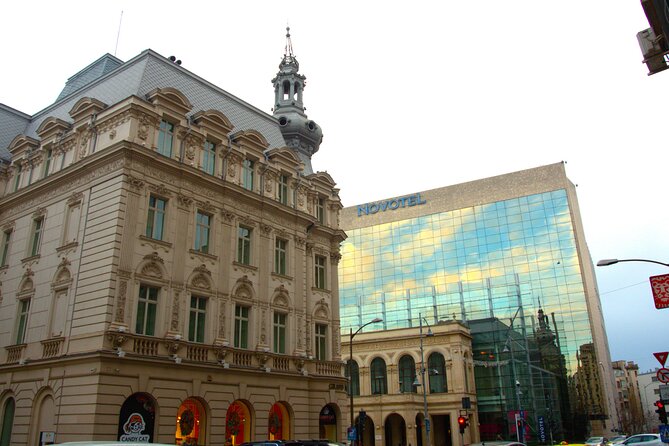
Bucharest’s past is written in layers: medieval trading streets, grand royal buildings, communist upheaval, and a modern city still deciding what to keep. This private walk connects those layers from Manuc’s Inn to the Romanian Athenaeum, with Razvan Trancu explaining how one city can feel like two cities at once.
I like the flexible route, which lets you spend more time on subjects that matter to you, and the guide’s ability to connect architecture with Romanian, Jewish, and European history. The private format is also useful for a small group that wants to ask questions without being rushed.
The main drawback is simple: this is an outdoor walking tour with no admissions, snacks, or drinks included. You will see important buildings from the outside, but the focus is on interpretation rather than extended visits inside museums or churches.
Key points to know before booking
- A compact story of Bucharest: Walk from medieval Old Town to the communist-era Revolution Square and finish at the Romanian Athenaeum.
- A private group of up to 10: Your party gets Razvan’s full attention, with room to adjust the conversation and route.
- Strong political and social context: University Square and Revolution Square bring Romania’s anti-communist revolution into focus.
- Excellent architectural contrast: See Manuc’s Inn, Cercul Militar Național, the former Royal Palace, and the Athenaeum in one outing.
- Downtown pickup can be arranged: The normal meeting point is Manuc’s Inn, but the start is flexible if you are staying centrally.
- Good value for a small group: At $216.74 per group, the cost works out to about $21.67 per person for ten people, or $54.19 each for four.
Bucharest in one walk, from medieval inn to concert hall
This tour works because the route is compact but not narrow in subject. You begin in the oldest part of central Bucharest and finish among the city’s grandest nineteenth-century buildings. Along the way, you get politics, architecture, education, religion, royal history, and the difficult memory of communism.
The route takes about three to four hours. The listed stops add up to roughly three and a half hours, though the timing can shift depending on your questions and interests. That flexibility matters. You are not being marched from one photo stop to the next. You can ask about Jewish history, the communist period, architecture, nightlife, or modern Romanian society and shape the talk around your own curiosity.
Razvan Trancu leads the experience in English. His background as a history scholar comes through in the way he connects small details to larger events. He also speaks Italian, according to the tour information, which may help Italian-speaking visitors feel more at ease.
More Walking Tours in Bucharest
- Bucharest: City Highlights Guided Walking Tour
★ 4.9 · 1,482 reviews - Bucharest Highlights Walking Tour
★ 5.0 · 469 reviews - Bucharest: Ghost Stories & Romanian Mythology Walking Tour
★ 4.9 · 287 reviews
Starting at Manuc’s Inn in Old Town
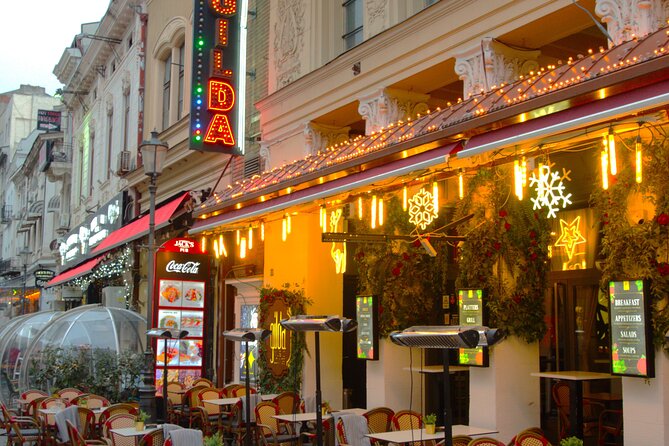
The usual meeting point is Manuc’s Inn, Hanul lui Manuc, at Strada Franceză 62. This is a fitting place to begin because the building links Bucharest’s commercial past with its current Old Town life.
The opening hour in Old Town is used to explain how Bucharest grew from a smaller settlement into a city of around three million people. You will hear about the city’s foundation, its changing street plan, and the forces that shaped the central area. The discussion also addresses the destruction and reshaping caused by communism, a major theme of the walk.
Old Town can look cheerful and restored at first glance, but the tour is designed to show what sits beneath that surface. You will look for signs of different periods rather than treating Lipscani as a collection of pretty facades. Razvan’s approach is especially useful here because the area is easy to experience as a row of cafes and bars if nobody explains its earlier purpose.
This is also where the idea of two Bucharests becomes useful. One is the historic city of inns, churches, merchants, and narrow streets. The other is the city altered by twentieth-century planning, political power, and modern redevelopment. You will see how those two versions meet, and sometimes clash, in the center.
University Square and the story of education
From Old Town, the walk reaches University Square, another important point in Bucharest’s modern story. The stop lasts about 30 minutes and combines the history of Romanian education with the anti-communist events that took place here.
This is a good example of the tour’s balance. You are not only looking at a square and taking a photograph. You are considering how institutions shape a city, how students and intellectuals influence public life, and how public spaces can become sites of protest.
University Square also helps you understand Bucharest beyond its royal buildings. The city’s story includes the development of education, public debate, and political resistance. If you have an interest in the final years of communist rule, this is one of the places where the past becomes especially immediate.
The square is an open urban space, so your experience may depend on the day’s noise and activity. The value comes from the explanation, not from a formal attraction with an entrance hall or display cases.
The National Theatre and anti-communist resistance
The outside view of the Ion Luca Caragiale National Theatre takes about 20 minutes. The stop focuses on anti-communist resistance events and adds another angle to the political story introduced at University Square.
Because the visit is outside, you will not be touring the theatre’s interior as part of this experience. Still, the location gives Razvan another place to explain how public buildings and city squares became tied to political power, public expression, and resistance.
This is the sort of stop that benefits from a guide who can supply context. On your own, you might admire the building and move on. With the story attached, it becomes part of a wider account of Romanian civic life.
A different sort of day out, same corner of Romania:
- Bucharest: Palace of Parliament Tickets and Guide
★ 4.3 · 3,182 reviews - Bucharest: Palace of Parliament Tickets and Guided Tour
★ 4.4 · 1,877 reviews - Bucharest: Parliament Palace Skip-the-line Ticket
★ 4.2 · 1,518 reviews - Taste Bucharest: A Food Lover’s Tour of Markets & Neighbourhoods
★ 5.0 · 689 reviews
Cercul Militar Național and Bucharest’s grand style
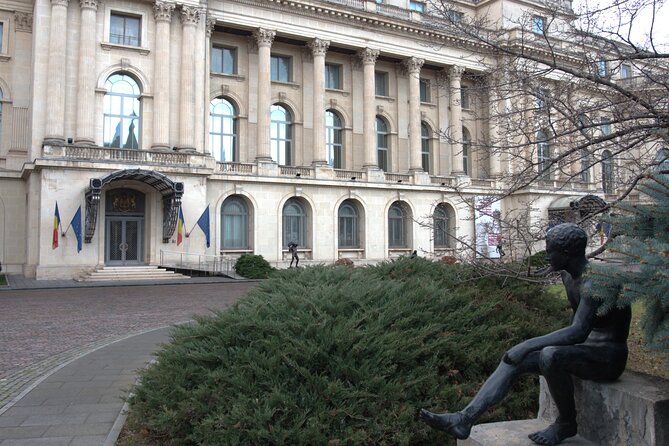
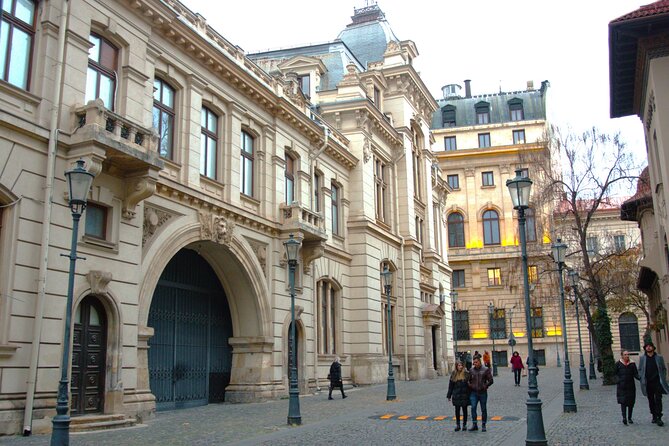
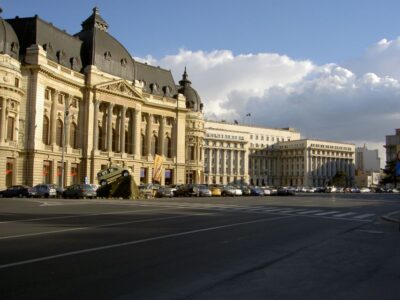
The Cercul Militar Național receives a short stop of about 10 minutes. You will admire its elaborate eclectic architecture and hear about the building’s story.
The short timing makes sense if you see this as a visual and historical pause rather than a full visit. The building helps mark the change from older commercial Bucharest to the formal, ceremonial city built along major avenues. It is one of the route’s strongest reminders that central Bucharest is not defined by one architectural style.
I like this kind of stop because it keeps the walk varied. You are not spending the whole afternoon on political history. Buildings, institutions, and urban design keep entering the conversation.
Calea Victoriei, the city’s historic main street
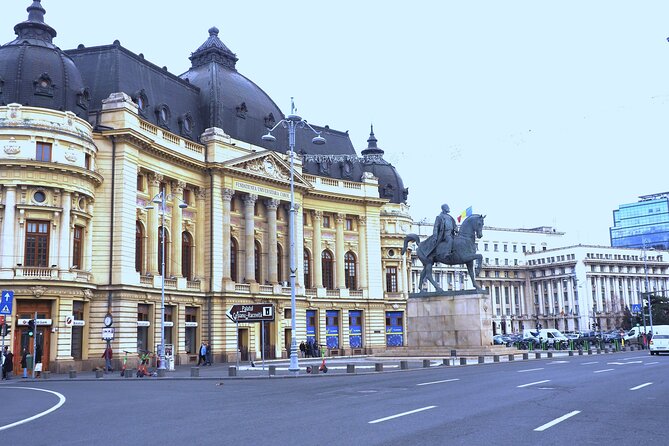
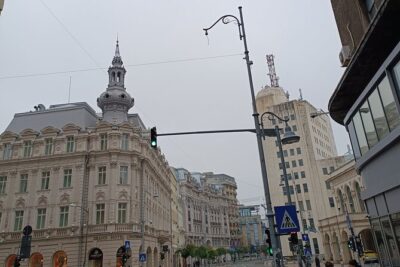
Calea Victoriei gets only about 10 minutes on the formal schedule, but it is an important connecting stretch. It has served as Bucharest’s main street for roughly 300 years and contains stories that are easy to miss while walking through the city.
This avenue helps explain how Bucharest presented itself as a capital. It links royal, military, cultural, and commercial parts of the center. The route also promises attention to side corners and details that you might pass without noticing.
The brief time here is a consideration. If you want an extended architectural walk along Calea Victoriei, you may need to ask for more time or return later on your own. The route has several major stops to cover, so this section is more about orientation and selected stories than a complete survey of the avenue.
Revolution Square and the end of communist rule
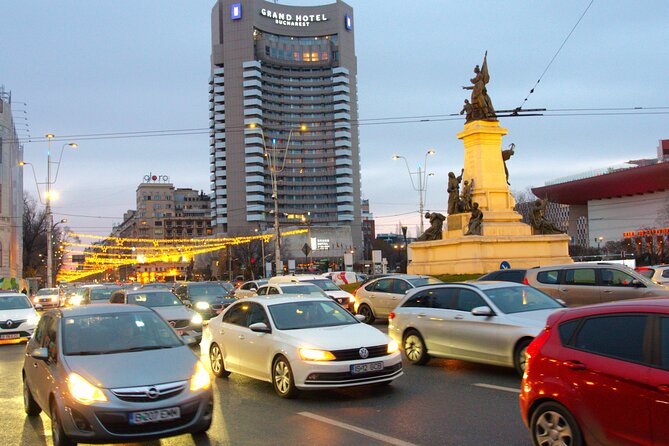
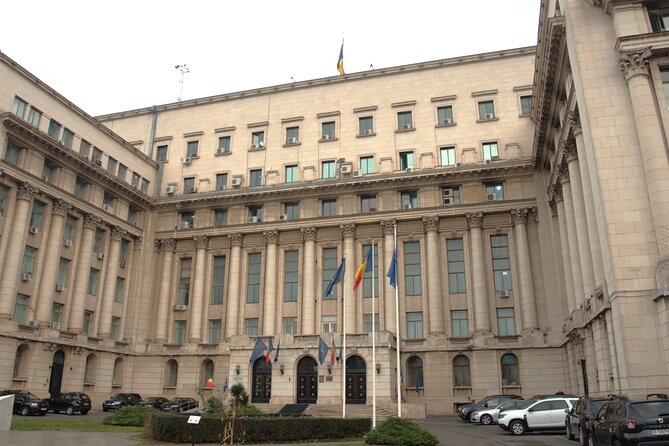
Revolution Square is the emotional center of the tour. The visit lasts about 40 minutes and brings together the former Central Committee headquarters of the Communist Party, the secret services, and the Revolution Memorial.
This is where the tour examines one of the harshest chapters in Romania’s modern history. You will hear how the square relates to the anti-communist revolution and why the surrounding buildings carry such heavy meaning. The subject is not treated as a distant political footnote. It is tied to the streets, buildings, and people who experienced those events.
The Revolution Memorial can be visually puzzling, and a guide’s explanation is useful. You get a chance to ask direct questions about the monument, the square, and the events it recalls. The stop also gives you a clearer sense of how Romania moved from dictatorship toward a different political system, and why that transition still shapes public memory.
I would not choose this tour if you want only light sightseeing. The route includes serious subjects: repression, resistance, political violence, and the effects of communist planning. Razvan’s style, based on the information available, is thoughtful and open to discussion, which suits visitors who want more than dates and labels.
The former Royal Palace and Romania’s cultural life
The Muzeul Național de Artă al României occupies the former Royal Palace. The stop lasts about 20 minutes and focuses on the building’s royal past.
You will view the National Art Gallery from the outside, across from the Romanian Athenaeum and near the InterContinental Athénée Palace Hotel. This position makes the building part of a larger civic scene rather than an isolated museum visit.
The former palace adds another layer to the walk. After hearing about merchants, education, military institutions, and communist power, you encounter the monarchy and the cultural ambitions of the capital. The building helps show how Bucharest sought to present itself as a European capital through art, court life, and architecture.
Admission to the gallery is not included. The tour gives you historical orientation, but you would need a separate visit if you want to see the collections indoors. That is not a flaw, but you should plan for it if art is a top priority.
Finishing at the Romanian Athenaeum
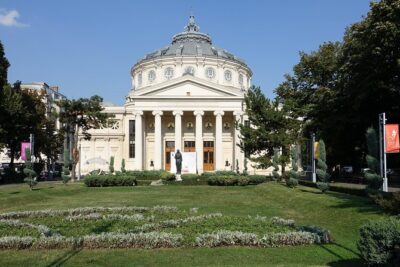
The walk ends at the Romanian Athenaeum on Strada Benjamin Franklin 1-3. The final stop lasts about 20 minutes and focuses on this celebrated building as a center for music and the arts.
Ending here gives the tour a satisfying visual finish. You begin at a historic inn connected with trade and end at a building associated with culture, national identity, and public ambition. The Athenaeum also provides a quieter counterpoint to Revolution Square.
The tour describes the building as a symbolic place with meanings waiting to be explained. That is a fair reason to save it for last. By this stage, you have enough context to understand why the Athenaeum matters beyond its appearance.
Again, the standard experience is a guided exterior visit. If you want to attend a concert or explore the inside, that would require separate planning. The tour is best understood as a guided introduction to the city center, not a ticketed museum circuit.
What makes Razvan’s guiding style useful
The strongest feature here is the guide. Razvan is described as punctual, kind, highly articulate in English, and able to adjust the walk to specific interests. That matters most on a private tour, where the quality of the conversation determines much of the value.
You can bring up Jewish history, architecture, politics, Romanian society, or the changes that followed the collapse of communist rule. Razvan has also provided practical suggestions about bars, clubs, and fine dining, which can help you plan the rest of your stay.
His experience is not limited to prepared speeches. The available information describes him as someone who can respond to questions across history, politics, and architecture, while keeping the conversation welcoming. He also designs custom outings beyond Bucharest, including countryside visits with small wineries, villages, spa stays, and boutique hotels. Those extra services are not part of this walk, but they show the level of customization he may be able to offer.
The tour can also be adapted for different interests. One private group focused on Jewish history, while another used the city walk as a starting point before arranging a countryside excursion. You should state your priorities when booking or at the start. A private format gives you a real chance to shape the experience.
Price, group size, and practical value
The price is $216.74 for a group of up to 10 people. For a full group, that is about $21.67 per person. A group of four pays about $54.19 per person, while a couple pays about $108.37 each.
That makes the tour a stronger value for families or groups of friends than for two people traveling on a tight budget. You are paying for a private guide rather than a basic group walk, so the price makes more sense if you value questions, flexibility, and a tailored pace.
Pickup is offered, and the start can be adjusted if you are staying downtown. The regular start is Manuc’s Inn, with the finish at the Athenaeum. Since the route crosses central Bucharest, this arrangement is practical for getting oriented on your first day.
Wear comfortable shoes. The experience lasts three to four hours and covers several central areas on foot. Snacks, coffee, tea, entrance fees, and taxes are not included, so you should plan a drink or meal before or after the walk. The tour is offered in English, and service animals are allowed.
Most people can take part, and the route is near public transportation. Still, the provided details do not promise a fully step-free route or seating at every stop. If mobility is a concern, ask about the exact route before booking.
Free cancellation is available if you cancel at least 24 hours before the local start time. Changes or cancellations made inside that window are not refunded.
Who should book this Bucharest walk
I would choose this tour for a first visit, especially if you want Bucharest to make sense quickly. It gives you a strong framework for later museum visits, independent walks, and evenings in the Old Town.
It also suits visitors interested in difficult history. Revolution Square, University Square, and the National Theatre are not treated as simple photo stops. The walk explains how Romanian society changed and how the city still carries those changes.
This is a good fit for families, couples, or groups of friends who prefer private guiding. It is less suitable if you want long indoor visits, a food tour, or a route focused only on pretty architecture. You will spend much of the time outside, and the tour’s real product is the conversation.
Should you book it?
Book this walk if you want a clear introduction to Bucharest led by a thoughtful guide who can move beyond standard facts. The strongest reasons are the private format, the flexible discussion, and the route’s unusual mix of Old Town, royal architecture, cultural buildings, and communist-era history.
Skip it if your priority is visiting museum interiors or keeping costs as low as possible for a small party. For everyone else, especially a group of four or more, $216.74 buys a useful first look at Bucharest and a guide who can help you understand what you are seeing.
FAQ
How long does the Bucharest walking tour last?
The tour lasts approximately three to four hours. The scheduled stops total about three and a half hours, but the route can be adjusted around your interests and questions.
Where does the tour begin?
The usual starting point is Manuc’s Inn, Hanul lui Manuc, at Strada Franceză 62 in Bucharest.
Where does the tour end?
The tour ends at the Romanian Athenaeum on Strada Benjamin Franklin 1-3, across from the National Art Gallery and near the InterContinental Athénée Palace Hotel.
Is hotel pickup available?
Pickup is flexible and optional. If you are staying in downtown Bucharest, the tour can start from your location.
How many people can join the private tour?
The price covers one private group of up to 10 people. Only your group participates.
Is the tour offered in English?
Yes. The tour is offered in English. The guide also speaks Italian, according to the available tour information.
Are entrance fees, food, and drinks included?
No. Snacks, coffee, tea, entrance fees, and taxes are not included. The experience is a private guided walking tour, with the main route and explanations provided by the guide.
More Half-Day Trips Around Bucharest
- Bucharest: Half Day Bike Tour
★ 4.9 · 379 reviews - Private Half Day Trip to Snagov Monastery & Mogosoaia
★ 4.1 · 29 reviews - Bucharest: Half-Day Sightseeing Tour
★ 4.5 · 29 reviews - Half-Day Jewish Heritage Walking Tour in Bucharest
★ 5.0 · 20 reviews
Newest Bucharest trips on the site
- Winery touring & private wine tasting – one day private tour★ 5.0 · 3 reviews
- Bucharest: Dealu Mare Winery Private Trip with Wine Tasting★ 4.9 · 6 reviews
- Village Museum Bucharest Guided Tour★ 5.0 · 6 reviews
- Private Transfer from Giurgiu Port to Bucharest★ 4.5 · 12 reviews
- Airport Henri Coanda (Otopeni) to Bucharest – Private Transfer – Driver★ 5.0 · 5 reviews
- Salt Mine Tour from Bucharest with Entrance Ticket★ 4.5 · 19 reviews
- Wine tasting in Bucharest Old town – bonus cheese platter★ 4.5 · 6 reviews
- Walking tour of Bucharest★ 5.0 · 3 reviews
Walking Tours, compared.
Ghost Stories & Romanian Mythology Walking Tour
Read our review →
Walking Tour- Delightful Bucharest (Highlights, Stories, Sights)
Read our review →
Browse the lists this tour appears in