
Reviewed · CITY TOURS
City Tour Sighisoara Legends & Landmarks A Walk Through Time
Sighișoara’s medieval citadel is small enough to explore on foot but layered enough to reward a good guide. This two-hour walk leads you from the Monastery Church through old squares, guild towers, the covered staircase, and up to the Gothic Church on the Hill, with Vlad the Impaler’s birthplace woven into the story.
I like the way the tour connects famous sights with everyday medieval life, rather than treating the town as a backdrop for Dracula tales. I also like the guides’ flexible approach. Peter, Charles, Carol, Andrea, and others are praised for answering questions, adapting the route, and sometimes spending extra time with the group.
The main drawback is the pace and terrain. You’ll walk on cobbles and climb the 164 steps of the Covered Staircase, so this is not a good choice for people with mobility impairments. Entrance fees, food, and drinks cost extra.
Key points at a glance
- The Clock Tower anchors the walk: See Sighișoara’s best-known landmark and learn about its clock mechanism, artifacts, and 64-meter height.
- The Dracula connection gets proper context: Visit Vlad the Impaler’s Birth House, while separating local history from later legend.
- The Covered Staircase is part of the story: Climb 164 wooden steps built to protect schoolchildren from bad weather.
- The Church on the Hill adds the biggest climb: Reach the Gothic church, medieval frescoes, and German Cemetery above the citadel.
- Guild towers explain the town’s defenses: Butchers, tailors, furriers, and tin moulders each had a role in protecting Sighișoara.
- The guide makes the difference: English-speaking guides are valued for clear explanations, local stories, patience, and route changes when needed.
Entering Sighișoara’s medieval citadel
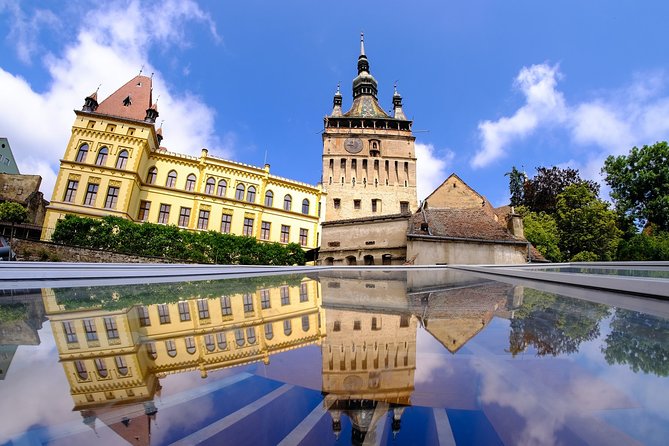
The meeting point is Piața Muzeului 5, in front of the Monastery Church. A second starting point is listed at Piața Muzeului 6, so check your confirmation carefully before setting off. The tour begins at 11:00 and operates daily.
This is a walking tour, not a ride between sights. That matters here. Sighișoara’s historic center is best understood slowly, with your attention on the colored houses, narrow lanes, defensive walls, and uneven stones underfoot.
The route stays within the citadel and returns to Piața Muzeului 5 or Piața Muzeului 6. You do not need to arrange transport between stops. Bring a passport or identity card, and leave large bags and oversize luggage elsewhere.
The tour costs $45 per person for two hours. That is not the cheapest way to look around a compact town, but the value depends on what you want from Sighișoara. If you only need photographs of the Clock Tower and main square, you can walk independently. If you want the defensive system, church, cemetery, architecture, and Romanian history explained in a connected way, the price is easier to justify.
More walking tours in Sighisoara:
- City Tour Sighisoara Legends & Landmarks A Walk Through Time
★ 5.0 · 11 reviews - Bucharest: City Highlights Guided Walking Tour
★ 4.9 · 1,482 reviews - Bucharest Highlights Walking Tour
★ 5.0 · 469 reviews
The Market Place and the story behind the streets
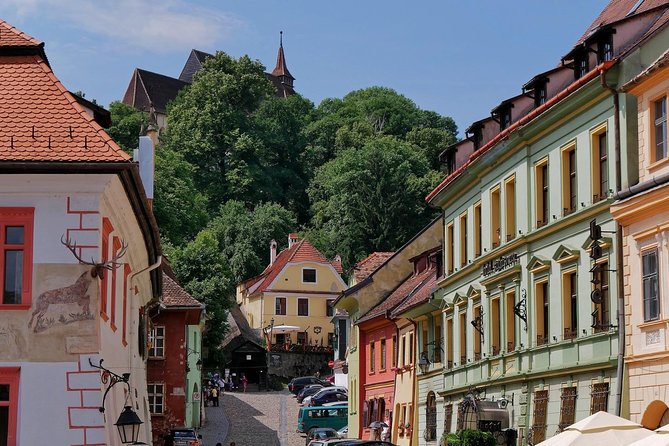
The Citadel’s Market Place gives you a useful first look at Sighișoara’s old center. Colorful burgher houses surround the square, and the guide uses the setting to explain how the medieval town functioned.
I like beginning here because it gives the rest of the walk a frame. The houses are not just attractive facades. They reflect the importance of merchants, craftspeople, and the fortified community that grew inside the citadel.
The guides also place Sighișoara within the wider story of Transylvania and Romania. Several visitors specifically valued learning about local customs, the region, and modern Romanian life, not only dates and building names. That broader conversation is useful if this is your first stop in Transylvania.
The style is conversational rather than purely scripted. Peter is praised for bringing old photographs and discussing ordinary life in earlier periods. Charles is noted for answering questions directly and explaining both exterior architecture and building interiors. Individual guides vary, but the strongest part of the experience is the human explanation of the town.
Dracula’s Birth House and a more careful legend
The Birth House of Vlad the Impaler is one of the citadel’s most famous stops. Vlad is the historical figure linked to Dracula, but the real story is more complicated than the popular vampire image.
The building now functions as a restaurant and museum dedicated to Sighișoara’s past. You can see the site connected with Vlad while hearing how the legend differs from the documented medieval ruler. That distinction is important. A tour that simply repeats Dracula folklore would miss much of the place’s value.
You should also note that the tour price does not include entrance fees. The description identifies the Birth House as a visit point, but it does not promise that every interior admission is covered. Keep a little extra money available if you decide to enter paid attractions.
For me, this stop works best when treated as a doorway into the city’s history, not the entire reason to visit. The Dracula connection catches your attention. The political, cultural, and architectural story gives Sighișoara staying power.
The Clock Tower and views over the citadel
The Clock Tower is Sighișoara’s main landmark and reaches 64 meters above the town. Its height makes it easy to find, but the details inside are what make the stop worthwhile.
The tour covers the clock mechanism and historical artifacts. If you pay to enter, the tower also offers a panoramic view. Since admission is not included, ask your guide about the current entrance arrangement and decide if the extra cost fits your plans.
The tower helps you read the citadel from above. You can better understand how tightly the houses, lanes, towers, and hilltop church fit together. It also makes a good orientation point early in your stay, especially if you plan to explore alone afterward.
This is one reason I would book the walk near the start of a Sighișoara stay. You get the basic map of the old town, hear which sites deserve more time, and can return to the Clock Tower or another museum later if you want a slower visit.
A few more Sighisoara trips worth a look
- From Brasov: Sighisoara and Viscri UNESCO Day Tour
★ 4.8 · 86 reviews - Sighisoara: Candlelight Tour of Dracula’s Home Town
★ 4.6 · 83 reviews - Sighisoara and Viscri Private Full-Day Tour from Brasov
★ 5.0 · 51 reviews - From Cluj: Sighișoara and Church of Biertan Guided Tour
★ 4.8 · 36 reviews
The Covered Staircase and the climb to the hill
The Covered Staircase is one of the most memorable parts of the route. Built in the 17th century, it contains 164 wooden steps and was designed to protect schoolchildren from severe weather as they climbed toward school and church.
The passage is practical, atmospheric, and physically demanding in a modest way. The steps are not a decorative shortcut added for modern visitors. They show how the town adapted to its hilltop setting and how education and worship shaped daily movement through the citadel.
You should wear sensible shoes. The tour is only two hours, but the climb and cobbled streets make the walk more tiring than a flat city stroll. The experience is not suitable for people with mobility impairments, and anyone with knee or balance concerns should think carefully before booking.
Guides have adjusted this section when needed. One guide began early and removed the hill climb for a couple who had already visited it and needed to catch a train. That kind of flexibility is useful, but you should discuss physical limits at the start rather than assume every route change will be possible.
The Church on the Hill and the German Cemetery
At the top, the Church on the Hill provides the tour’s strongest sense of place. It is a Gothic church with a notable interior and medieval frescoes, and its position gives the stop more weight than another pretty building in the old town.
The church also completes the climb. You have moved from the commercial center, through the defensive streets, and up to a major religious site. The route shows how Sighișoara’s buildings fit together as a working town, not just as isolated monuments.
Nearby, the German Cemetery adds a quieter and more personal layer. It contains the graves of influential Sighișoara families and helps explain the town’s German-speaking heritage. The cemetery is especially useful if you want to understand who shaped the citadel over time.
I value this stop because it moves beyond postcard history. You can look at names, family connections, and the remains of a community. Several guides use the cemetery to explain the town’s population and changing demographics, which gives you a clearer sense of Sighișoara’s past.
The church and cemetery also provide a pause from the tighter streets below. Still, the hill requires effort, and the tour may feel rushed if you want a long interior visit or quiet time among the graves. Two hours is enough for an overview, not an unhurried study of every detail.
Guild towers and the defensive ring
Sighișoara’s towers are easier to appreciate once you know who maintained them. The Butchers’ Bastion and Tower, Tailors’ Tower, Furriers’ Tower, and Tin Moulders’ Tower connect the city’s defenses with its craft guilds.
These names tell you that protection was organized by trade. The towers were not simply military structures assigned to anonymous soldiers. They reflect the responsibilities of local craftspeople and the economic groups that helped keep the citadel secure.
The Tailors’ Tower and Furriers’ Tower are especially useful for understanding how the fortifications worked as a system. Your guide can point out how the towers and walls guarded access points and explain the dangers the town faced.
The Butchers’ Bastion adds another angle. Its name links a practical trade with defense, showing that medieval urban life did not divide neatly into civilian and military roles. A person could be part of a guild, support a household, and still carry responsibility for the town’s protection.
Do not expect a full museum visit at every tower. The experience is primarily an outdoor walking tour, and entrance charges are separate. The reward is the connected explanation, not a long stop inside each structure.
Venetian House, the Deer Antler House, and final details
The Venetian House brings a change of architectural mood. Its Renaissance-style design is elegant, and its history gives the guide another chance to explain Sighișoara’s links with wider European styles.
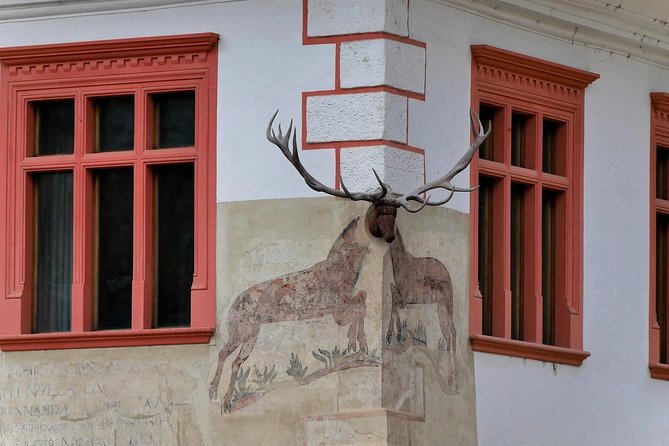
The House with the Deer Antler provides a memorable ending. Its facade is recognized by the deer antlers mounted on it, a small detail that is easy to miss if you explore without local eyes. It is exactly the kind of stop that turns a general walk into a collection of stories you can recall later.
These final sights are not as dominant as the Clock Tower or church, but they give the route variety. You move from major landmarks to unusual architectural details, which keeps the two hours from feeling like a march through a checklist.
The tour ends near the same museum square where it begins. That is practical if you want to continue eating, shopping, visiting another attraction, or returning to your hotel on foot.
The guide style and what the $45 buys you
The strongest quality of this experience is the guide. The available guides include Peter, Charles, Carol, Andrea, and others, so you should not book on the assumption that one named person is guaranteed unless the provider confirms it.
The guides are consistently described as friendly, clear in English, patient with questions, and willing to discuss more than the next building. Peter is praised for his use of old photographs and his explanations of daily life. Charles is noted for strong English, humor, architecture, and flexibility. Carol is described as a local teacher who shares stories across many subjects.
That range matters because Sighișoara can be seen in two ways. You can treat it as a photogenic medieval town and move on. Or you can ask how the guilds worked, why the staircase was built, what the cemetery tells you, and how Vlad became linked with Dracula. A good guide turns those questions into a coherent visit.
The price also buys time. The walk is scheduled for two hours, but guides have sometimes continued longer or adjusted the start and route. Do not count on extra time, but it is a sign that the experience is not rigidly delivered in every case.
Food and drinks are not included. Souvenir photos are also not included and may be available for purchase. Entrance fees are separate, and private tours require a $20 per-person supplement. These costs can change the final total, so consider them before booking.
Who should book this walking tour?
I would recommend it to first-time visitors who want quick orientation and solid historical context. It is also a good match for anyone interested in medieval architecture, Transylvanian history, church interiors, defensive towers, or the real person behind the Dracula legend.
Families can enjoy it, especially if children can manage the stairs and cobbles. One guide received praise for working well with children, but the tour still involves sustained walking and a steep staircase.
History fans will get the most from it. The route covers the main sights, but the added value comes from connections between them: guilds and towers, schoolchildren and the Covered Staircase, families and the German Cemetery, legend and documented history.
You may prefer to explore alone if you want a slow photographic walk, plan to spend a long time inside museums, or do not want to follow a set route. Since the tour is only two hours, you will need to return later for a more detailed visit to paid attractions.
The activity allows free cancellation up to 24 hours before the start and offers reserve-now, pay-later booking. Those terms make it easier to fit into a changing Romania itinerary, but they do not remove the need to arrive ready for a walking tour.
Should you book City Tour Sighișoara?
Book it if you want Sighișoara to make sense, not just look pretty. The Clock Tower, Birth House, covered staircase, Church on the Hill, cemetery, and guild towers form a strong route, and the English-speaking guides add the context that is hard to pick up from plaques.
Skip it if stairs are a serious problem, if you already know the town well, or if you prefer to set your own pace and pay only for the sights you enter. For most first visits, though, $45 is a fair price for a focused two-hour introduction, especially when the guide can answer questions and adjust the walk to your interests.
FAQ
Where does the tour meet?
The meeting point is Piața Muzeului 5, in front of the Monastery Church. Piața Muzeului 6 is also listed as a possible starting location, so check your booking details.
What time does the tour start?
The listed departure time is 11:00. The tour operates daily.
How long does the walking tour last?
The scheduled duration is two hours.
What language is the tour conducted in?
The tour is conducted in English with a live English-speaking guide.
What does the tour price include?
The $45 price includes the guided walking tour with an English-speaking specialized guide. Food, drinks, entrance fees, and souvenir photos are not included.
Is a private tour available?
Yes. A private tour requires a supplement of $20 per person.
Do I need to bring identification?
Yes. You should bring a passport or identity card.
Can I bring a large suitcase or oversized bag?
No. Oversize luggage and large bags are not allowed on the tour.
Is the tour suitable for people with mobility impairments?
No. The tour is not suitable for people with mobility impairments because it includes cobbled streets and the climb to the Church on the Hill via the 164-step Covered Staircase.
Newest Sighisoara trips on the site
- Székely Land countryside and Sighisoara one day trip★ 5.0 · 3 reviews
- City Tour Sighisoara Legends & Landmarks A Walk Through Time★ 5.0 · 11 reviews
- Exclusive tour: Sighisoara, Medias and Biertan tour from Sibiu★ 5.0 · 9 reviews
- Sighisoara, UNESCO & wine tasting (1 day, from Cluj)★ 5.0 · 4 reviews
- Transylvania Gems: Sighisoara, Medias, Biertan & Gypsy Encounter★ 4.5 · 14 reviews
- Fortified Church of Viscri and Sighisoara in Spanish (native Spanish guide).★ 5.0 · 8 reviews
- Private Day Tour Sighisoara and Viscri from Brasov with Hotel Pick Up/ Drop Off★ 5.0 · 3 reviews
- Sighisoara – Marienburg – Viscri Trip from Brasov★ 4.5 · 15 reviews
City Tours, compared.



Bucharest Panoramic Sightseeing – Private City Tour
Read our review →
SB01 – City Tour Sibiu: Exploring the Heart of Transylvania
Read our review →
Black Sea and Constanța City – Private Tour from Bucharest
Read our review →Browse the lists this tour appears in