
Reviewed · DRACULA CASTLE TOURS
Dracula beyond the legend: 8-day private tour in Transilvania
Dracula’s story makes the best doorway into this tour, but the real reward is meeting the Romania behind the legend. You follow Vlad the Impaler from Bucharest and Târgoviște to Sighișoara and Snagov, while also seeing castles, churches, salt mines, and mountain roads that have little to do with vampires.
I like the small-group format, capped at eight people, and the way the route mixes famous stops with less expected places such as Densuș Church and Biertan. I also like that transport, entrance fees, breakfast, and seven hotel nights are bundled together. The trade-off is pace: this is a long road tour with many one-hour visits, so you need moderate fitness and a tolerance for frequent hotel changes.
Key points to know before booking
- Vlad’s real story: Visit places linked to Vlad the Impaler, including his former court in Bucharest, Târgoviște, Sighișoara, Bran, and Snagov.
- More than Dracula: The route includes Sibiu, Alba Iulia, Turda Salt Mine, Curtea de Argeș, and the Transfăgărășan Highway.
- Small group transport: The published maximum is eight people, with a modern vehicle and an English-speaking guide.
- Seven nights included: Accommodation, breakfast, airport transfers, entrance fees, and a carriage ride at the ASTRA Museum are covered.
- Best castle contrast: Bran is the famous Dracula stop, while Corvin Castle gives you a more imposing medieval fortress experience.
- Check the hotel category: The tour summary refers to 3-star hotels, while the included details say centrally located 4-star hotels. Confirm this before paying.
Bucharest begins with communism, royalty, and Vlad’s old court
Your first day stays in Bucharest, beginning at the Palace of Parliament. This huge building was constructed between 1984 and 1997 and now houses Romania’s Parliament. Its scale helps you understand the ambition and excess of the communist era, even though it has no direct link to Dracula.
The visit lasts about an hour and entrance is included. I would treat it as a history lesson before the medieval material begins. The building is not an ancient castle, but it gives the tour a useful modern counterpoint.
Next comes a walking tour of the Old Town, known locally as Centrul Vechi. Cafes, restaurants, and historic buildings fill the center, and you will see Curtea Veche, the former royal court associated with Vlad the Impaler. This is one of the first places where the historical prince comes into focus as a real ruler rather than a fictional monster.
The day is fairly light, which is helpful after arriving in Romania. You start at 9 a.m. and receive a manageable introduction to Bucharest before the longer drives begin.
More Dracula Castle Tours in Transylvania
- Private tour Transylvania: UNESCO Gems and Legend of Dracula
★ 4.9 · 13 reviews - 2-Day Small-Group Tour to Dracula’s Castle, Rasnov Fortress, Peles Castle, Sighisoara and Libearty Brown Bear Sanctuary with Overnight in Brasov
★ 4.5 · 9 reviews - 4-Day Transylvania and Dracula Tour from Bucharest
★ 4.5 · 9 reviews
Târgoviște and Curtea de Argeș reveal the medieval prince
Day two turns toward Wallachia and Târgoviște, a medieval capital and an important setting in Vlad’s story. The Princely Court includes the Princely Church and Chindia Tower, and the guide uses the site to explain the political world in which Vlad ruled.
The story here is more grounded than the castle marketing surrounding Dracula. Târgoviște was attacked and burned in different periods, and Vlad’s Night Attack in 1462 helped stop an Ottoman advance. You are seeing the setting of a hard, contested frontier, not simply a spooky ruin.
The next stop is Curtea de Argeș Monastery, built between 1512 and 1517. It is known for the legend of Manole, a builder whose work required sacrifice before it could last. The monastery also serves as the burial place of several members of Romania’s royal family.
After this, the route reaches the Valea cu Pești hotel on the Transfăgărășan road. This overnight stop matters because it breaks up the long journey and puts you close to the mountain section on the following day. The drive is a major part of the experience, so do not expect a quick castle-hopping tour.
The Transfăgărășan Highway brings a welcome change of mood
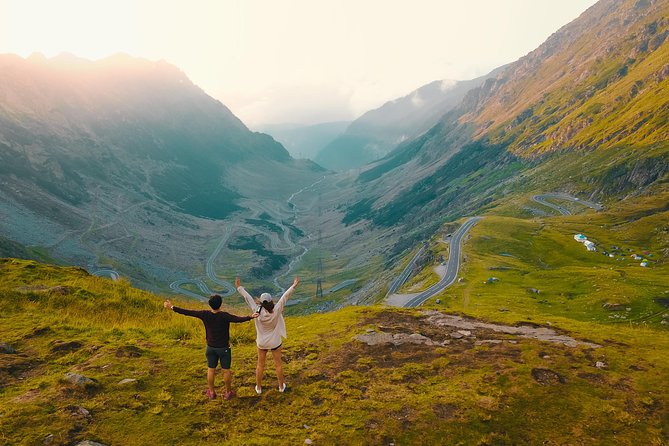
The Transfăgărășan Highway gives the tour one of its best changes in rhythm. The road crosses the Făgăraș Mountains, the highest mountains in Romania, reaching 2,042 meters. Expect mountain views and plenty of photo opportunities.
The itinerary allows about an hour at the highway stop, but the road itself takes up more of the day than that simple time label suggests. It is a scenic transfer, not just a viewpoint visit. If you prefer history at every stop, this day may feel lighter. If you enjoy seeing how Romania’s regions connect, it is a welcome pause from churches and fortresses.
In Sibiu, the ASTRA Museum offers another shift in subject. More than 300 traditional buildings and thousands of household objects show rural life across Romania. A wooden carriage ride is included, giving the visit a physical, old-fashioned touch rather than making it only a museum walk.
Sibiu’s center is one of the strongest city stops on the route. You walk through the Main Square, see the Brukenthal Museum, visit the Roman Catholic Cathedral, and continue to Huet Square and its Evangelical Church. You also receive several hours to explore on your own.
I would use that free time for a slow walk through the center and a meal. The itinerary calls this a one-hour guided visit, but the extra time is important because Sibiu is better enjoyed at street level than rushed between landmarks.
Corvin Castle delivers the strongest medieval setting
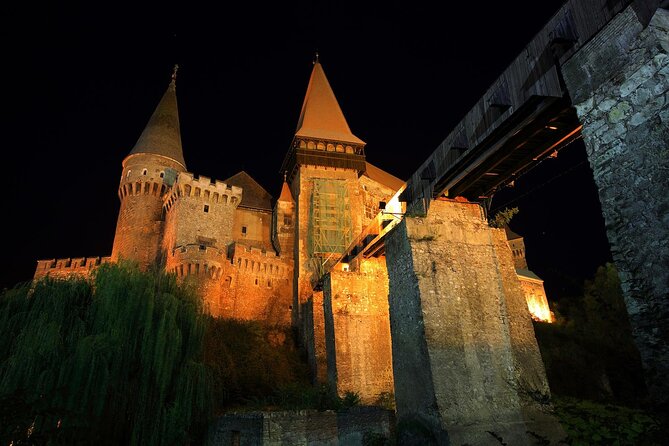
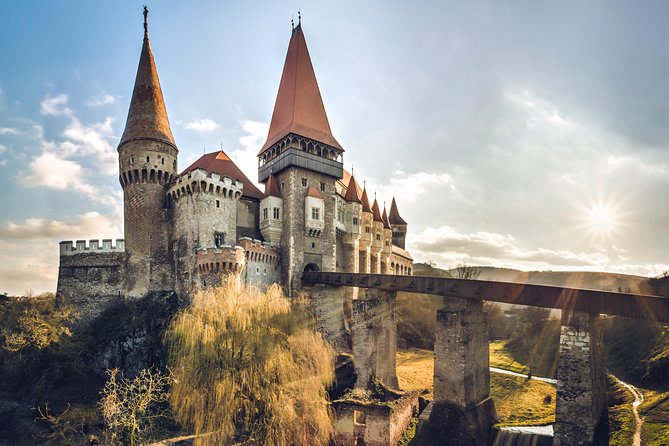
Corvin Castle, also called Hunyadi Castle, is one of the tour’s most dramatic stops. Its towers, bastions, moat, inner courtyard, and Renaissance-Gothic design create the kind of setting people expect from a Dracula trip.
The castle is also tied to a dark claim about Vlad. One legend says he was imprisoned there for seven years. The castle’s architecture and the imprisonment story work well together, but keep the distinction clear: the legend is part of the atmosphere, not proof that every Dracula tale is historically settled.
The next stop, Densuș Church, is much smaller and stranger. It is described as one of Romania’s oldest surviving churches, with origins placed in the seventh century and wall paintings from the fifteenth century. The paintings show Jesus in traditional Romanian clothing, an unusual detail that makes the church memorable.
The building’s origins remain debated. It may have begun as a pagan temple, or it may have been built as a mausoleum for the Roman general Longinus Maximus. Details such as the altar’s southern position, the roof shape, and lion statues joined by their tails feed those theories.
This day suits anyone who enjoys unusual historical sites more than polished attractions. Densuș is not a grand castle, and the visit may feel brief, but it adds texture to the trip.
More ways to get to Bran Castle:
- Private Tour to Salt Mine, Lunch at Winery and Dracula Grave
★ 5.0 · 60 reviews - 4×4 Nature Tour in Land of Dracula – 1 day
★ 5.0 · 34 reviews - Small-group max 7, Salt Mine, Lunch at Winery & Dracula Grave
★ 5.0 · 25 reviews - Searching for Dracula: Private Day Trip from Bucharest
★ 4.5 · 21 reviews
Alba Iulia and Turda move from military power to underground wonder
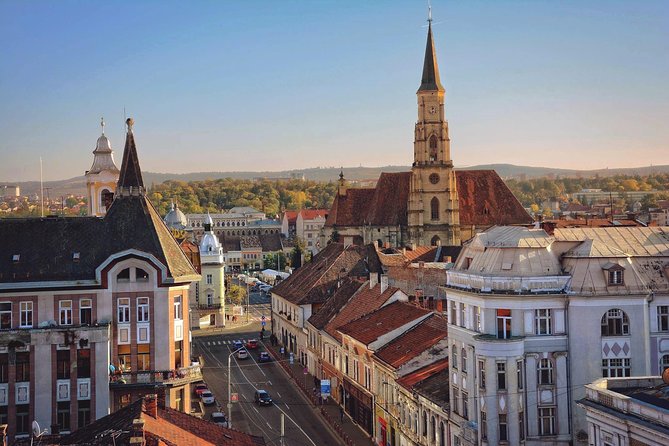
Alba Iulia’s Alba Carolina Citadel gives you a different kind of fortress. Built between 1715 and 1738, it belongs to the Habsburg era and was designed as part of a defense system associated with Prince Eugene of Savoy.
The citadel was built over earlier Roman and medieval fortifications. That layering is the point: one place lets you move from Roman military power to medieval rule and then to Habsburg engineering. The visit lasts about an hour, so listen closely to the guide’s explanation because you will not have unlimited time to explore every section.
Turda Salt Mine changes the mood again. Salt mining here goes back hundreds of years, with the site first mentioned in 1075. Today, the mine is arranged as an underground attraction with a lake, a Ferris wheel, mini-golf, table tennis, bowling, and boat rides.
The salt mine is especially useful for families or anyone who needs a break from churches and fortifications. It is not a quiet, untouched cavern. Its attractions make it more accessible and playful, but that also means it feels more like a designed visitor site than a purely historic mine.
The route includes breakfast and transport, but meals beyond those specified are not included. Plan to budget for lunches and dinners throughout the week.
Biertan and Sighișoara bring the Saxon story into focus
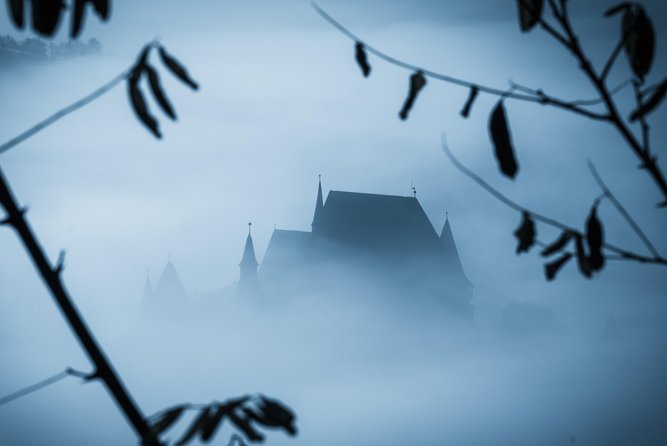
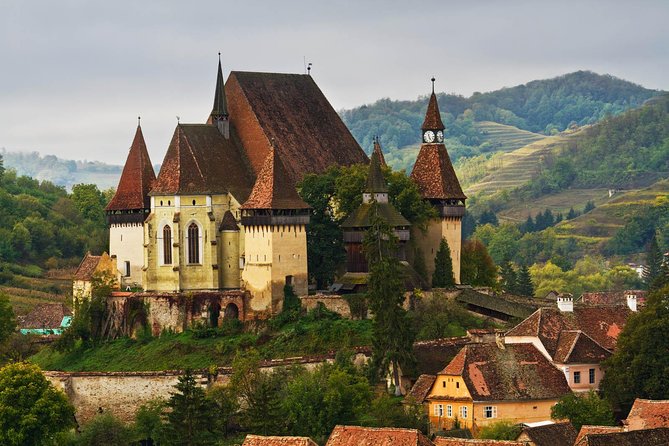
Day six begins with Biertan Fortified Church, surrounded by three sets of defensive walls. Its Gothic architecture shows how religious buildings also served as places of refuge in Saxon communities.
This is a valuable stop because it broadens the story beyond Vlad. Transylvania was shaped by Romanian, Hungarian, German, Ottoman, and Habsburg influences. Biertan helps you see the region as a cultural crossroads rather than a stage built only for Dracula.
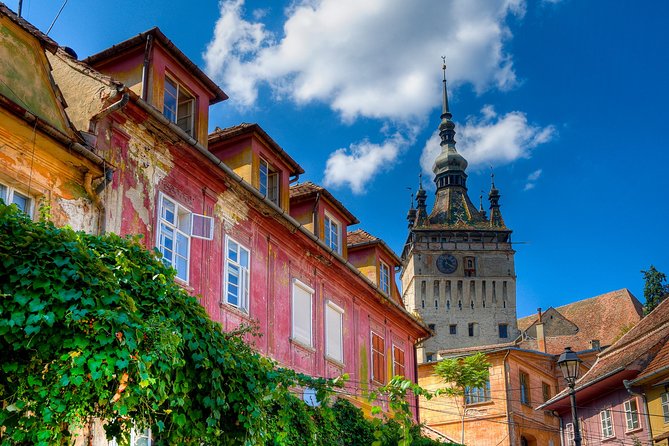
Sighișoara is the day’s major attraction. Its medieval citadel remains inhabited, and its cobbled streets lead to the Clock Tower, which contains a medieval weapons museum and a torture chamber. The fortified center is a UNESCO World Heritage Site, and the walking route gives you time to absorb its streets and buildings.
Sighișoara is also identified as Vlad the Impaler’s birthplace. You visit the house associated with his early years, bringing the historical thread back into the main story.
Expect uneven cobblestones, stairs, and walking through an old fortified town. Comfortable shoes matter. The tour asks for moderate physical fitness, and this is one of the places where that requirement is practical rather than formal.
Brașov and Bran show the difference between history and myth
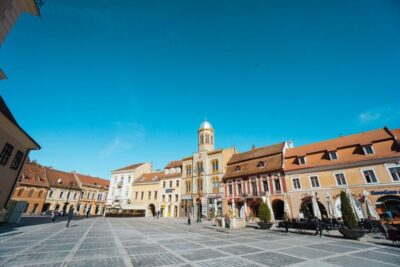
Brașov begins day seven with a guided walk through its historic center. You see Council Square, the Black Church, and one of the world’s narrowest streets. The Black Church is a major Gothic cathedral, and Brașov’s old center gives you a pleasant urban counterpoint to the isolated castles and rural churches.
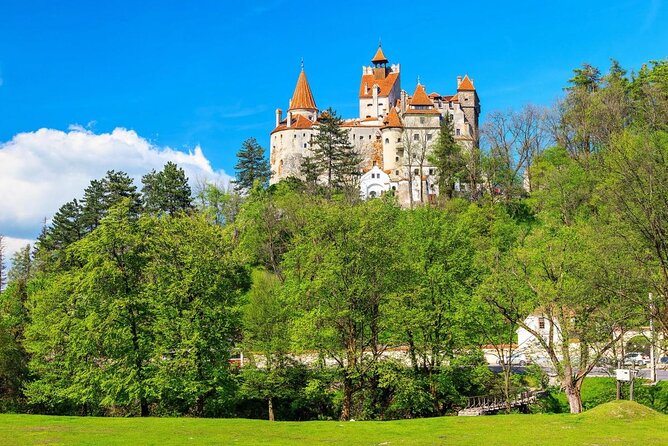
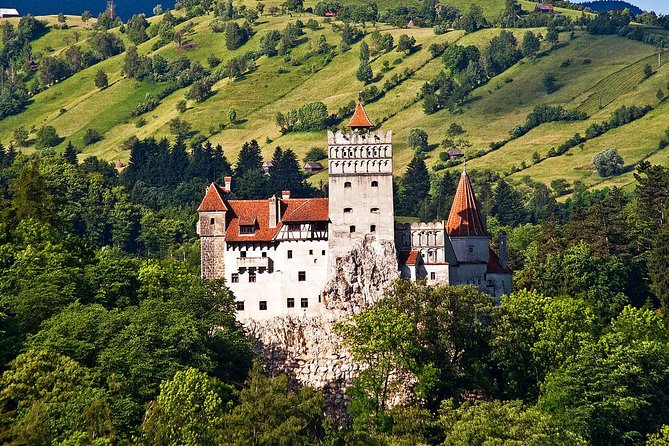
Then comes Bran Castle, the tour’s headline attraction. Often called Dracula’s Castle, it was built in the thirteenth century on a 60-meter cliff above an important route into Transylvania.
Bran is the place most closely tied to the popular Dracula image, but the historical connection between the castle and Vlad is not as strong as the marketing suggests. That does not make the visit pointless. The castle has the right setting, the right silhouette, and enough medieval atmosphere to satisfy the story’s dramatic side. Just keep the legend and the documented history separate.
The final stop is Snagov Monastery, associated with Vlad’s burial. The location of his grave remains disputed, and several legends compete with one another. The commonly repeated account says monks secretly took his body and gave him a Christian burial after rival nobles prevented a proper funeral.
This uncertain ending suits the tour. After several days of separating facts from folklore, Snagov leaves you with a mystery instead of a tidy answer.
What the price includes, and where extra costs appear
At $3,113.31 per person, this is a substantial tour price. The rate is based on two people sharing a double room, so solo pricing may work differently and should be checked before booking.
The value comes from the amount bundled into the price. You receive:
- Seven nights of accommodation
- Breakfast
- A professional English-speaking guide
- Modern vehicle transport
- Airport pickup and drop-off
- Entrance fees listed in the route
- A carriage ride at the ASTRA Museum
That package removes many of the small costs that can add up on an eight-day road trip. It also gives you a guide for a route that would require careful planning across Bucharest, Wallachia, central Transylvania, Hunedoara, Sibiu, Brașov, and several rural sites.
Meals other than included breakfasts are not covered. Airfare and health insurance are also extra, as are entrance fees for attractions not listed in the route.
There is one important detail to clear up. The overview describes hand-picked 3-star hotels, while the included section says centrally located 4-star hotels. Ask Rolandia which category applies to your booking and request the hotel details before committing.
The guide and group size matter on a route this long
A small group makes a real difference here. The published information gives a maximum of eight people, although another line says a maximum of 14 per booking. Confirm the actual vehicle and group limit when you book.
You are picked up from any hotel in Bucharest, with a stated start time of 9 a.m. Airport pickup and drop-off are included, which is useful for an arrival or departure built around the tour.
The guide’s role matters because many stops involve legends, disputed claims, or several layers of history. Florin is specifically praised for explaining the history and for helping with hotel check-ins. That kind of practical care is valuable on a multi-night route, especially when you are changing towns and hotels often.
The experience is offered in English. Children must be accompanied by an adult, and the activity is designed for people with moderate physical fitness.
Who should book this Romanian road trip
I would recommend this tour to you if you want one organized journey through Romania rather than a single castle visit. It suits people who enjoy medieval sites, local legends, mountain drives, historic cities, and a guide who can connect them.
It is also a good fit if you do not want to rent a car or manage Romanian roads yourself. The route covers a lot of ground, and the included transport and entrance fees simplify the planning.
I would be more cautious if you want long, unhurried visits at each site. Many stops are scheduled for about an hour, and several days involve considerable driving. Bran Castle is also not a pure historical explanation of Dracula. It is the famous image, while places such as Târgoviște, Sighișoara, and Snagov offer stronger links to Vlad’s actual story.
The tour’s strongest quality is its range. In one week, you move from communist Bucharest to medieval Wallachia, a mountain highway, a rural museum, Gothic castles, fortified churches, an underground salt mine, and Saxon towns. Sibiu is likely to be a personal favorite if you enjoy charming old centers, while Corvin Castle may be the visual high point.
FAQ
How long is the tour?
The tour lasts approximately eight days and includes seven nights of accommodation.
Where does the tour start?
Pickup is offered from any hotel in Bucharest, with a stated start time of 9 a.m.
Is airport pickup included?
Yes. Airport pickup and drop-off are included.
Is the tour offered in English?
Yes. A professional English-speaking guide is included.
How many people can join the tour?
The activity information says the maximum is eight travelers, while another booking detail gives a maximum of 14 people per booking. Confirm the actual group limit before booking.
Are hotels included?
Yes. Seven hotel nights with breakfast are included. The supplied details differ on the category, listing both 3-star and centrally located 4-star hotels, so confirm this with the provider.
Are entrance fees included?
Entrance fees for the listed attractions are included. Fees for other sights are not included.
Are meals included?
Breakfast is included with the accommodation. Other meals are not included.
Can I cancel for a full refund?
Yes, if you cancel at least 24 hours before the experience start time. Cancellations or changes made less than 24 hours before the start are not accepted for a refund.
Newest Bucharest trips on the site
- Winery touring & private wine tasting – one day private tour★ 5.0 · 3 reviews
- Bucharest: Dealu Mare Winery Private Trip with Wine Tasting★ 4.9 · 6 reviews
- Village Museum Bucharest Guided Tour★ 5.0 · 6 reviews
- Private Transfer from Giurgiu Port to Bucharest★ 4.5 · 12 reviews
- Airport Henri Coanda (Otopeni) to Bucharest – Private Transfer – Driver★ 5.0 · 5 reviews
- Salt Mine Tour from Bucharest with Entrance Ticket★ 4.5 · 19 reviews
- Wine tasting in Bucharest Old town – bonus cheese platter★ 4.5 · 6 reviews
- Walking tour of Bucharest★ 5.0 · 3 reviews
Dracula Castle Tours, compared.
Dracula’s Castle, Peles Castle, & Brasov Old Town
Read our review →
Dracula Castle, Peles Castle & Brasov Old Town
Read our review →
Dracula’s Castle, Peleș Castle & Brașov Day Trip
Read our review →
Day Trip to Dracula Castle, Peles Castle & Brașov
Read our review →
Bucharest to Dracula Castle, Peles Castle and Brasov Guided Tour
Read our review →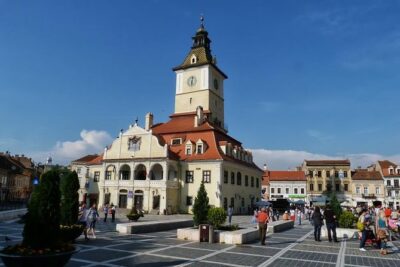
Dracula’s Castle, Peles Castle and Brasov Day Trip from Bucharest
Read our review →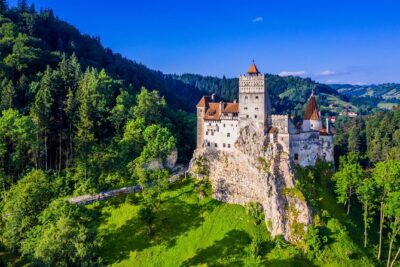
Transylvania and Dracula Castle Full Day Tour from Bucharest
Read our review →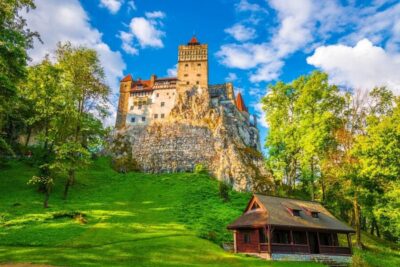
Browse the lists this tour appears in