

Reviewed · CITY TOURS
2-Hours Private Bucharest City Tour
Bucharest’s story swings from village life to communist excess, and this private tour puts both extremes in front of you. You’ll see the enormous Palace of Parliament, the former communist power center at Revolution Square, and the modest houses preserved at the National Village Museum. That contrast gives the city real shape in a short time.
I like the private car and flexible route, especially if you are traveling with family or friends and want to set the pace. I also like the English-speaking guide and driver arrangement, since you can ask questions as you go instead of simply watching the city through a window. The main drawback is time: two hours is tight for this many sights, and some stops may be viewed from outside rather than explored at length.
Key points to know before booking
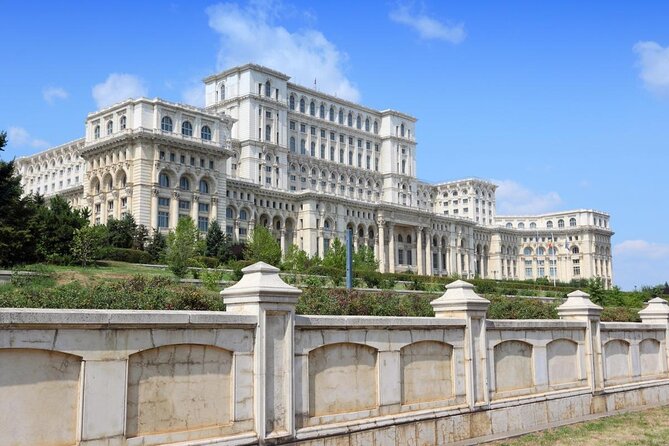
- The Palace of Parliament gives the tour its strongest political lesson: You see the scale of Ceaușescu’s building program and the damage caused by totalitarian rule.
- A private vehicle saves time: Hotel pickup, parking, fuel, road tolls, and taxes are included.
- The route can change: You can discuss your interests with the guide, even after the tour begins.
- The Village Museum adds a human scale: Traditional wooden, adobe, and stone homes show a very different Romania from the grand city boulevards.
- The tour covers a lot in two hours: It works best as a first look at Bucharest, not as a detailed visit to every attraction.
- The price is easiest to justify for a small group: At $140.58 per person, the value improves when the private vehicle and guide cost are shared with family or friends.
Why this short Bucharest tour works
Bucharest can feel scattered at first. Its major sights sit across broad avenues, formal squares, old neighborhoods, and large parks. A private vehicle helps you connect those pieces without spending your first hours working out buses, taxis, or directions.
The tour also gives you a useful way to read the city. One moment concerns rural traditions and practical village homes. The next brings you face to face with a giant administrative palace built under Nicolae Ceaușescu. Between them are royal buildings, cultural institutions, churches, and the places tied to the 1989 Revolution.
I would treat this as a city orientation with strong historical themes. You will see many important locations, but the two-hour limit means you should not expect long interior visits at every stop. If your priority is a broad first impression and local explanation, the format makes sense. If you want a slow museum visit, choose one or two sites and give them more time.
More City Tours in Bucharest
- Bucharest: City Highlights Guided Walking Tour
★ 4.9 · 1,482 reviews - Bucharest: 2-Hour City Highlights Bike Tour
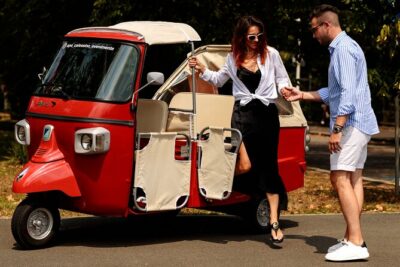
★ 4.8 · 269 reviews - Bucharest Tuk Tuk city tour
★ 5.0 · 188 reviews
The Palace of Parliament and the cost of excess
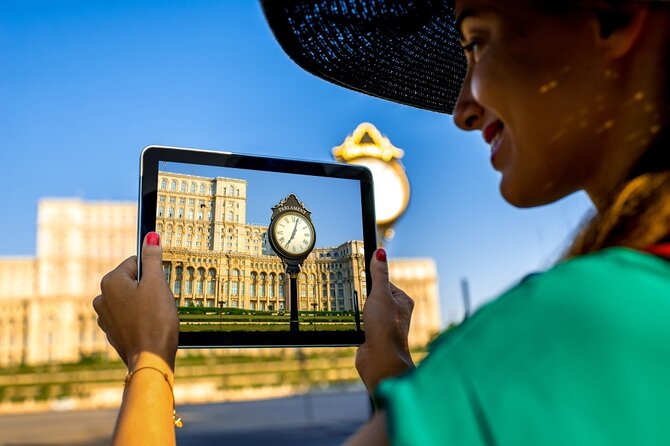
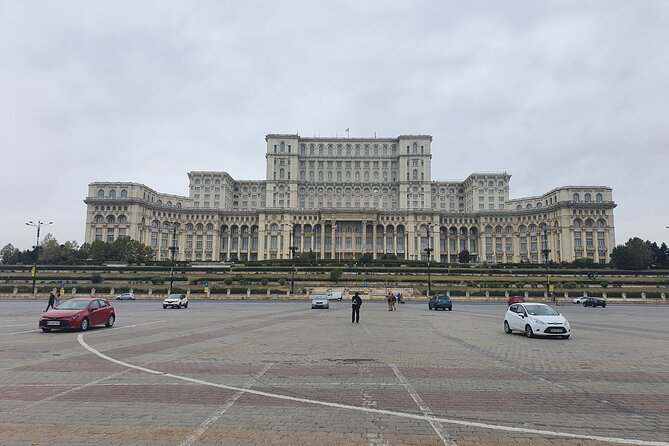
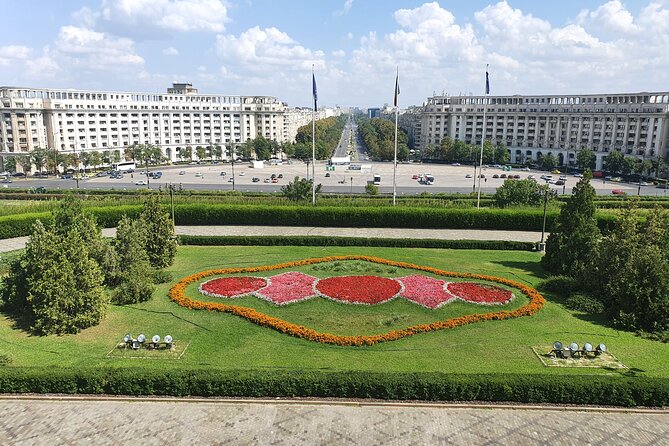
The Palace of Parliament, also called the People’s House, is the clearest symbol of the tour’s political focus. It is described as the second-largest administrative building in the world after the Pentagon, a fact that helps explain why the building is not merely another government office.
Its size is the point. You are meant to feel the scale of a project that consumed enormous resources while ordinary Romanians lived under severe restrictions. The building shows what unchecked power can create when reason, public need, and human cost are pushed aside.
Your guide can place the structure within the communist period and explain why it remains a difficult subject for Romania. This is not just an architectural photo stop. It is a chance to connect a physical building with the choices of a regime and the lives affected by those choices.
Because the tour is short, ask at the start whether a full interior visit is part of your plan or whether the building will be viewed from outside. The supplied details confirm the Palace of Parliament as a central stop, but they do not specify admission arrangements or the amount of interior time. That matters if this is the one place you most want to enter.
The National Village Museum and old Romanian life
The National Village Museum changes the mood. Instead of grand halls and state power, you see homes and structures from Romanian rural life gathered in one place. The collection includes traditional buildings made from wood, adobe, stone, and other local materials.
I like this stop because it gives you something more than a list of rulers and political events. You can look at how people built homes, worked with available materials, and organized daily life around practical needs. Mills and wooden churches add social and spiritual meaning to the display.
The museum also helps correct a common impression of Bucharest. The capital is not only wide boulevards, palaces, communist blocks, and modern shops. Romania’s identity was shaped across villages and regions, and the museum brings those regional traditions into one setting.
Again, two hours limits what you can see. The tour may provide an overview rather than a careful look at every house. If village architecture interests you most, tell the guide early so the route can give that stop the attention it deserves.
Revolution Square and the fall of Ceaușescu
At the Senate Palace, you reach the building that once housed the Central Committee of the Romanian Communist Party. This is also the place linked to the beginning of the December 1989 Revolution, when public protest and sacrifice brought Ceaușescu’s rule to an end.
The value here comes from the guide’s explanation. A building that might look like another official block becomes part of a turning point in Romanian life. You can picture the connection between political authority, public anger, and the sudden collapse of a regime that had seemed firmly fixed.
The tour also refers to the secrets surrounding Ceaușescu’s fortune, the state security service, and offshore accounts. Those subjects can make the stop feel less tidy than a standard political timeline. Romania’s transition left questions and controversy behind, and the guide can help you understand why the period still matters.
I would listen closely here and ask questions. This may be one of the most useful parts of the tour for anyone who knows little about Romania after the Second World War.
A few more Bucharest trips worth a look
- Bucharest: Palace of Parliament Tickets and Guide
★ 4.3 · 3,182 reviews - Bucharest: Palace of Parliament Tickets and Guided Tour
★ 4.4 · 1,877 reviews - Bucharest: Parliament Palace Skip-the-line Ticket
★ 4.2 · 1,518 reviews - Taste Bucharest: A Food Lover’s Tour of Markets & Neighbourhoods
★ 5.0 · 689 reviews
Ceaușescu Mansion and the private side of power
The Ceaușescu Mansion was the private home of Nicolae and Elena Ceaușescu and their children from 1965 to 1989. It offers a different view of the same regime, moving from public monuments to the family’s personal surroundings.
The mansion can help you consider the gap between official communist ideals and the lifestyle of the ruling family. The Palace of Parliament shows public-scale power. The mansion brings that power down to a household level, where rooms, possessions, and family life can make the period easier to picture.
The provided details do not state whether the tour includes admission inside the mansion or an exterior stop. If you want to visit the rooms, confirm that point before booking or at pickup. With only two hours and several locations on the route, the exact treatment of this stop matters.
The Arch of Triumph and Romania’s national story
The Arch of Triumph rises 27 meters and recalls the great arch in Paris. Its design changed several times before reaching its current form, which gives the monument more to explain than its formal shape alone suggests.
The arch is linked to Romania’s fight for freedom and national unity. With luck, you may find exhibits covering the Great War for the Unification of Romania, the heraldry of major boyar families, the arch itself in photographs and models, and the Great Union of 1918.
Those displays may not always be available, so do not book the tour solely for an interior exhibition. Even from the outside, the arch helps connect military memory, national identity, and public architecture. It also gives the route a change of pace after the heavy communist subjects.
The Romanian Athenaeum and central Bucharest
The Romanian Athenaeum is one of Bucharest’s best-known cultural symbols. Its elegant exterior provides a useful counterpoint to the Palace of Parliament, and it gives the tour a chance to discuss music, art, and national culture.
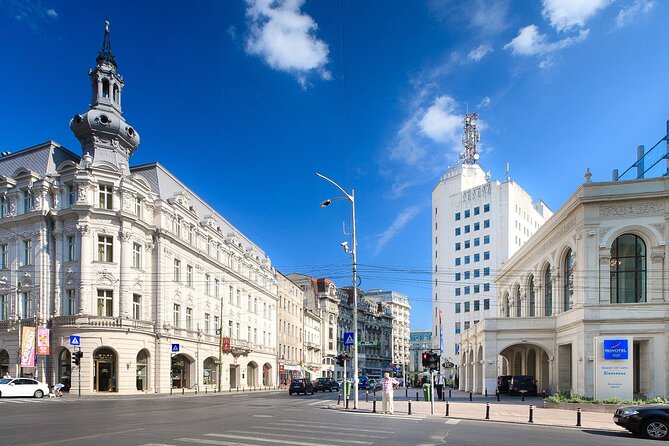
You will also pass through central areas filled with boyar houses, churches, luxury shops, restaurants, cafes, inns, museums, casinos, government buildings, and statues. This is where Bucharest’s different periods sit close together, sometimes in the same block.
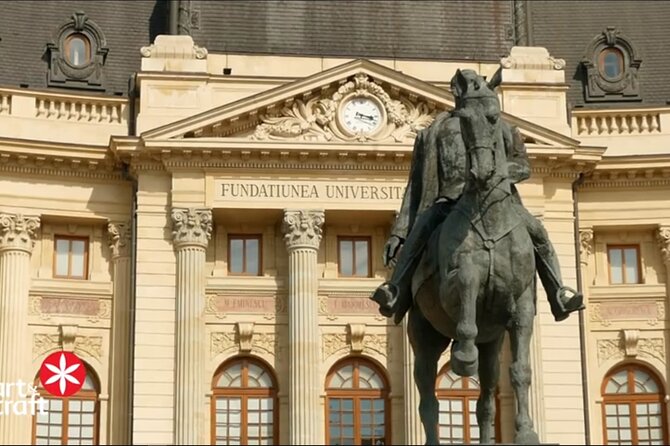
Important landmarks in this central section include the Royal Palace, the National History Museum in the former Post Palace, the Lady’s Church, the CEC Palace, the Palace of the National Military Circle, Cantacuzino Palace, the Central University Library, and the former communist Central Committee building.
This part of the tour is especially useful for first-time visitors because it shows where you may want to return on foot. You can make a quick list of places that deserve a slower visit later. The tradeoff is that you will see many names and facades in a short period, so do not expect a full guided visit to each one.
Private transport, pickup, and route flexibility

Pickup is offered from your Bucharest hotel, but you need to provide the pickup time and address. That simple detail is worth handling carefully, especially if your hotel has more than one entrance or sits on a busy street.
Transport is by a private tourism car or minibus for your group. Fuel, parking, road tolls, and taxes are included, so you do not need to keep cash ready for routine vehicle costs. Food and drinks are not included, although two hours is short enough that this should not cause much trouble.
The guide is a licensed English-speaking guide and driver who remains available throughout the tour. Since the route can be adjusted even after it begins, tell the guide what matters most. You might put the Village Museum first, focus on communist history, or spend more time on central architecture, depending on what is possible that day.
This flexibility is one of the tour’s strongest features. A fixed group outing has to follow its schedule. Here, your own group can discuss the balance between driving, photography, and short stops.
Is $140.58 per person good value?
The listed price is $140.58 per person. That is a serious price for a two-hour city tour, especially for one or two people. The calculation looks better when several friends or family members share the private vehicle and guide, and group discounts may be available.
You are paying for more than transport. The cost includes a dedicated car or minibus, an English-speaking licensed guide and driver, hotel pickup, fuel, parking, road tolls, and taxes. You also gain privacy and the chance to adjust the route, which can be valuable if your time in Bucharest is limited.
The price is harder to defend if you want long interior visits or plan to explore the city independently. You could see some central sights on foot at little cost, but you would lose the local explanation and the convenience of moving quickly between distant areas.
My advice is to compare the cost with your group size and schedule. For a family arriving for a short stay, the tour can save effort and provide useful context. For a solo visitor on a tight budget, it may feel expensive unless the private format is especially important.
Who should book this experience?
I would choose this tour if you want a fast, private introduction to Bucharest and prefer history explained in English. It suits families, friends, and small groups who value hotel pickup and do not want to manage transport between spread-out sights.
It is also a good match if Romania’s communist period interests you. The Palace of Parliament, the former Communist Party headquarters, the Revolution site, and the Ceaușescu Mansion give the tour a clear theme.
I would be more cautious if your main goal is a relaxed museum day. The list of stops is long for two hours, and the details do not promise extended time inside every building. Before you go, identify your top two priorities and tell the guide at pickup.
The only published rating information gives the tour a five-star score from 17 reviews, with 100 percent recommending it. One especially useful comment praised the local perspective and the guide’s command of history. That is the quality I would hope for here: not just names and dates, but an explanation of how Bucharest’s buildings reflect the people and systems behind them.
Should you book the two-hour Bucharest tour?
Book it if you want to get your bearings quickly, travel only with your own group, and see both traditional Romania and the city’s communist landmarks. The private format, included vehicle costs, and flexible itinerary make it practical for a short stay.
Skip it if you want to spend an hour inside one museum or prefer to explore at a slow walking pace. The route covers a great deal, so its best use is as a focused introduction. Free cancellation is available if you cancel at least 24 hours before the start time. Changes or cancellations within 24 hours are not accepted for a refund.
FAQ
How long does the Bucharest private tour last?
The tour lasts approximately two hours.
What language is the tour offered in?
The tour is offered in English with a licensed English-speaking guide and driver.
Is hotel pickup available?
Yes. Pickup is offered, and you must provide the pickup time and address.
Is this a private activity?
Yes. Only your group participates, using a private tourism car or minibus.
What transport costs are included?
Fuel, parking, road tolls, and all taxes are included.
Are food and drinks included?
No. Food and drinks are not included.
Can the itinerary be changed?
Yes. The itinerary is flexible, and changes may be made even after the tour begins, subject to what can fit into the two-hour visit.
Newest Bucharest trips on the site
- Winery touring & private wine tasting – one day private tour★ 5.0 · 3 reviews
- Bucharest: Dealu Mare Winery Private Trip with Wine Tasting★ 4.9 · 6 reviews
- Village Museum Bucharest Guided Tour★ 5.0 · 6 reviews
- Private Transfer from Giurgiu Port to Bucharest★ 4.5 · 12 reviews
- Airport Henri Coanda (Otopeni) to Bucharest – Private Transfer – Driver★ 5.0 · 5 reviews
- Salt Mine Tour from Bucharest with Entrance Ticket★ 4.5 · 19 reviews
- Wine tasting in Bucharest Old town – bonus cheese platter★ 4.5 · 6 reviews
- Private Wine Tasting at Bucharest’s First Wine Bar★ 5.0 · 3 reviews
City Tours, compared.
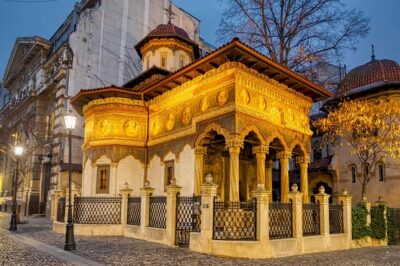
Bucharest Panoramic Sightseeing – Private City Tour
Read our review →
SB01 – City Tour Sibiu: Exploring the Heart of Transylvania
Read our review →
City Tour Sighisoara Legends & Landmarks A Walk Through Time
Read our review →Browse the lists this tour appears in