
Reviewed · WALKING TOURS
Cluj-Napoca: 2.5-Hour Guided Walking Tour
Cluj-Napoca’s story is unusually crowded for a city you can cross on foot in a morning. In 2.5 hours, you move from the birthplace of a celebrated Hungarian king to Gothic church towers, university streets, medieval defenses, an Orthodox cathedral, and a grand Viennese-designed theater. The result is a useful first look at a city shaped by Romanian, Hungarian, German, Roman, and medieval influences.
I like the clear historical timeline, which can take you from the Dacians and Romans through the Middle Ages, the World Wars, Communism, and modern Cluj. I also like the human stories, including medieval witch trials, wine, guilds, and the lives of local intellectuals. The main drawback is that the tour leans heavily toward history and religion, with less time for interiors, everyday culture, or modern city life.
Key points at a glance
- Matthias Corvinus’s birthplace: See the house where Hungary’s famous 15th-century king was born and hear how his life connects Cluj to Central European history.
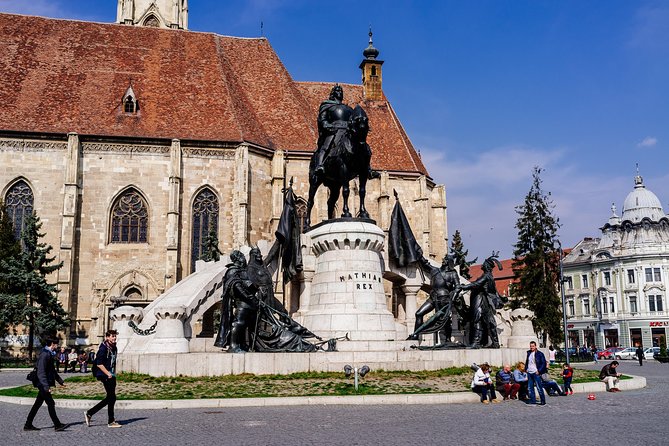
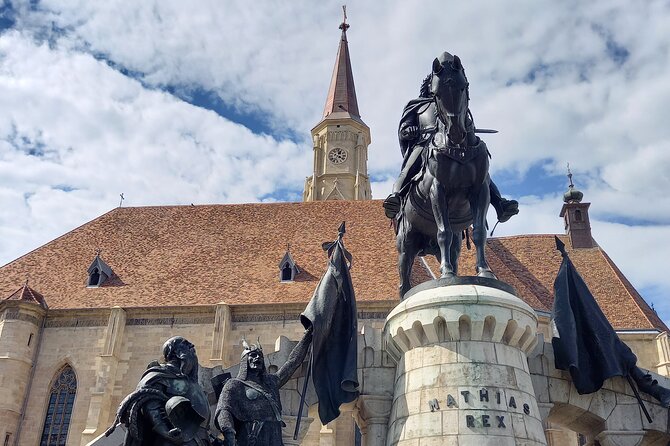
- Union Square’s Gothic centerpiece: Study St. Michael’s Church and the equestrian statue of Corvinus in one of the city’s most important public spaces.
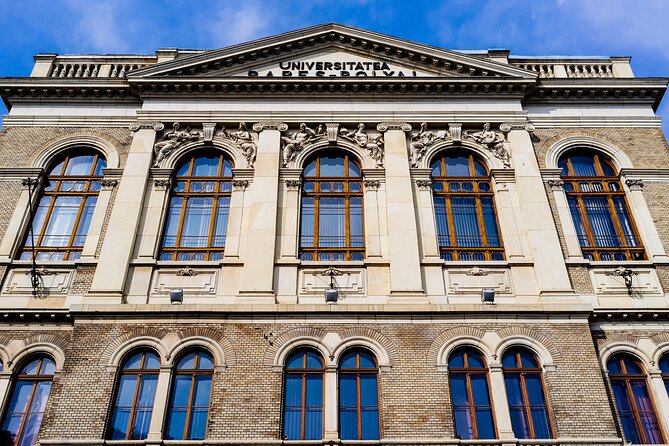
- The Street of the Intellectuals: Walk past Babes-Bolyai University and learn how education helped shape Cluj’s identity.
- Medieval stories beyond the monuments: Hear about local witches, guilds, wine, and the remains of the defensive walls.
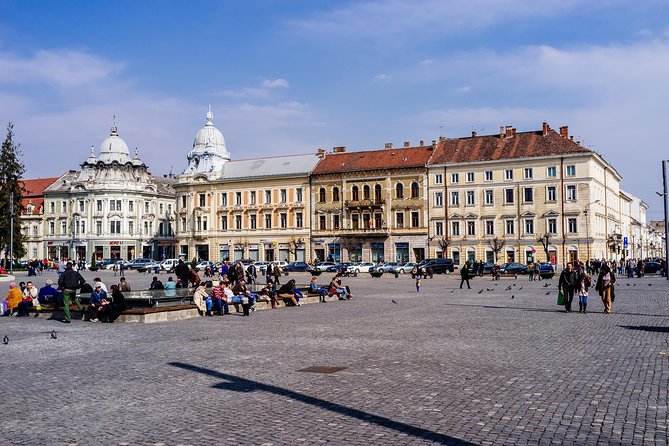
- A striking change of era: Finish at Avram Iancu Square, where the 1930s Orthodox Cathedral faces the 1906 National Theatre.
- Strong guide record: Daniela, David, Andrei, Adrian, and Urzica have all led tours praised for clear explanations, humor, flexibility, and local pride.
Why this Cluj walking tour works for a first visit
I see this as a city orientation tour with historical depth, not a casual stroll from one pretty building to another. The guide gives you a framework for understanding Cluj before you spend time exploring on your own.
That framework matters here. Cluj has changed hands and identities over many centuries, and its architecture does not tell the whole story at a glance. Romanian, Hungarian, German, Roman, Catholic, Protestant, Orthodox, academic, and political threads all appear along the route.
The tour lasts a full 2.5 hours, which gives the guide time to explain cause and effect instead of handing you a string of dates. One guide, Daniela, began with the Dacians and Romans before moving through the Middle Ages, World War I, World War II, Communism, and the present day. That kind of broad timeline helps you understand why the city contains such different religious buildings and architectural styles.
You should expect a history-led walk rather than a food tour or an entertainment program. The strongest material concerns architecture, religion, politics, and local history. If you want restaurant advice, shopping, nightlife, or more about daily life, ask directly. Some guides have offered suggestions for later meals and plans, but this is not the central purpose of the route.
More Walking Tours in Cluj-Napoca
- Cluj-Napoca: 2.5-Hour Guided Walking Tour
★ 4.5 · 29 reviews - Cluj-Napoca Walking City Tour
★ 4.5 · 16 reviews - Cluj : Must-See Attractions Walking Tour
★ 4.8 · 8 reviews
Starting with Matthias Corvinus in the old town
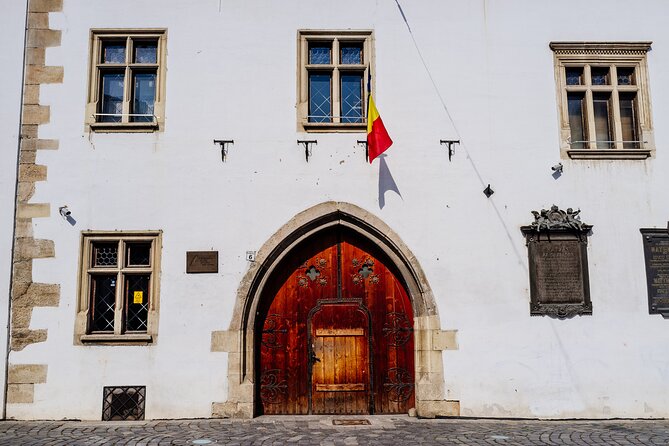
The first major stop is the birth house of Matthias Corvinus, one of Hungary’s best-known kings. He was born in Cluj in 1443, and the building gives the tour an immediate connection to the city’s Hungarian past.
This stop is valuable because it makes history personal. Instead of beginning with an abstract discussion of medieval borders, you stand at the place connected to a major Central European ruler. The guide also explains the importance of wine in the region, adding an everyday economic and social detail to the royal story.
Do not expect the house itself to be the main interior visit of the tour. The appeal is its historical setting and the explanation around it. If you are especially interested in interiors, you may find the outdoor commentary more satisfying than the access inside buildings.
The stop also introduces one of the tour’s recurring themes: Cluj cannot be reduced to a single national story. Matthias Corvinus is tied to Hungarian history, yet his birthplace is in present-day Romania, within a city shaped by several communities over time. A good guide can explain that overlap without turning the walk into a dry political lecture.
Union Square and St. Michael’s Church
From the Corvinus house, the route continues to Union Square, the broad central space at the heart of old Cluj. Here, the focus shifts from one famous person to the city’s architecture and public life.
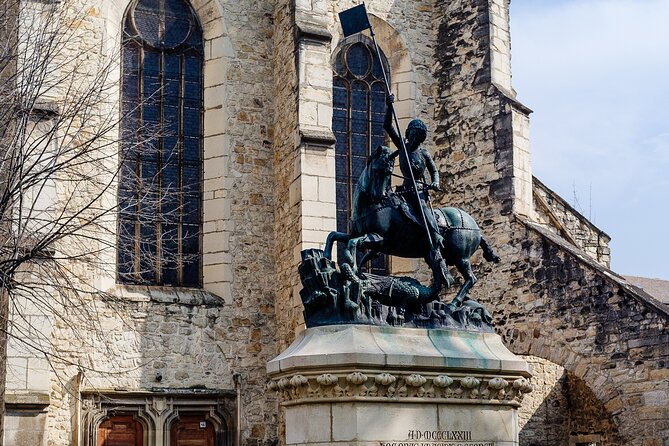
St. Michael’s Church is the visual anchor. Built in the 14th century, it is a major example of Gothic architecture and one of the most important historic buildings in Cluj. Its scale and vertical lines give Union Square a strong medieval character, even though the square around it has changed many times.
In front of the church is the large equestrian statue of Matthias Corvinus. Seeing the statue beside the church brings together two of the tour’s main subjects: royal power and religious architecture. The guide can also help you read the square as a civic space, not just a backdrop for photographs.
This is one of the places where you will want time to look up. Notice the church’s Gothic form, the relationship between the statue and the building, and the way the square frames both. The guide’s explanation adds context that a quick solo visit might miss.
A practical note: the walk includes repeated standing and moving through historic streets. One participant appreciated sitting down several times during the 2.5 hours, and the pace can be adjusted in some cases. Still, you should wear comfortable shoes and be realistic about your mobility. The activity is listed as wheelchair accessible, but it is also not recommended for people with limited mobility, so check the exact option and route before booking.
The Street of the Intellectuals and Babes-Bolyai University
The next section takes you toward what is known as the Street of the Intellectuals. Its name points to the academic character of this part of town, especially the presence of Babes-Bolyai University.
This is a useful change of focus. You are no longer looking only at medieval rulers and churches. You begin to see Cluj as a university city, with education playing a major role in its public identity.
The university also fits the city’s layered cultural story. The institution is associated with Romanian and Hungarian academic traditions, reflecting the broader mix that gives Cluj much of its character. The guide can explain how education, language, and political change have affected the city over time.
This part of the walk may appeal most to visitors who enjoy social history. You are not simply ticking off buildings. You are learning why certain streets attracted students, scholars, and institutions, and how those institutions influenced the city.
The route also brings in the medieval guilds. Guilds shaped craft, trade, and civic organization, and they help explain how an old European town functioned before modern industry. The subject is especially useful when paired with the discussion of city walls and defenses, because it shows how commerce and security worked together.
More walking tours in Cluj Napoca:
- Cluj : Private Walking Tour with A Guide ( Private Tour )
★ 5.0 · 7 reviews - From Cluj: Winter Walking Trip on the Great Mountain
★ 5.0 · 5 reviews - Cluj-Napoca Walking City Tour
★ 5.0 · 5 reviews - Cluj: Private City Walking Tour
★ 4.4 · 4 reviews
Witches, guilds, wine, and the old defensive walls
One of the more unusual parts of the tour concerns the fate of witches in medieval Cluj. This gives the walk a human and sometimes unsettling edge. Instead of hearing only about kings, churches, and architects, you encounter the fears and legal practices that affected ordinary people.
The witch stories are not a separate folklore show. They fit into the larger discussion of medieval society, religion, law, and community control. Ask questions if this subject interests you, since the amount of detail can depend on the guide and the group.
The conversation about guilds and wine adds another layer. Wine was important in the region, and its role helps you think about local trade, production, and social life. You will not be attending a tasting, but the topic gives the city’s past more texture than a simple list of monuments.
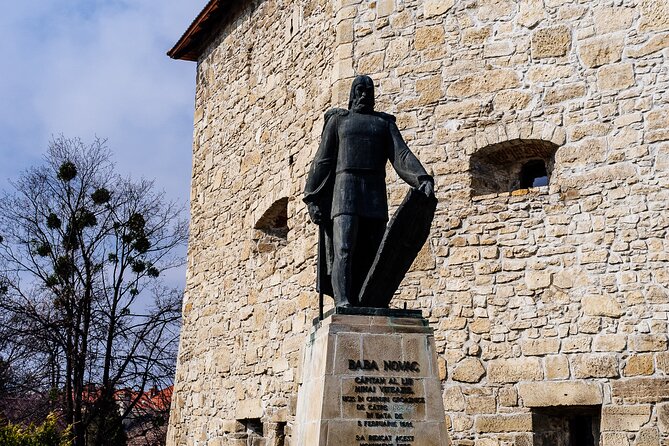
The route then passes remains of Cluj’s defensive walls. These fragments are easy to overlook if you do not know what you are seeing. They are less dramatic than a complete fortress, but they help you picture the limits of the old town and the need to protect a growing urban center.
I like this stretch because it connects the grand and the ordinary. A royal statue tells you about power. A church tells you about faith. A guild tells you about work. A wall tells you about danger. Together, these details make the old city easier to understand.
Avram Iancu Square and a change in architectural mood
The final major section takes you to Avram Iancu Square, a newer part of the old city. The change is important. After the medieval center, you encounter buildings that reflect Romania’s modern national and cultural identity.
The Orthodox Cathedral dates from the 1930s and gives the square a different religious and architectural presence from St. Michael’s Church. Comparing the two is one of the best reasons to take the full route. You see how different communities and historical periods left their mark on the same city.
The National Theatre, built in 1906 by Viennese architects, adds another strong point of contrast. Its design reflects the influence of the Austro-Hungarian period and the wider architectural culture of Central Europe. The building also shows that Cluj’s story is not limited to its medieval core.
The square works well as a final stop because it brings the tour into a more recent period. You have moved from medieval kings and Gothic architecture to 20th-century Romanian religious and cultural institutions.
The main limitation here is that the tour is primarily an exterior sightseeing walk. One person specifically wished for more interiors. If entering churches, theaters, and historic buildings is essential for you, ask about access at the start and confirm what is open on your date. The supplied details promise the city tour, not guaranteed interior visits.
Guide style and the value of the commentary
The guide can make or break a walking tour, and this experience has a strong record in that area. Daniela has been praised for clear historical explanations, humor, and passion for Cluj. David was described as bringing visitors to streets they would not have found alone. Andrei has been noted for keeping attention and welcoming questions.
Other named guides include Adrian, who has helped with suggestions for later meals and plans, and Urzica, who has covered politics, religion, art, architecture, and present-day Romania. These names do not guarantee who you will receive, but they show the range of guide styles associated with the experience.
The best feature is adaptability. One booking became a private tour because of the selected date and time, while another guide adjusted the discussion to the group’s level of interest in history. A guide even stayed longer on one occasion to finish the material.
Do not assume every departure will become private or run over time. Treat those as possible bonuses, not part of the promise. What you can reasonably expect is live commentary in English or German, with room for questions.
The tour has earned a 4.8 rating from 104 reviews, and the repeated praise centers on clear explanations, friendly presentation, and strong knowledge of Cluj’s past. A small number of less enthusiastic comments point to the same limitation: the content can focus more on history and religion than on culture, and some people would like more recommendations for the rest of their stay.
Is $34 a fair price?
At $34 per person, this is not the cheapest way to walk through Cluj, since you can see the squares and exterior buildings without a guide. The value comes from the interpretation.
You are paying for 2.5 hours of organized context, not transportation, food, or admission to a series of attractions. That makes the price reasonable for a first visit if you want to understand what you are seeing rather than simply photograph it.
The tour is especially good value when you use it at the start of your stay. You can return to Union Square, the university area, or Avram Iancu Square later with a better sense of what matters. You can also ask the guide where to continue, although restaurant and cultural suggestions are not guaranteed.
For repeat visitors, the value depends on your interest. If you already know Cluj’s central monuments and have read about its history, you may prefer a specialized museum visit or a self-guided walk. If you still want the stories behind the buildings, the guided route remains useful.
Practical details before you book
Wear shoes suitable for 2.5 hours of city walking. A sun hat is useful in warm weather, and the activity information also asks participants to bring a face mask or protective covering.
The tour is offered in English and German. The meeting point can vary according to the option you choose, so check the booking details carefully rather than assuming the same starting place for every departure.
Pets are not allowed. The activity is described as wheelchair accessible, but it is not recommended for people with mobility impairments. Because the route includes historic streets, standing, and walking between several areas, contact the provider if accessibility is a serious concern.
You can cancel up to 24 hours in advance for a full refund, and the reserve-now, pay-later option lets you hold a place without paying immediately. Starting times depend on availability.
Who should book this Cluj tour?
I would choose this tour for a first visit, especially if you want a strong historical map of the city before exploring independently. It suits people who enjoy architecture, religion, political history, and stories about how cities change.
It also works well for small groups, colleagues, and visitors who prefer to ask questions rather than read plaques. The guide’s ability to adjust the pace and level of detail is a useful advantage.
I would think twice if your main goal is local food, nightlife, shopping, museum interiors, or modern Romanian culture. You can ask for extra recommendations, but the route’s center of gravity is the historic city and its religious, political, and architectural past.
Should you book it?
Book it if you want to understand why Cluj contains Hungarian royal history, Gothic church architecture, German and Central European influence, Romanian Orthodox landmarks, and a major university tradition within one compact center.
The strongest reasons are the full 2.5-hour timeline, the unusual stories about witches and guilds, and the contrast between St. Michael’s Church and the Orthodox Cathedral. The main caution is that the tour is more historical than cultural, and interior access is limited or uncertain.
For $34, I consider it a solid first-day choice. Put it early in your visit, wear good shoes, and arrive ready to ask questions. You will leave with a clearer idea of where to go next and why Cluj looks the way it does.
FAQ
How long is the Cluj-Napoca walking tour?
The tour lasts 2.5 hours.
What language is the tour offered in?
The live guide speaks English or German, depending on the option and departure.
How much does the tour cost?
The listed price is $34 per person.
What are the main sights on the route?
The route includes Matthias Corvinus’s birth house, Union Square, St. Michael’s Church, the equestrian statue of Corvinus, the Street of the Intellectuals, Babes-Bolyai University, sections of the old defensive walls, Avram Iancu Square, the Orthodox Cathedral, and the National Theatre.
Does the tour include a visit inside the buildings?
The tour information does not guarantee interior visits. The route focuses on the city and its main sights, with commentary from the guide.
Is the tour suitable for people with limited mobility?
The activity is not recommended for people with mobility impairments. It is listed as wheelchair accessible, so check the exact booking option and route before reserving.
What should I bring?
Bring comfortable shoes, a sun hat, and a face mask or protective covering.
Are pets allowed?
No. Pets are not allowed on the tour.
Can I cancel and receive a refund?
Yes. You can cancel up to 24 hours in advance for a full refund. You can also reserve now and pay later.
Newest Cluj Napoca trips on the site
- Private tour to Turda Salt Mine, Rimetea and Alba Iulia★ 4.8 · 5 reviews
- Turda salt mine and Corvin Castle day tour from Cluj★ 5.0 · 9 reviews
- Turda Salt Mine, Gorge & Rimetea Village (private from Cluj)★ 5.0 · 5 reviews
- 1250cc Motorcycle Rental from Turda★ 5.0 · 4 reviews
- Day Trip to Turda Salt Mine and Corvin Castle from Timisoara★ 5.0 · 10 reviews
- Discover Apuseni Mountains – Scarita Summit,Sipote Waterfall and Dumesti Village★ 5.0 · 17 reviews
- CLUJ ADVENTURE TOUR ! ZIP LINE and HIKE★ 5.0 · 15 reviews
- Turda salt mine, Rimetea village and Alba Iulia, from Cluj★ 5.0 · 11 reviews
Walking Tours, compared.
Ghost Stories & Romanian Mythology Walking Tour
Read our review →
Walking Tour- Delightful Bucharest (Highlights, Stories, Sights)
Read our review →
4h Bucharest Private Tour (2h by Car and 2h Walking in Old Town)
Read our review →Browse the lists this tour appears in