
Reviewed · CITY TOURS
Best Walking Tour of Bucharest’s City Center – 2.5 hours
Bucharest makes the most sense on foot, where grand royal buildings, Orthodox churches, communist scars, and lively Old Town lanes sit within a short walk of one another. This 2.5-hour route gives you that useful first look, with guides such as Cristina, Maria, and Nicolae praised for clear stories and strong knowledge of Romanian culture.
I like the mix of subjects, from Carol I and the monarchy to the 1989 Revolution, and I like the chance to enter several churches rather than simply pass them. The main concern is reliability: several bookings were canceled late or met with no guide, so confirm the tour before setting aside a valuable morning.
Key points to know before booking
- You cover both Old Town and Revolution Square, giving you a much wider view than a short Old Town stroll.
- The history moves quickly but covers a lot, including Romanian kings, Vlad the Impaler, communism, Orthodoxy, and the 1989 uprising.
- Church entries are included, with visits to Stavropoleos Monastery, St. Anthony Church, and St. Demeter Church.
- The group can reach 14 people, a manageable size, though this is not always a one-to-one private tour.
- The route is a point-to-point walk, listed as starting at Manuc’s Inn and ending near the Romanian Athenaeum.
- Operator reliability needs attention, since some bookings were canceled or left without a guide.
A useful first walk through Bucharest
At $54.77 per person, this is not the cheapest way to see Bucharest’s center. You are paying for an English-speaking guide, a planned route, church access, and historical explanation rather than simply following a map between landmarks.
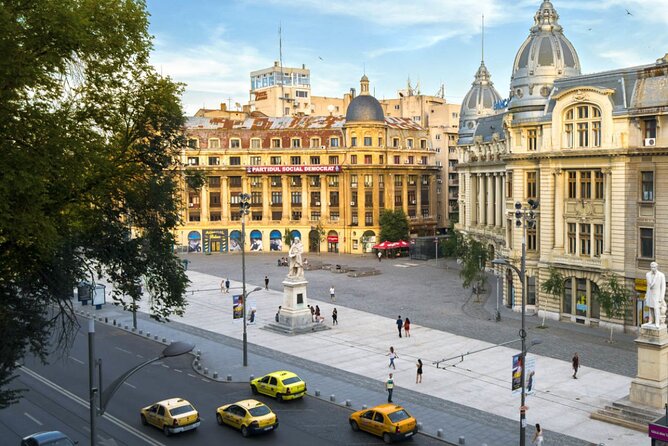
I think the price makes the most sense on your first day in the city. Bucharest’s center can feel scattered at first. One minute you are looking at a French-influenced concert hall, and a few minutes later you are beside an Orthodox church or a monument tied to the fall of communism. A guide helps connect those places.
The tour is listed as lasting two to three hours, with 2.5 hours as the practical expectation. That is enough time for a strong orientation, but not enough for long museum visits or relaxed meals. The stops are often brief, usually five to 20 minutes, so you should expect explanation, photographs, and exterior viewing more than extended sightseeing inside each site.
There is also a small oddity in the route details. The meeting point is Manuc’s Inn, while the listed endpoint is the Romanian Athenaeum, yet the stop list begins with the Athenaeum and ends with the Patriarchal Cathedral. Treat the tour as a flexible city-center walk, and confirm the exact starting direction and endpoint before you go.
More City Tours in Bucharest
- Bucharest: City Highlights Guided Walking Tour
★ 4.9 · 1,482 reviews - Bucharest: 2-Hour City Highlights Bike Tour
★ 4.8 · 269 reviews - Bucharest Tuk Tuk city tour
★ 5.0 · 188 reviews
Manuc’s Inn and the Old Town setting
Manuc’s Inn, or Hanul lui Manuc, is the stated meeting point at Strada Franceză 62. This historic inn also appears later in the walk, where you hear about its builder and its place in Bucharest’s commercial past.
The inn is also recommended for lunch, which makes it useful beyond the tour itself. If you plan to eat there, book separately and allow time after the walk. The tour price does not include food, drinks, or other personal expenses.
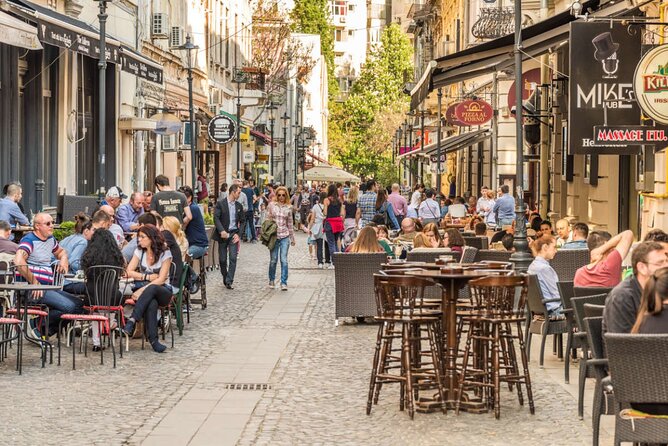
Starting near Manuc’s Inn places you close to the heart of the Old Town. This is the part of Bucharest where narrow streets, old churches, restaurants, and historic buildings crowd together. It is a good launch point, but the pavement and lanes can make a walking tour feel more tiring than the distance suggests, so wear sensible shoes.
The Romanian Athenaeum and the royal city
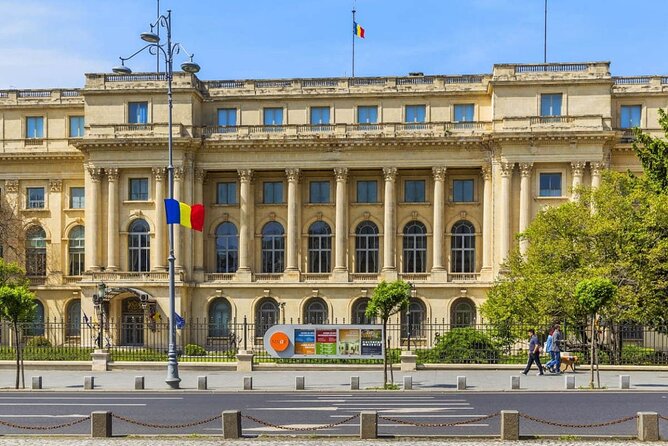
The Romanian Athenaeum is one of Bucharest’s signature buildings and a strong focal point for the tour. Its architecture recalls French style, a useful reminder of the city’s long effort to present itself as a modern European capital.
The guide ties the building and nearby palace to Romania’s monarchy, including Carol I, Ferdinand I, Carol II, and Michael I. That royal thread gives structure to the early part of the walk. You are not just looking at handsome facades. You are hearing how the capital changed under different kings.
The interior visit is listed as included if the Athenaeum is open. The supplied opening information gives daily hours of 10:30 a.m. to 1 p.m., but access can depend on availability. Do not assume you will certainly enter. If seeing the interior matters to you, choose a tour time within that window and confirm the plan in advance.
The timing here is important. The Athenaeum stop is listed at about 20 minutes, which is enough for a guide talk and perhaps a short interior look, but not a full concert-hall visit. The building is also the stated endpoint, so you may have the option to stay nearby and explore it further on your own.
Carol I, the university, and Revolution Square
The Central University Library is linked to Carol I, Romania’s first king, and sits near an equestrian statue of him. This is a compact stop, listed at five minutes, but it adds another piece to the royal story begun at the Athenaeum.
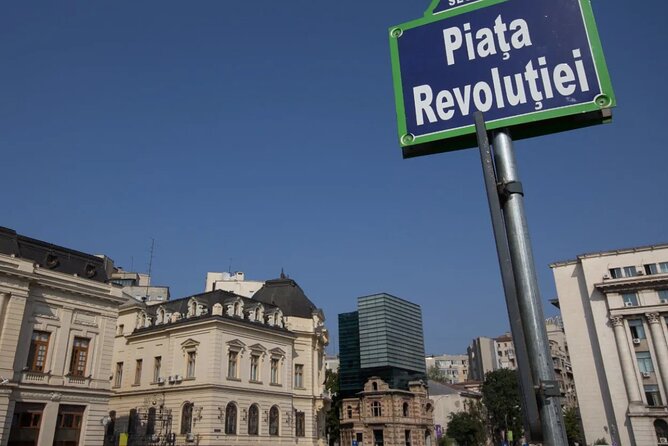
The walk then reaches the Memorial of Rebirth in Revolution Square. Locals sometimes refer to the tall monument by an unflattering nickname because of its shape. The important point is not the nickname, but what the site represents: the December 1989 Revolution and the last days of communist rule.
Here, the guide explains how young people fought against the regime and points out memorials connected to people who were captured and tortured by the communists. This is one of the tour’s most valuable stops because the history is tied to the exact square beneath your feet.
I would give this section your full attention. Bucharest’s communist past can seem abstract when you only see broad avenues and large state buildings. Revolution Square makes it specific. You are standing in a place where Romania’s political order changed, and the stories give meaning to the monuments.
The route also includes a look at Byzantine and Orthodox architecture. Around 90 percent of Romanians are identified in the tour material as Christian Orthodox, so the churches are not decorative side stops. They help explain the religious culture that continues alongside the capital’s royal and communist landmarks.
More Walking Tours in Bucharest
- Bucharest Highlights Walking Tour
★ 5.0 · 469 reviews - Bucharest: Ghost Stories & Romanian Mythology Walking Tour
★ 4.9 · 287 reviews - Bucharest: Guided Walking Tour with Romanian Snack
★ 4.9 · 228 reviews - Best of Bucharest | Private Walking Tour
★ 5.0 · 199 reviews
University Square and the start of the old center
University Square is another important link to the 1989 Revolution. It is home to several major Romanian universities and includes the Kilometer 0 of democracy, a symbolic marker connected with the uprising.
The stop is listed at about 15 minutes, long enough to explain the square’s political role before the walk continues through the Old Town. I like this transition because it shows how Bucharest changes by neighborhood. You move from broad civic spaces and public monuments into smaller streets filled with churches, inns, and older buildings.
The tour also notes a structure erected by the Russian community in the early 20th century. The information does not give the building’s name, so you should expect the guide to provide the exact context on site. It is one of those brief points that may mean more once you hear the local story behind it.
Stavropoleos Monastery and three small churches
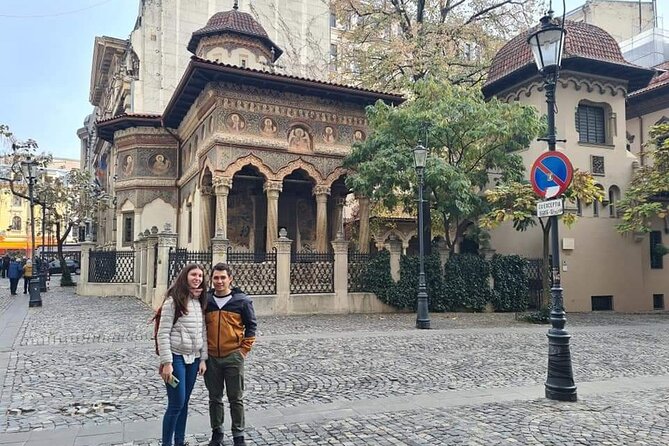
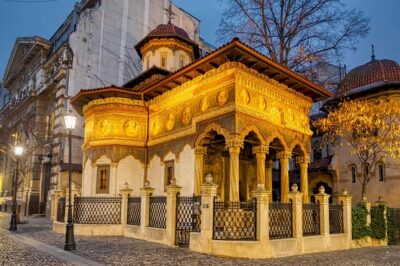
Stavropoleos Monastery is one of the visual highlights. It is small, intimate, and built in a Byzantine style. The carved details and painted decoration offer a quick introduction to the look of Romania’s famous painted monasteries in Bucovina, although this stop is much shorter than a full monastery visit.
The tour includes entrance to Stavropoleos, and the stop is listed at five minutes. That is a tight schedule. You can see the main features and listen to the explanation, but you should not expect a quiet, extended visit for prayer or close study of every detail.
Next comes St. Demeter Church, described as the White Princess of the Old Town. Its story gives the guide another chance to explain how religious buildings survived and changed within the city center.
St. Anthony Church, beside the Old Princely Court, is also included. The interior atmosphere and decoration are part of the appeal, and the guide explains its role in Romanian history. Entry to the three churches is included, but opening conditions can still affect what you see. Churches are active sacred places, not just monuments, so respectful clothing and quiet behavior are sensible.
These religious stops are especially useful if you have only seen Bucharest through its grand public buildings. They bring the scale down. Instead of kings and national monuments, you are looking at small spaces shaped by worship, local tradition, and daily city life.
Curtea Veche and the world of Vlad the Impaler
The Old Princely Court Museum, known as Curtea Veche, contains some of Bucharest’s oldest historical remains. The site reaches back to evidence from the 13th century and served as a residence for Wallachian rulers from the 14th century onward.
Vlad the Impaler ruled Wallachia from here for a period, which gives the stop a clear connection to one of Romania’s best-known historical figures. The tour does not turn this into a fantasy story. Instead, it places Vlad within the political history of Wallachia and the development of Bucharest.
The stop is listed at only five minutes, so think of it as a historical marker rather than a full museum visit. If you want a long look at archaeological remains or a more detailed study of Vlad, you will need separate time. Still, the site works well in a walking route because it explains why the Old Town is more than a restaurant district.
Manuc’s Inn and the route toward Unirii Square
At Manuc’s Inn, the guide tells the story of the wealthy and politically clever boyar associated with the inn. The stop lasts about ten minutes, longer than most of the small church visits, and gives you a chance to understand the role of inns in the old capital.
The tour may continue toward Unirii Square, with a view from a distance. This part is optional and depends on your available time and desire to keep walking. That flexibility is helpful if you need to stop for lunch or have an evening plan, but it also means the final part of the route is not guaranteed in every version of the walk.
Unirii Square provides a broader city view than the Old Town lanes. It helps you see the relationship between the historic center and the larger modern capital. If you are tired by this point, you can reasonably treat it as a bonus rather than a must-see.
The Patriarchal Cathedral, if time allows
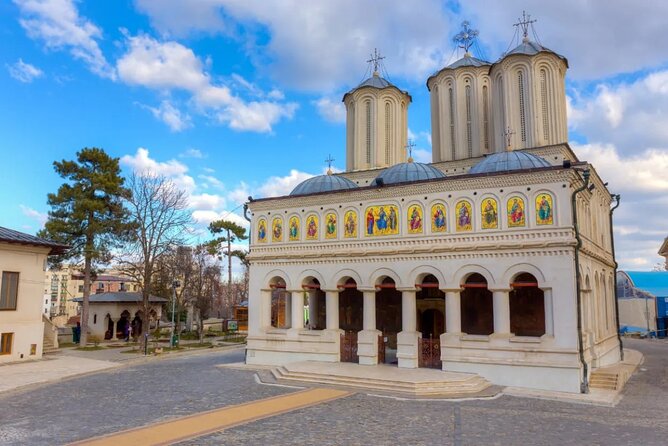
The Patriarchal Cathedral sits on the hill near Unirii Square and is another optional stop. The tour describes it as a sacred place filled with paintings and decoration.
This is a worthwhile extension if you want more Orthodox architecture and your schedule allows it. It is less useful if your priority is a slow meal, the Athenaeum interior, or independent time in the Old Town. Since the stop depends on time and your desire to continue, ask the guide early how much of the final section is realistic.
The optional ending also matters because the stated route ends at the Romanian Athenaeum. If the Patriarchal Cathedral is included in your walk, the actual finish may differ from the simple start-to-end description. Confirm where you will part company.
What the guide adds, and the reliability concern
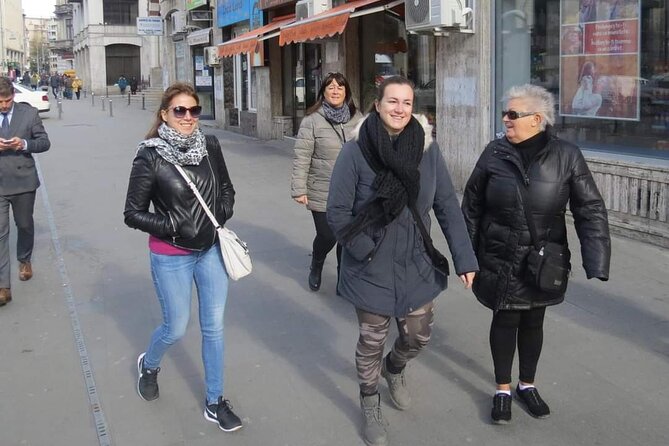
The strongest part of this experience is the human explanation. Cristina is described as serious and well prepared, with a strong interest in culture. Maria is praised for using anecdotes to bring buildings, statues, and streets to life. Nicolae is noted for collecting a group from a hotel and providing about three interesting hours of history and city sights.
Those details suggest that the quality can depend heavily on the guide assigned. A good guide makes the route feel connected rather than like a parade of unrelated buildings. You should expect the most value from the historical storytelling, not from spending long periods inside each attraction.
The serious drawback is the operator’s record of missed starts and cancellations. Some bookings were canceled only a few hours before departure. In other cases, the guide did not appear, the supplied phone number went unanswered, and the cancellation message arrived after the scheduled start time. Money was refunded in at least one case, but a refund does not return a lost morning in Bucharest.
I would contact the provider before the tour, confirm that it is running, and keep your messages and booking details available. Free cancellation applies until 24 hours before the start time. After that, the amount is not refunded, and changes are not accepted. The experience also requires a minimum number of participants, so the provider may offer another date or a full refund if that minimum is not met.
Who will get the most from this walk
I would choose this for a first visit, especially if you want the city’s history explained in plain language. It suits anyone interested in monarchy, communism, Orthodox culture, architecture, or the Old Town, and it is a useful option before exploring Bucharest on your own.
It is less suitable if you want a slow photography walk, a full interior tour of the Athenaeum, or extended museum time. The pace is purposeful, and several stops last only five minutes.
The tour is offered in English, uses a mobile ticket, and is near public transportation. Most people can participate, but the experience is still a two to three-hour walk with multiple stops. The group size can reach 14, so it is small enough for questions but not necessarily a fully private experience despite the private-tour wording.
Is this Bucharest walking tour worth booking?
Book it if you want a well-planned first look at Bucharest and value stories more than long visits inside individual buildings. The combination of Revolution Square, the Old Town, royal landmarks, Orthodox churches, Curtea Veche, and Manuc’s Inn gives you a better sense of the city than a narrow Old Town stroll.
At $54.77, I would call it fair value when the guide is present and the Athenaeum or church entries work as planned. I would not book it without confirming the departure, since the cancellation and no-show problems are the main risk.
If you do book, schedule it early in your stay, wear comfortable shoes, keep the rest of the day flexible, and ask about the Athenaeum interior and optional cathedral stop. For a first orientation, this can be an excellent use of half a day. For a guaranteed appointment, the operator’s reliability deserves careful checking.
FAQ
How long does the Bucharest walking tour last?
The tour lasts about two to three hours, with 2.5 hours given as the usual duration.
Where does the tour start?
The stated meeting point is Manuc’s Inn, Hanul lui Manuc, at Strada Franceză 62 in Bucharest.
Where does the tour end?
The stated endpoint is the Romanian Athenaeum on Strada Benjamin Franklin 1-3. The optional route toward the Patriarchal Cathedral may affect the final stop.
Is the Romanian Athenaeum interior included?
A visit is included if the Athenaeum is open. The listed opening hours are Monday through Sunday from 10:30 a.m. to 1 p.m., though access is subject to availability.
Which churches are included?
Entrance to St. Anthony Church, Stavropoleos Monastery, and St. Demeter Church is included.
How large is the group?
The activity can have a maximum of 14 participants. It is described as a private tour, but the stated maximum means you should not assume it will be a one-person or family-only walk.
Can I cancel for a full refund?
Yes, if you cancel at least 24 hours before the local start time. Cancellations or changes made less than 24 hours before the tour are not refunded, and a minimum number of participants is required for the experience to operate.
Newest Bucharest trips on the site
- Winery touring & private wine tasting – one day private tour★ 5.0 · 3 reviews
- Bucharest: Dealu Mare Winery Private Trip with Wine Tasting★ 4.9 · 6 reviews
- Village Museum Bucharest Guided Tour★ 5.0 · 6 reviews
- Private Transfer from Giurgiu Port to Bucharest★ 4.5 · 12 reviews
- Airport Henri Coanda (Otopeni) to Bucharest – Private Transfer – Driver★ 5.0 · 5 reviews
- Salt Mine Tour from Bucharest with Entrance Ticket★ 4.5 · 19 reviews
- Wine tasting in Bucharest Old town – bonus cheese platter★ 4.5 · 6 reviews
- Walking tour of Bucharest★ 5.0 · 3 reviews
City Tours, compared.



Bucharest Panoramic Sightseeing – Private City Tour
Read our review →
SB01 – City Tour Sibiu: Exploring the Heart of Transylvania
Read our review →
City Tour Sighisoara Legends & Landmarks A Walk Through Time
Read our review →Browse the lists this tour appears in