
Reviewed · WALKING TOURS
Bucharest: 3-Hour Walking Tour
Bucharest’s story is unusually dramatic for a three-hour walk. You begin where Nicolae Ceaușescu’s final speech helped spark the 1989 revolution, then pass royal buildings, churches, cafés, and the former home of Vlad Tepes, the ruler who inspired Dracula. The city changes character block by block.
I like the way this tour connects big political events with ordinary city streets, rather than treating Bucharest as a collection of pretty façades. I also like the small local touches: a covrig, Romania’s soft pretzel-like snack, and a stop at Carturesti Carusel, one of the city’s most striking bookstores. The main consideration is pace. Three hours gives you a strong introduction, but there is little time for long interior visits or leisurely stops.
Key points at a glance
- Revolution Square begins the story: Learn how the 1989 uprising unfolded around the former Palace Square.
- Victory Avenue links the major sights: Pass the Romanian Athenaeum, former Royal Palace, Athenee Palace Hilton, museums, palaces, and Kretzulescu Church.
- Old Town is the tour’s most atmospheric stretch: Follow winding streets that once connected merchants, princes, and Ottoman officials.
- Carturesti Carusel adds a modern cultural stop: This beautiful bookstore offers a welcome change from monuments and political history.
- A covrig is included: Try a popular Romanian street snack without adding another food tour to your schedule.
- The finish is Vlad Tepes’s former residence: See the ruins of the Old Princely Court, linked with the historical figure behind Dracula.
Starting at Revolution Square and the 1989 uprising

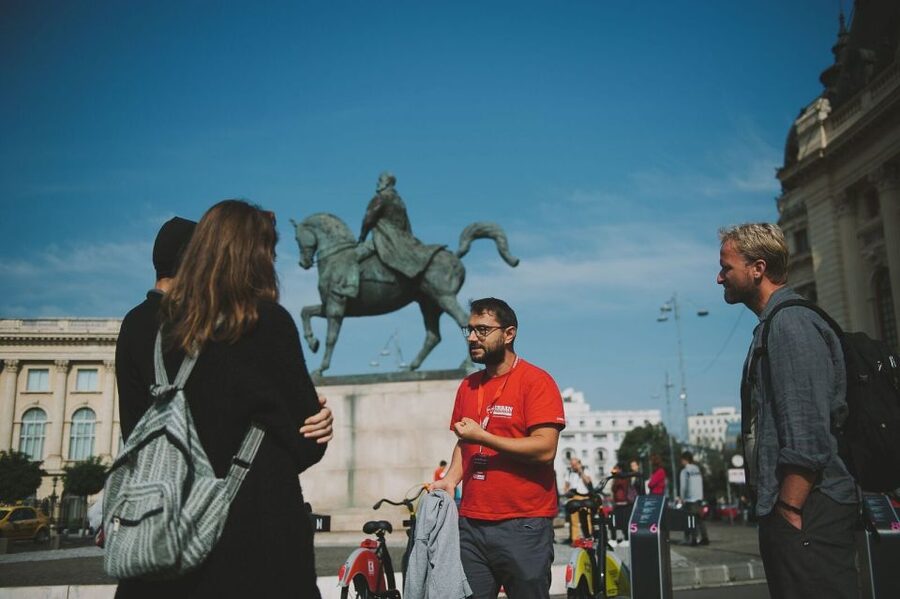
Meet your English-speaking guide in Revolution Square, in front of the statue of King Carol I on horseback. It is the only horse statue in the square, so finding the meeting point should be straightforward.
This is an excellent place to begin because Bucharest’s past is not presented as a tidy timeline. Palace Square, as it was once called, has witnessed royal ceremony, Communist rule, public speeches, and revolt. The most important modern episode came in December 1989, when Nicolae Ceaușescu addressed a crowd from here. The gathering turned against him, helping trigger the Romanian revolution.
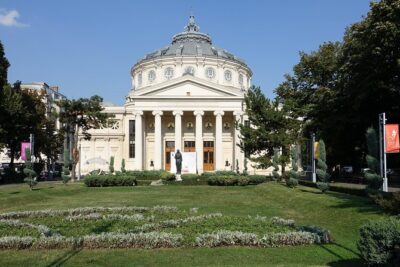
Your guide uses the square to explain the political setting before leading you toward the buildings around it. You will see the former Royal Palace, now associated with the National Museum of Art, and the Romanian Athenaeum, Bucharest’s principal concert hall. The Athenaeum is one of the city’s architectural highlights, so it is worth taking a moment to look closely rather than simply ticking it off as another stop.
The Athenee Palace Hilton adds a different kind of story. Built in 1914, the hotel was once a favored meeting place for spies. That detail gives the square a sense of international intrigue without requiring a theatrical presentation. Guides including Mara, Andrea, Elena, and Ioana have been praised for making these political and cultural subjects clear, lively, and easy to follow.
I would pay close attention here if you are new to Romanian history. The tour does not assume that you already understand the country’s monarchy, Communist period, or revolution. It gives you enough context to make later buildings and streets more meaningful.
More Walking Tours in Bucharest
- Bucharest: City Highlights Guided Walking Tour
★ 4.9 · 1,482 reviews - Bucharest Highlights Walking Tour
★ 5.0 · 469 reviews - Bucharest: Ghost Stories & Romanian Mythology Walking Tour
★ 4.9 · 287 reviews
Walking Victory Avenue past Bucharest’s grand façades
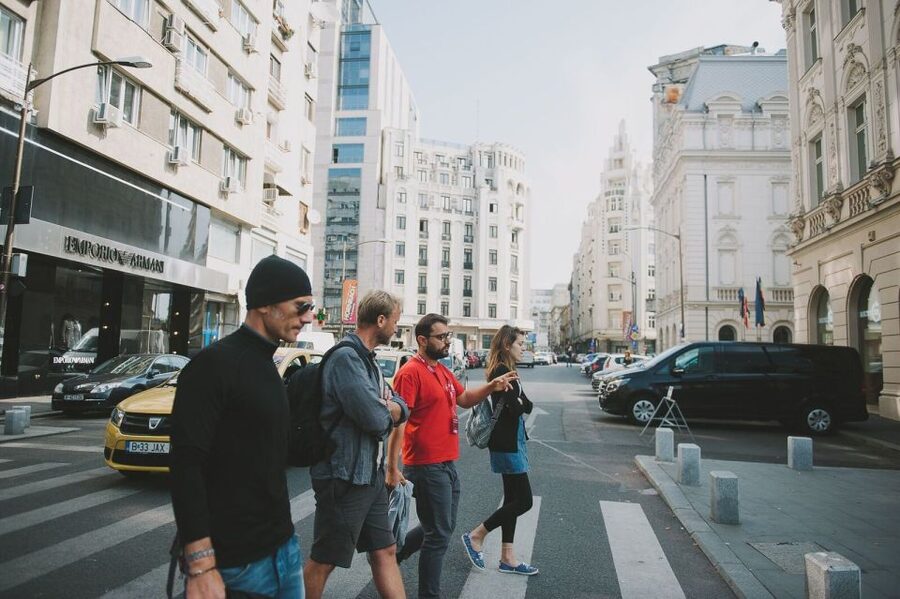
From Revolution Square, the route heads south along Calea Victoriei, or Victory Avenue. Its name refers to Romania’s victory in the 1877 War of Independence, and the road carries much of Bucharest’s architectural identity.
This section is useful because it shows how the capital looked toward Western Europe while retaining its own mixture of Romanian, Ottoman, French, and other influences. You pass palaces, museums, churches, and other notable buildings, with the guide explaining what you are seeing and why it matters.
Kretzulescu Church is one of the key stops. Its red-brick exterior and decorative details make it one of Bucharest’s best-known churches, but the value of seeing it with a guide is the surrounding context. Instead of only photographing the façade, you can learn how religious buildings fit into the changing city around them.
The walk is also where the tour’s format becomes clear. This is not a museum-heavy outing. You generally stop outside, listen, ask questions, and continue on foot. That keeps the route moving and lets you cover a wide part of central Bucharest, but it also means you should not expect extended time inside the Athenaeum, Royal Palace, or other buildings.
The walk is suitable for a first day in the city because it gives you a mental map. After three hours, you should understand how Revolution Square, Victory Avenue, and the Old Town relate to one another. Several guides have also offered practical suggestions about where to eat and what else to see, which can make the tour useful beyond its scheduled route.
Entering Old Town through medieval Bucharest
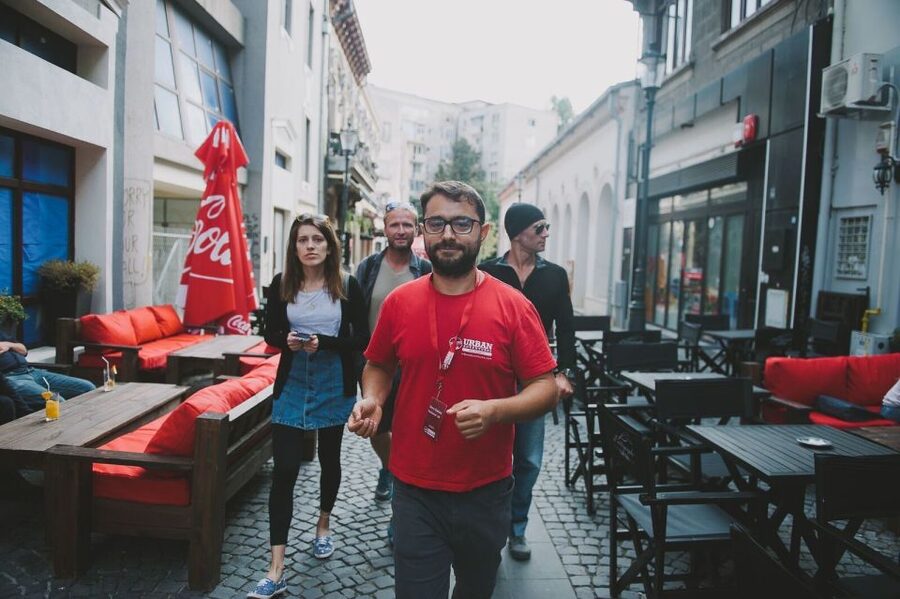
The Old Town is the most atmospheric portion of the walk. Its narrow, winding streets recall Bucharest’s earlier role as a meeting point between East and West. Ottoman pashas, Transylvanian princes, merchants, and local officials all passed through this part of the city.
Today, the same streets hold bars, cafés, shops, and restaurants. That contrast is part of the appeal. You are not seeing a preserved medieval quarter untouched by modern life. You are walking through a historic center that remains one of Bucharest’s main places for eating, drinking, and meeting friends.
The route helps you look past the modern signs and crowded storefronts. The guide points out buildings and stories that are easy to miss when you walk through Old Town alone. If you have only a short stay in Bucharest, this is a practical way to gain a sense of the area before returning later on your own.
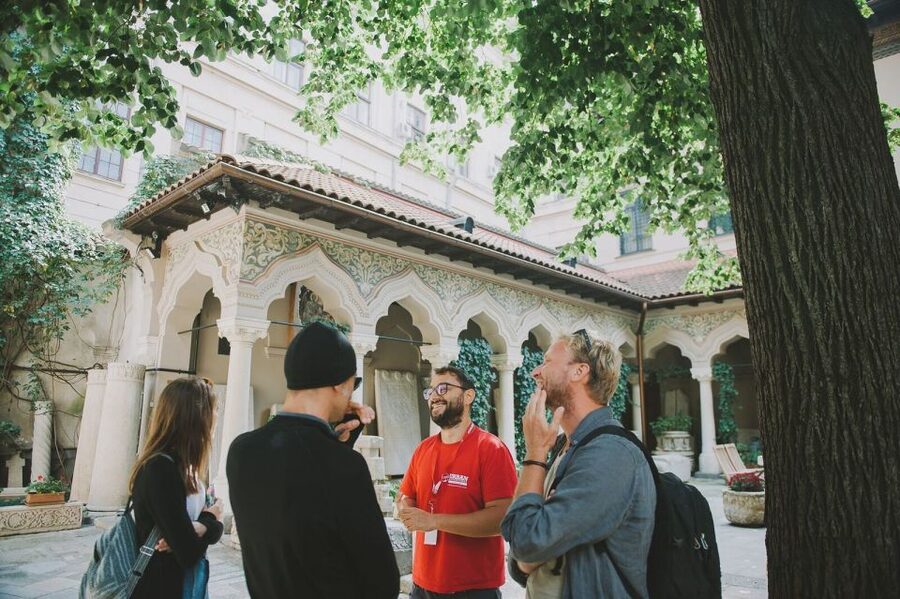
One of my favorite planned pauses is Stavropoleos Monastery. Its courtyard offers a quieter setting within the busy center, with attractive stonework and carved wooden details. You get a brief change of pace here, and the stop shows that Old Town is more than nightlife and restaurants.
Hanul Lui Manuc provides another look at the past. This large wooden inn is tied to the old commercial life of the city and gives you a better idea of how travelers and merchants once moved through Bucharest. It is a useful counterpoint to the grand palaces along Victory Avenue. There, the focus is on power and national identity. Here, you see trade, lodging, and everyday movement.
Expect uneven or cobbled surfaces in parts of the historic center. Comfortable shoes are essential, and sunscreen plus a hat or other head covering are sensible in summer. The walk is three hours, so even a small footwear problem can become irritating by the end.
Carturesti Carusel and the Romanian covrig
The tour includes two lighter moments that help balance the political and architectural material.
Carturesti Carusel is a beautiful bookstore in the Old Town. Its elegant interior makes it a memorable stop even if you are not shopping for a book. I like this part of the route because it shows present-day Bucharest as a creative, modern city rather than only a capital defined by its past.
You also receive a traditional covrig. Think of it as a Romanian soft pretzel, a common street snack that is simple, portable, and easy to try during a walking tour. The snack is included, but additional food and drinks are not. If you want a full meal, coffee, or dessert, plan to pay separately.
This is a small inclusion, but it matters. A local snack gives you a taste of daily life without turning the walk into a formal food tour. At the same time, you should book this experience for its city history and walking route, not for a large meal. One older booking record described a coffee and other food arrangements instead of the expected food sampling, so I would treat the included covrig as the defined food element and confirm any broader tasting expectations before booking.
A different sort of day out, same corner of Romania:
- Bucharest: Palace of Parliament Tickets and Guide
★ 4.3 · 3,182 reviews - Bucharest: Palace of Parliament Tickets and Guided Tour
★ 4.4 · 1,877 reviews - Bucharest: Parliament Palace Skip-the-line Ticket
★ 4.2 · 1,518 reviews - Taste Bucharest: A Food Lover’s Tour of Markets & Neighbourhoods
★ 5.0 · 689 reviews
Finishing at Vlad Tepes’s Old Princely Court
The route ends in front of the ruins of the Old Princely Court. The site dates to the 15th century and is linked with Vlad Tepes, the ruler who became the inspiration for Dracula.
The Dracula connection attracts attention, but the real value is historical. Vlad Tepes was a ruler of Wallachia, and his former residence ties the popular legend to a specific place in Bucharest. The ruins give you a final reminder that the city’s past is not only royal and Communist. It also reaches back to the medieval principality that shaped the region.
Ending here works well. You finish in the Old Town, where you can continue exploring, stop for food, or return to a building that caught your attention earlier. The guide can also offer suggestions for what to do next. Andrea, Mara, Helena, and several other guides have been praised for answering questions and sharing restaurant or sightseeing tips.
Do not expect a complete visit to every part of the archaeological site. The tour is designed around seeing the area and understanding its place in Bucharest’s story. If you want a detailed archaeological visit, you may need to return separately and allow more time.
Guide quality and group size
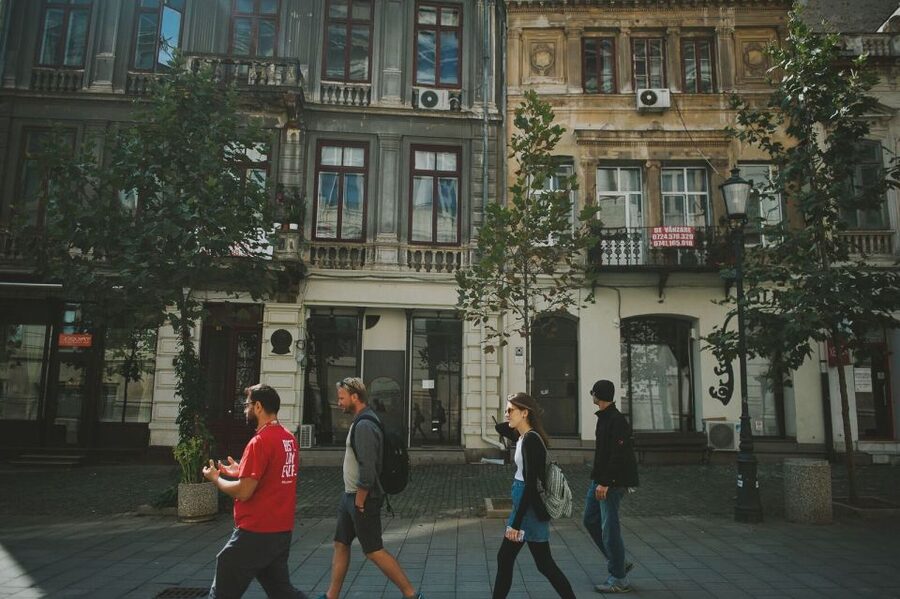
The experience uses a live English-speaking guide, and the group is capped at 12 people. That limit is important on a city walk. You are more likely to hear explanations clearly, ask questions, and keep the group together in busy streets.
The strongest pattern across the guide feedback is clear communication and an easy, friendly manner. Mara has been singled out for engaging explanations and practical photos. Andrea has guided small groups and solo participants, while Elena, Ioana, Helena, Adrian, Alex, and others have been praised for explaining Romanian politics, culture, and history in accessible English.
The quality of a walking tour depends heavily on the individual guide, so the experience may vary in style. Some guides may lean toward political history, while others may spend more time on buildings, local customs, or food advice. The route remains the same, but the conversation will not be identical each time.
A small group also means the walk can feel more personal. One person received a particularly tailored experience when the scheduled group was very small. That is not something you should count on, but the maximum of 12 keeps the format more intimate than a large coach-style city tour.
Is $53 a fair price for three hours?
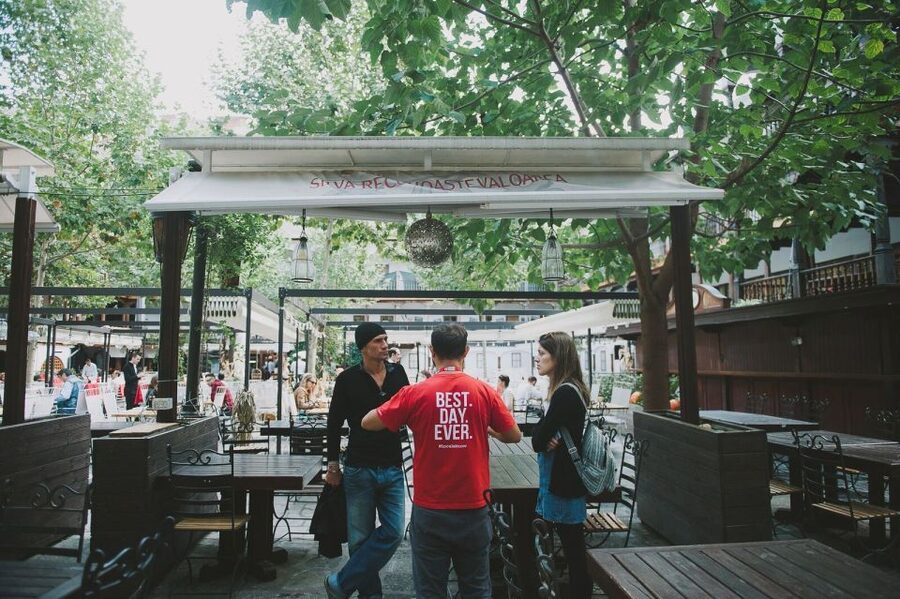
At $53 per person, this is not the cheapest way to stroll through Bucharest. You can walk many of these streets independently for free. The price makes more sense if you value the guide’s explanations, the organized route, the small group, and the included snack.
I see the best value for a first visit. You are not simply paying to be led from one monument to another. You are getting the political background of Revolution Square, the architectural context of Victory Avenue, the medieval and commercial stories of Old Town, a covrig, and a clear ending at Vlad Tepes’s court.
The tour is also useful early in a city break. It gives you restaurant suggestions, points out places you might otherwise miss, and helps you decide which buildings or neighborhoods deserve a return visit. One three-hour walk cannot cover all of Bucharest, but it can prevent you from spending your limited time without a plan.
If you already know central Bucharest well, the value is lower. You may prefer a museum visit or a more specialized food experience. The one lower-rated account still found the guide informative but felt that some sights could have received more attention because of time. That is a fair limitation of a fixed three-hour route.
Who should book this Bucharest walk?

I would recommend this tour to first-time visitors, couples, solo travelers, and families with children aged six and older who want a clear introduction to central Bucharest. Children under six can join free, provided you inform the operator when booking. The route combines stories, buildings, a snack, and short pauses, which is easier for families than a long indoor lecture.
It also suits anyone who wants history explained in plain English. You will hear about Romania’s monarchy, Communist government, revolution, medieval rulers, churches, trade, and modern city life in one compact outing.
I would be more cautious if you dislike walking on uneven streets, need frequent indoor seating, or want substantial time inside museums and historic buildings. The tour covers ground, and summer sun can be intense. Wear comfortable shoes, use sunscreen, and bring something to cover your head.
Cancellation is free up to 24 hours before the start, and you can reserve while paying later, which gives you some flexibility when arranging a city break.
Final verdict: a strong first look at Bucharest
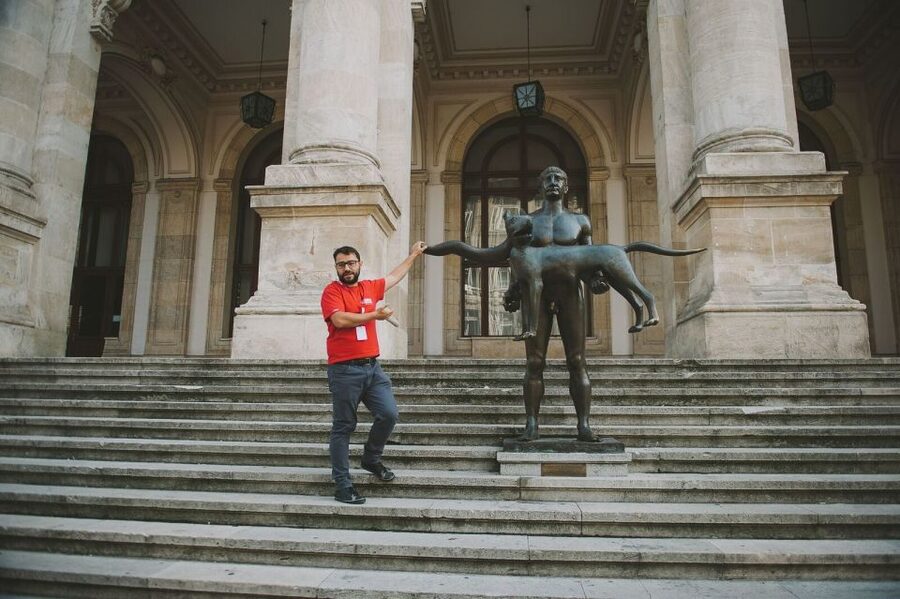
Book this tour if you want Bucharest explained as a living city, not just photographed as a set of landmarks. The route is well chosen: Revolution Square supplies the modern political drama, Victory Avenue brings in royal and architectural Bucharest, Old Town adds medieval streets and everyday life, and Vlad Tepes’s court provides a memorable finish.
I especially value the small details, from the spy stories at the Athenee Palace Hilton to the quiet courtyard at Stavropoleos and the covrig eaten along the way. The drawback is limited time. You will see many important places, but you will not explore each one in depth.
For a first day in Bucharest, the combination of a maximum 12-person group, local English-speaking guide, practical advice, and a broad central route makes the $53 price reasonable. If you want a relaxed introduction with history, architecture, and a few local touches, this is a good choice.
FAQ
Where does the Bucharest walking tour begin?
The tour begins in Revolution Square, in front of the statue of King Carol I. It is the only horse statue in the square.
How long does the tour last?
The walking tour lasts three hours.
What language is the tour in?
The tour is conducted in English by a live local guide.
What places do you see on the route?
The route includes Revolution Square, the former Royal Palace, the Romanian Athenaeum, Athenee Palace Hilton, Victory Avenue, Kretzulescu Church, Bucharest’s Old Town, Stavropoleos Monastery, Hanul Lui Manuc, Carturesti Carusel, and the Old Princely Court.
Is a snack included?
Yes. You receive a traditional covrig, a popular Romanian snack similar to a soft pretzel.
Are other food and drinks included?
No. Additional food and drinks are not included.
Is the tour suitable for children?
Yes. Children aged six to 11 can join at the listed child rate. Children under six can join free, but you must mention them when booking.
How large is the group?
The group has a maximum of 12 people.
What should I bring?
Bring comfortable shoes, sunscreen, and something to cover your head, especially in summer when the sun can be intense.
Can I cancel for a full refund?
Yes. You can cancel up to 24 hours in advance for a full refund.
More Three-Hour Outings in Bucharest
- 3-Hour Guided Tour of Communist Bucharest
★ 4.9 · 303 reviews - Bucharest: 3-Hour Dark History Tour with a Local
★ 4.9 · 301 reviews - Bucharest: Alternative Sightseeing 2.5-3h-Hour Guided Tour
★ 4.9 · 80 reviews - Bucharest: Relics of Communism 3-Hour Walking Tour
★ 4.9 · 77 reviews
Newest Bucharest trips on the site
- Winery touring & private wine tasting – one day private tour★ 5.0 · 3 reviews
- Bucharest: Dealu Mare Winery Private Trip with Wine Tasting★ 4.9 · 6 reviews
- Village Museum Bucharest Guided Tour★ 5.0 · 6 reviews
- Private Transfer from Giurgiu Port to Bucharest★ 4.5 · 12 reviews
- Airport Henri Coanda (Otopeni) to Bucharest – Private Transfer – Driver★ 5.0 · 5 reviews
- Salt Mine Tour from Bucharest with Entrance Ticket★ 4.5 · 19 reviews
- Wine tasting in Bucharest Old town – bonus cheese platter★ 4.5 · 6 reviews
- Walking tour of Bucharest★ 5.0 · 3 reviews
Walking Tours, compared.

Ghost Stories & Romanian Mythology Walking Tour
Read our review →
Walking Tour- Delightful Bucharest (Highlights, Stories, Sights)
Read our review →
Browse the lists this tour appears in