
Reviewed · HISTORICAL TOURS
Bucharest: 3-Hour Dark History Tour with a Local
Bucharest’s dark past is not tucked away in a museum. It is written into cemetery sculptures, revolution bullet holes, former brothels, and city squares where people faced tanks and secret police. This three-hour tour connects those places with stories about the Vampire of Bucharest, interwar prostitutes, communist prisons, and the bloodshed of 1989.
I especially like Bellu Cemetery, where funerary art gives the tour a haunting visual center, and the way the guide links small details to major events. Guides such as Alex, Elena, Andra, Vlad, Irina, and Bogi have been praised for bringing in architecture, folklore, personal memories, street art, and local food advice.
The main consideration is the pace and subject matter. You will walk a lot, spend time outdoors, and hear about murder, torture, political violence, and hardship. In cold weather, bring more layers than you think you need.
Key points at a glance
- Six cemeteries on one street: Begin with a remarkable concentration of burial grounds, including Bellu, the Jewish Cemetery, the Russian Soldiers Cemetery, and the cemetery for victims of the 1989 Revolution.
- Bellu Cemetery’s carved stories: Explore a national historical monument filled with elaborate tombs, sad love stories, folklore, mysteries, cats, and cemetery dogs.
- University Square and Revolution Square: See two places tied to the fall of communism, student protests, shootings, and the public face of Ceaușescu’s dictatorship.
- A broader view of Bucharest: Add interwar sex work, architecture, Romanian beliefs, and the 1970s serial killer known as the Vampire of Bucharest.
- A small-group city walk: The group is capped at 12, with an English-speaking local guide, metro tickets, and a traditional street snack included.
- A serious tour with an informal feel: The best guides, including Alex, Elena, Andra, and Vlad, explain difficult subjects in a friendly, conversational way.
Why this dark history tour is different
Many first visits to Bucharest focus on grand boulevards, the Old Town, and the Palace of Parliament. This tour takes a less polished route. It asks you to look at the city through death, fear, political repression, crime, and survival.
That does not mean three hours of grim facts delivered in a flat voice. The experience appears designed around storytelling. A guide may point out bullet holes, an overlooked piece of street art, a building detail, or local plants before explaining its place in the city’s story. That approach helps you understand Bucharest as a lived-in city, not just a collection of monuments.
I like that the subjects are varied. You move from ornate graves to revolution sites, from interwar nightlife to communist torture methods. The links are not always obvious at first, but together they show how Bucharest changed from Little Paris to a tightly controlled communist capital and then into the uncertain city that followed 1989.
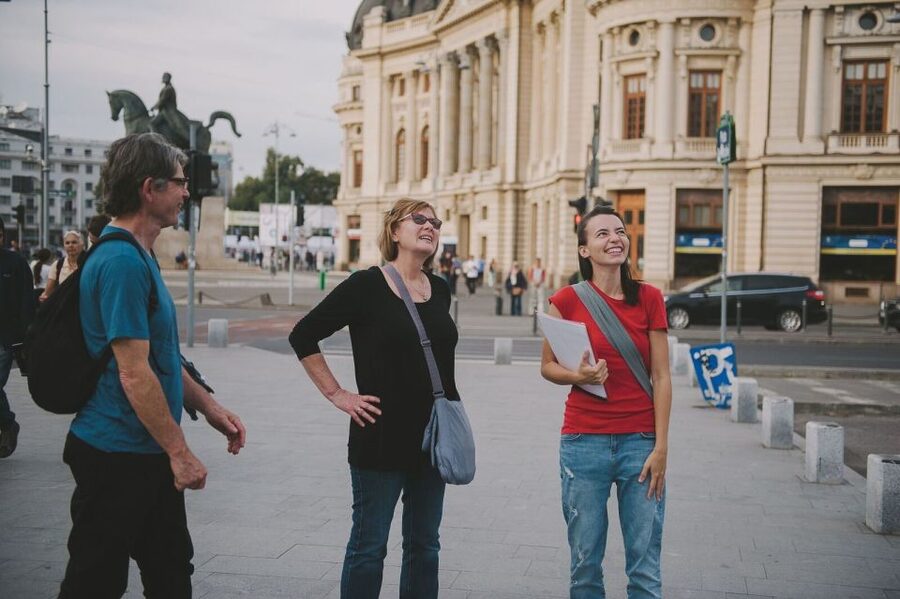
The tour is limited to 12 people. That matters here. The subject calls for questions, and the strongest guides are praised for adjusting the walk to the group’s interests. If your guide is Alex, you can expect extra attention to architecture and small visual details. Elena is often described as warm, engaging, and especially good at connecting local life with history. Andra is praised for clear explanations and humor, while Vlad is known for adding personal stories and sometimes extra time.
Guide assignments can vary, so you should not book on the assumption that a particular person will lead your walk. Still, the repeated praise for several guides is reassuring. The experience depends heavily on the person telling the story, and this tour appears to take that part seriously.
More Historical Tours in Bucharest
- Bucharest: Small Group History, Art & Secrets Tour
★ 4.7 · 152 reviews - Guided Walking Tour of Historical Bucharest
★ 5.0 · 84 reviews - Bucharest Jewish Heritage | Holocaust Memorial | Private Car Tour
★ 5.0 · 38 reviews
From the National Theatre to a street of cemeteries
The meeting point is the main entrance of the Ion Luca Caragiale National Theatre at Bulevardul Nicolae Bălcescu 2. This is central and easy to identify, but give yourself enough time to find the correct entrance rather than arriving at the last second.
From there, the tour heads toward a street with at least six cemeteries. That fact alone gives the opening a strange, memorable quality. Instead of treating burial grounds as isolated sights, the guide uses the whole area to show how Bucharest has layered different communities and periods of history in a small space.
Among the burial grounds are the Cemetery of the Victims of the Revolution in 1989, the Jewish Cemetery, the Cemetery of the Russian Soldiers, and Bellu Cemetery. Each points to a different part of the city’s past. The 1989 cemetery recalls the human cost of the uprising. The Jewish cemetery reflects a community and its place in Bucharest. The Russian soldiers’ graves point to military history and foreign influence.
You do not visit every cemetery in depth. Bellu is the main stop. Still, seeing the others helps set the tone before you enter it.
This section also shows why comfortable shoes matter. The walk is not a short stroll between postcard sights. You will spend time standing while the guide talks, then continue on foot through several parts of the city.
Bellu Cemetery, where stone becomes storytelling
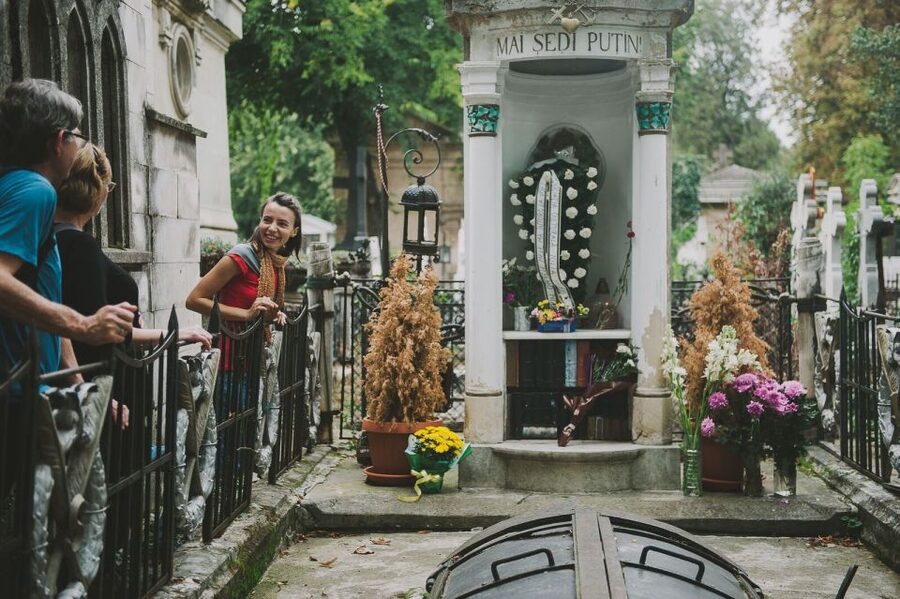
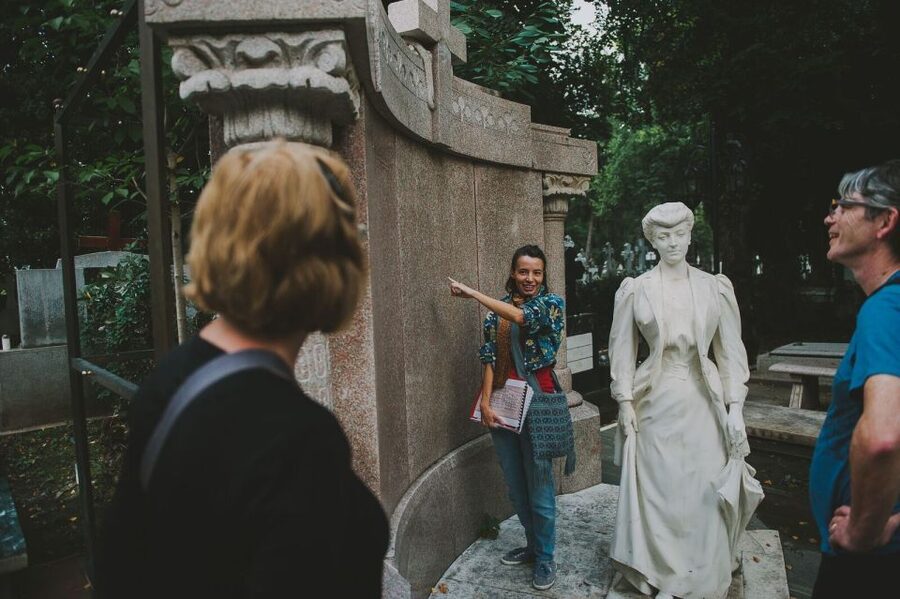
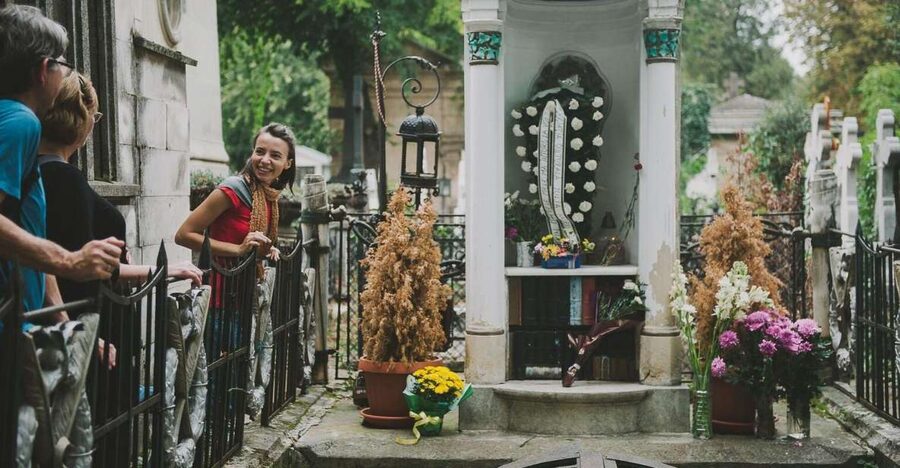
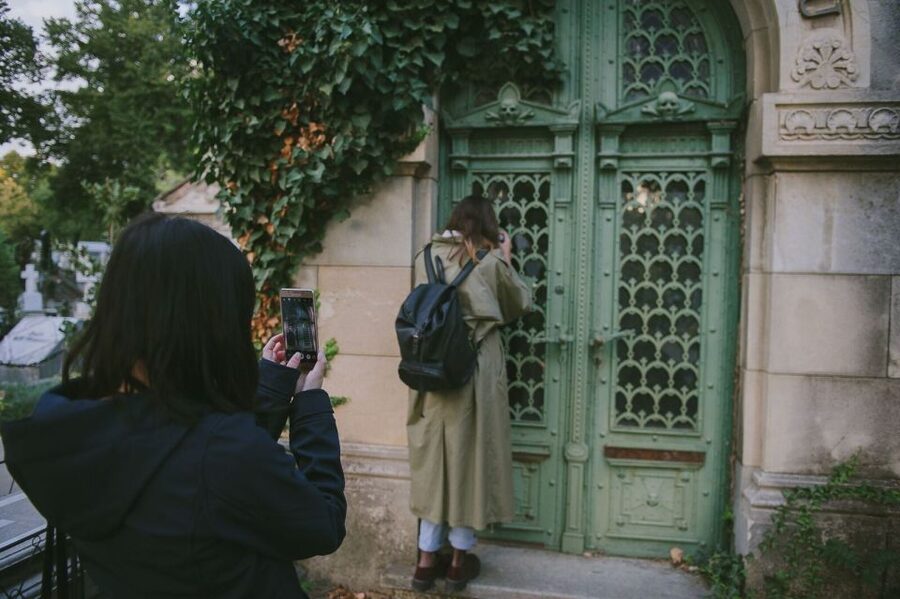
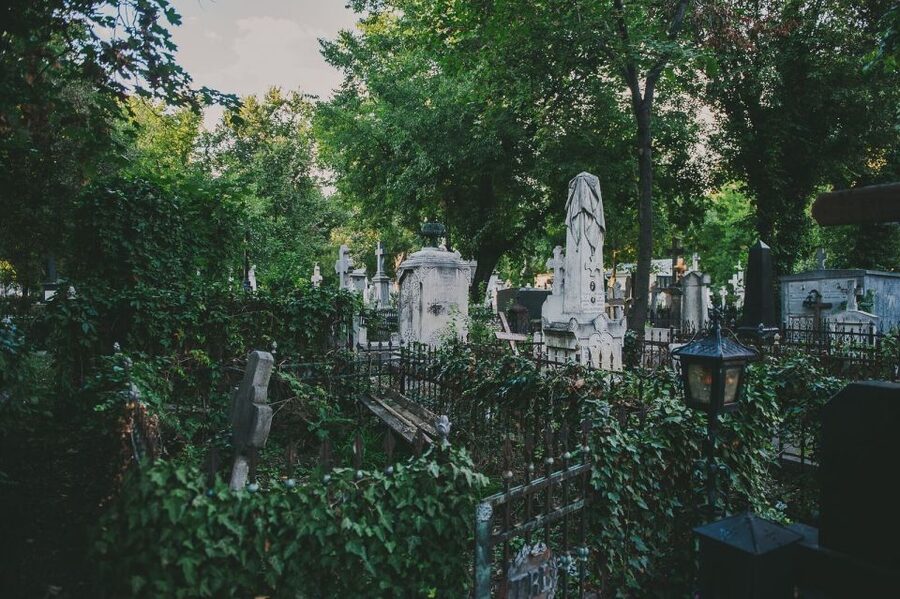
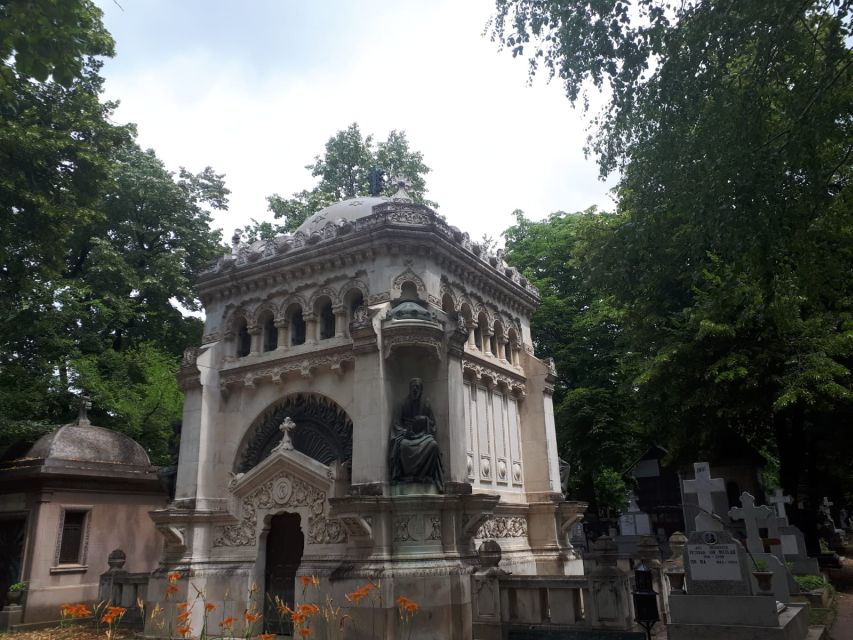
Bellu Cemetery is the tour’s strongest stop. It is a national historical monument, but that label does not fully describe the experience. Inside, you find elaborate tombs, carved figures, family monuments, and funerary architecture that can feel closer to an outdoor gallery than an ordinary cemetery.
The guide brings the place to life through individual stories. Expect sad love stories, unsettling mysteries, folklore, and accounts connected with notable figures. You are not simply looking at old graves and trying to guess what they mean. The explanations give the sculptures and mausoleums a human setting.
This is also where the tour’s dark mood works best. The setting is naturally quiet and reflective, but the storytelling keeps it from becoming solemn in only one way. Some tales are tragic, some strange, and some almost theatrical. Romanian beliefs about death and local customs may also come into the discussion.
Several guides have a fondness for the animals living around the cemetery. You might see cats or cemetery dogs, and some guides, including Elena, have been praised for caring for them and bringing food or treats. That is a small detail, but it adds warmth to a place that could otherwise feel relentlessly grim.
Allow yourself to slow down here. The cemetery is probably the portion you will remember most clearly, especially if you enjoy architecture, sculpture, folklore, or unusual city stories. The drawback is that the ground may not always feel easy underfoot, and the open setting can be chilly. In winter, the cold becomes more noticeable while you are listening rather than walking.
University Square and the bloodshed of 1989
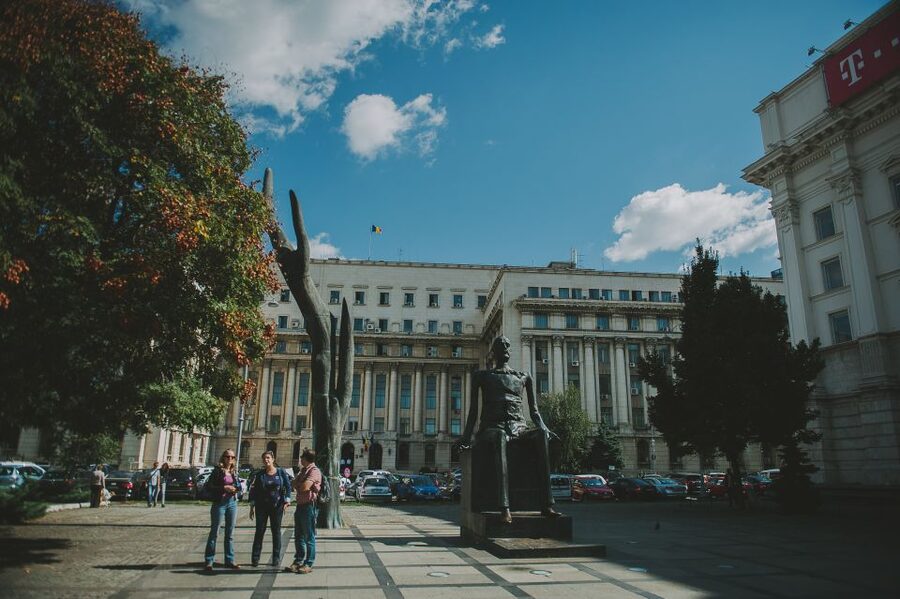
After Bellu Cemetery, the tour shifts from older death stories to modern political violence. University Square is one of Bucharest’s key public spaces, and the guide explains its role in the 1989 Revolution and the anti-communist student protests of the 1990s.
This is an important change of scale. At Bellu, the past is carried by individual graves. At University Square, the focus is on crowds, public anger, state power, and the danger of gathering in the open. You begin to see how a square can become a stage for resistance, but also a target.
The discussion may include the events that brought down Nicolae Ceaușescu’s regime and the unrest that followed. The tour does not treat the Revolution as a clean, simple story with an obvious ending. It focuses on the violence and confusion surrounding the period, helping you understand why 1989 remains such a powerful subject in Romania.
This is one of the places where a local guide makes a real difference. Dates and political names can be found in books, but a guide can explain how the events shaped ordinary life and how Romanians remember them. Guides have also been praised for answering questions about culture, language, architecture, and daily life rather than sticking to a memorized script.
More history tours around Bucharest:
- Private Bucharest: History & Food with Traditional Meal
★ 5.0 · 34 reviews - Bucharest Historical Food Tour in Old Center
★ 5.0 · 21 reviews - Half-Day Jewish Heritage Walking Tour in Bucharest
★ 5.0 · 20 reviews - Private Tour – Food, Culture, History & Traditions
★ 5.0 · 18 reviews
Interwar Bucharest, brothels, and the Vampire of Bucharest
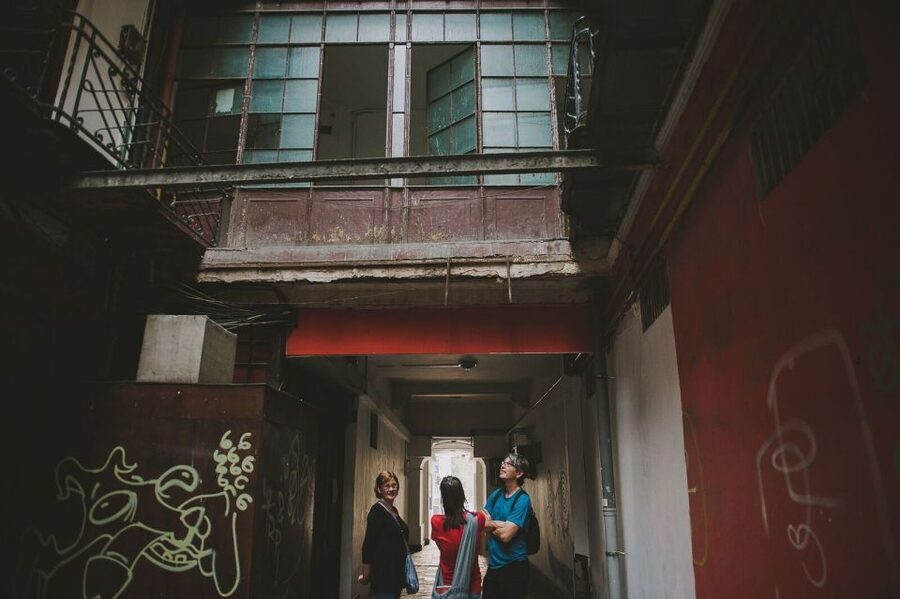
The tour then jumps back to the Little Paris era, when Bucharest had a more sophisticated interwar image. Here, the darker subject is the sex trade and the city’s former brothel culture.
You will get a glimpse of what remains of an interwar brothel rather than a polished attraction devoted to the subject. That is part of the appeal. The stop gives you a way to think about how people worked, socialized, and survived in a city that is often remembered only for elegant architecture and café culture.
The guide also tells the story of a serial killer who terrorized Bucharest in the early 1970s. He was nicknamed the Vampire of Bucharest. The story adds a true-crime thread, but the larger value is the way it places crime inside the city’s changing social and political setting.
If you enjoy spooky tales, this section will probably suit you. If you prefer a purely architectural tour, it may feel like a sharp turn. The subject matter is adult in tone, which is one reason children under 16 cannot join.
Revolution Square and the machinery of communist fear
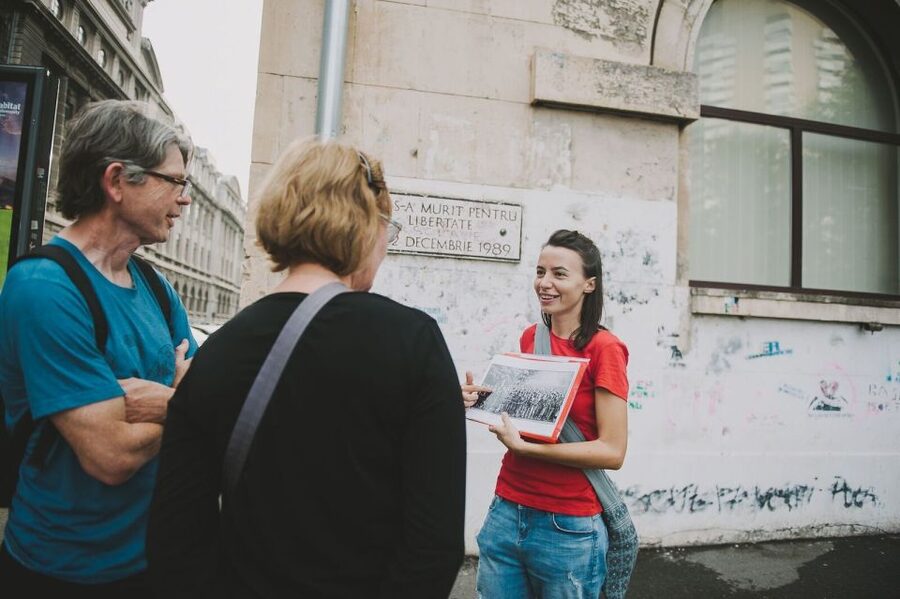
The final major setting is Revolution Square, identified as the place where the 1989 Revolution began in Bucharest. This is where the tour gathers its political threads and explains the institutions that kept Romanian society under control.
Expect discussion of communist prisons, labor camps, torture methods, and the Securitate, Romania’s secret police. You will also hear about Ceaușescu’s dictatorship and the daily pressure placed on people who wanted to avoid attracting official attention.
This section is not only about dramatic acts of violence. It is also about ordinary hardship. The tour explains how people managed day to day under a system shaped by fear, shortages, surveillance, and political silence. That focus is valuable because it moves beyond famous leaders and gives you a clearer sense of what dictatorship meant at street level.
The tone here may be more serious than at the cemetery or the interwar stop. That is appropriate. You are dealing with living memory, and some guides add personal experiences of life under communism. Vlad, for example, has been praised for offering personal insight alongside the broader historical account.
Look around the square while you listen. The buildings and open space are part of the lesson. Political history in Bucharest is not sealed in a distant museum. It happened in places where people still meet, cross the street, and go about daily business.
Walking, metro rides, and the three-hour format
The tour lasts three hours, but it covers several parts of Bucharest. Metro tickets are included, and public transport helps connect the stops without turning the entire experience into one long walk.
Do not mistake the metro for a break from walking. You should still expect a substantial amount of time on your feet. One guide described the route as a long walking tour, while others regularly paused to keep the group comfortable. Wear supportive shoes and dress for the forecast.
The outdoor format has clear advantages. You see the city between the headline sights, notice local details, and get a better feel for distance and neighborhood changes. It also has limits. If rain, snow, or strong cold arrives, the tour can feel harder because many explanations happen outside.
Winter visitors should wrap up warmly. Cold weather makes standing still surprisingly uncomfortable, even when you are interested in the story. A small bottle of water is sensible, although a traditional Romanian street snack is included and additional food and drinks are not.
The tour ends with more than a list of facts. Several guides are also happy to offer food, café, and restaurant suggestions for the rest of your stay. That can be useful early in a Bucharest visit, when you are still deciding what to eat and where to go next.
Is $55 a fair price?
At $55 per person, this is not the cheapest way to spend three hours in Bucharest. The value depends on what you want from a city tour.
You are paying for a small group capped at 12, an English-speaking local guide, transportation between stops, a traditional snack, and a route that would be difficult to assemble on your own. Bellu Cemetery and the less obvious remnants of interwar Bucharest are not as straightforward to understand without context. The same is true of the Revolution sites, where a few plaques cannot explain the full political story.
The strongest value comes from the guide. Alex, Elena, Andra, Vlad, Irina, and others have been praised for making complex subjects easy to follow, adding personal anecdotes, and responding to individual questions. Some have also extended the experience or shared further material afterward, though you should treat that as a personal guiding style rather than a guaranteed inclusion.
If you want a quick orientation to major landmarks, choose a standard city tour instead. If you want unusual stories, modern Romanian history, architecture, and a local explanation of why certain places matter, the price is easier to justify.
The flexible booking terms help too. You can cancel up to 24 hours ahead for a full refund, and reserve now while paying later. Keep in mind that these are booking conditions, not a substitute for checking the available starting time before you commit.
Who should book this experience?
I would choose this tour if you have already seen the obvious center of Bucharest or if you want a first tour with a sharper edge. It suits adults and older teenagers who are comfortable with stories of murder, torture, political imprisonment, and death.
It is especially good for you if you enjoy:
- Cemetery art and unusual architecture
- Romanian communism and the 1989 Revolution
- Local folklore and ghostly stories
- True crime presented in a historical setting
- Small groups and plenty of questions
- A guide who can suggest food and other places to explore
I would skip it if you want a gentle sightseeing walk, dislike extended time outdoors, or prefer a tour centered on palaces and famous buildings. The experience is also not suitable for anyone under 16.
Should you book the Bucharest Dark History Tour?
Book it if you want to understand Bucharest through the stories that official sightseeing often leaves out. Bellu Cemetery is the main reason to go, but the Revolution squares, interwar sex-work history, and account of the Vampire of Bucharest give the afternoon real range.
The best preparation is simple: wear comfortable shoes, dress warmly in cold weather, and arrive ready for serious subjects. If you enjoy a guide who explains small details and welcomes questions, this is a strong use of three hours and a useful way to see the city beyond its standard route.
FAQ
How long does the Bucharest Dark History Tour last?
The tour lasts three hours.
What language is the tour conducted in?
The tour is conducted in English by a live local guide.
Where does the tour meet?
The meeting point is at the main entrance of the Ion Luca Caragiale National Theatre, Bulevardul Nicolae Bălcescu 2, Bucharest.
What places are visited?
The tour includes Bellu Cemetery, University Square, Revolution Square, a street with several cemeteries, and a former interwar brothel site.
Is Bellu Cemetery included?
Yes. Bellu Cemetery is one of the main stops and is a national historical monument with funerary architecture and stories connected with local history and folklore.
Are metro tickets included?
Yes. Metro tickets are included in the tour price.
Is food included?
A traditional street snack is included. Additional food and drinks are not included.
Can children join the tour?
No. Travelers under 16 are not permitted to join.
How large is the group?
The maximum group size is 12 people.
More Three-Hour Outings in Bucharest
- 3-Hour Guided Tour of Communist Bucharest
★ 4.9 · 303 reviews - Bucharest: Alternative Sightseeing 2.5-3h-Hour Guided Tour
★ 4.9 · 80 reviews - Bucharest: Relics of Communism 3-Hour Walking Tour
★ 4.9 · 77 reviews - Bucharest: 3-Hour Walking Tour
★ 4.9 · 77 reviews
Newest Bucharest trips on the site
- Winery touring & private wine tasting – one day private tour★ 5.0 · 3 reviews
- Bucharest: Dealu Mare Winery Private Trip with Wine Tasting★ 4.9 · 6 reviews
- Village Museum Bucharest Guided Tour★ 5.0 · 6 reviews
- Private Transfer from Giurgiu Port to Bucharest★ 4.5 · 12 reviews
- Airport Henri Coanda (Otopeni) to Bucharest – Private Transfer – Driver★ 5.0 · 5 reviews
- Salt Mine Tour from Bucharest with Entrance Ticket★ 4.5 · 19 reviews
- Wine tasting in Bucharest Old town – bonus cheese platter★ 4.5 · 6 reviews
- Walking tour of Bucharest★ 5.0 · 3 reviews
Historical Tours, compared.
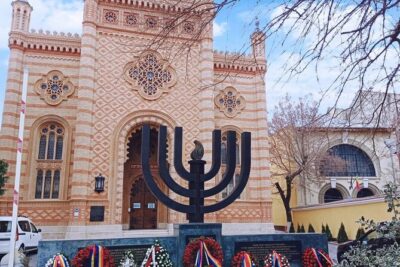
Bucharest Jewish Heritage | Holocaust Memorial | Private Car Tour
Read our review →
Private Bucharest: History & Food with Traditional Meal
Read our review →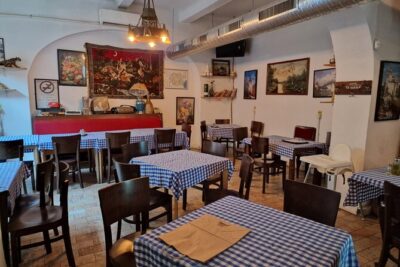

Discover Romania’s Wine Heritage in Brasov’s Historic Center
Read our review →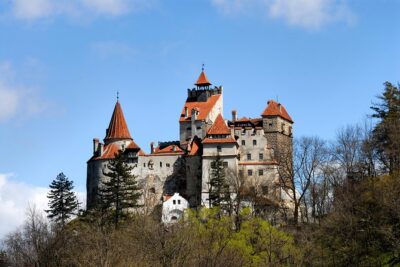
Experience the History of Bran Castle and Saxon Fortifications in Burzenland
Read our review →Browse the lists this tour appears in