
Reviewed · 7-DAY EXPERIENCES
7 days Private Romania Grand Tour from Bucharest
Romania reveals itself slowly on this long loop from Bucharest. You move from Saxon-built Transylvanian towns to Maramures wooden churches, Bucovina’s painted monasteries, dramatic mountain roads, and castles tied to Romanian kings and Dracula lore. I especially like the private format, since your guide can explain local customs and adjust the pace for your group.
I also like the chance to see corners of Romania that are awkward to connect by train, including Vadu Izei, Sucevita, Red Lake, and the Bicaz Gorges. Guides George and Liviu are named in the tour feedback, and the personal care provided by George was singled out. The main caution is the packed schedule, plus conflicting information about the number of nights and whether entrance fees are included.
Key points to know before booking
- Seven days of major sights: The route covers Bucharest, Sibiu, Cluj-Napoca, Maramures, Bucovina, Sighisoara, Brasov, Bran, and Sinaia.
- Private air-conditioned minivan: You travel with only your own group and a driver-guide.
- Best cultural stops: The painted monasteries, Merry Cemetery, Surdesti Wooden Church, and Vadu Izei offer more than the usual castle circuit.
- Long driving days: Day 4 and Day 5, in particular, combine several stops with substantial road time.
- Check the price details: The headline price is $1,719.59 per person, but entrance fees are also listed as excluded.
- Confirm the duration: The title says seven days, the overview refers to eight days, and the included lodging says six nights.
A grand Romanian loop, with one important paperwork question
At $1,719.59 per person, this is not a cheap city break. It is a private, multi-region tour with hotel pickup and drop-off, private transport, a driver-guide, breakfast, and six nights of accommodation listed as included. That can be fair value if you want to cover a large part of Romania without arranging several hotels, road transfers, and local visits yourself.
Still, you should ask for a written cost breakdown before paying. The tour description says entrance fees are included in one place, while the exclusions clearly say entrance fees are not included. Many stops also show admission as not included. The same material gives three different signals about length: the title says seven days, the overview says eight days, and the lodging section includes six nights. These may be simple editing errors, but they affect your budget and hotel planning.
More week-long trips from Bucharest:
- 4×4 Driving Experience at Flying Altitudes – 7 Days
★ 5.0 · 13 reviews - Transylvanian week
★ 5.0 · 7 reviews - Amazing Romania – Seven day private tour from Bucharest
★ 5.0 · 7 reviews
Day 1: Cozia Monastery and the squares of Sibiu
Your first day heads toward the Olt Valley and Cozia Monastery, a fourteenth-century Wallachian monument founded by Mircea II the Old. The visit is short, about 30 minutes, but useful as an introduction to the religious and political past of the region.
Look for the Armenian-style decoration on the facade and the frescoed interior. The monastery was restored in the seventeenth century by the Cantacuzino family, so the site reflects several periods of Romanian history in a compact setting.
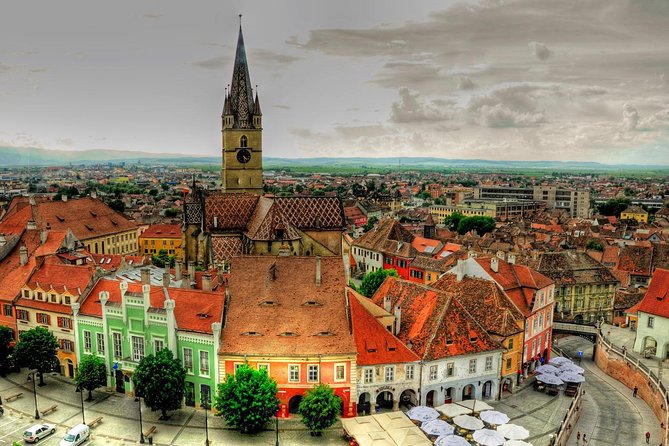
Sibiu gets the larger share of the day, with about three hours in the old center. This is one of the strongest urban stops on the route. Its Big Square, Small Square, and Huet Square create an easy walking circuit, while towers, old bastions, museums, and the famous houses with eyes give the city a distinctive look.
Sibiu also offers a useful lesson in Transylvania’s mixed past. Romanian, Saxon, Catholic, Orthodox, and Protestant traditions appear in the city’s churches and public spaces. The large Gothic Evangelical Church is one of the key sights.
Three hours is enough to get a good first look, but not enough for every museum. I would use the time for the central squares, the church area, and a relaxed meal rather than trying to see everything.
Day 2: Alba Iulia, Turda Salt Mine, and Cluj-Napoca
Alba Iulia is a brief historical stop. The city is linked to the creation of Greater Romania on December 1, 1918, just after the First World War. You have about an hour here, so expect an overview rather than a long museum visit.
The main event is Turda Salt Mine, where you descend roughly 400 feet underground. This is not simply an old mine with a few tunnels. Inside, you find an amphitheater, bowling alley, underground lake, paddle boats, rowboats, and a Ferris wheel.
The unusual scale makes Turda one of the tour’s most memorable stops. It also gives the day a change of pace after the historic streets of Alba Iulia. Allow three hours, and remember that admission is listed as not included.
Cluj-Napoca follows with a one-hour visit. The city is home to St. Michael’s Church, the statue group of King Matthias Corvinus, and a major university where lectures are held in several languages. Its Hungarian connections are an important part of the city’s character.
The drawback is time. Alba Iulia and Cluj-Napoca each receive short visits, while Turda gets three hours. If you care more about city life than underground attractions, this balance may feel uneven. If you want variety, it works well.
Day 3: Wooden churches and old mountain customs in Maramures
Day 3 moves into Maramures, one of the most distinctive areas on the route. At Surdesti, you visit a UNESCO-listed wooden church built in 1721 from oak logs. Its tower once made it the tallest wooden church in Europe, and the double-eaved roof is unusual for the Chioar area.
The church’s structure matters as much as its age. It shows how local builders created tall, finely detailed religious buildings without stone. Admission is listed as not included, so keep some money available for cultural sites.
Next comes Barsana Monastery, a wooden Orthodox complex with tall spires and a convent of sixteen nuns. The site is relatively recent compared with Surdesti, but it reflects the region’s older wooden building style.
At Vadu Izei, the subject changes from churches to everyday rural technology. You see a valtoare, a whirlpool mechanism driven by a fast stream. Water is guided through a wooden channel into a bowl-like structure used for washing laundry and other items. It is a small stop, yet it gives you a better sense of how mountain communities worked with natural water power.
This day is especially good for anyone who wants more than famous landmarks. The visits are short, but together they show religious design, village craft, and practical local life.
A few more Bucharest trips worth a look
- Bucharest: Palace of Parliament Tickets and Guide
★ 4.3 · 3,182 reviews - Bucharest: Palace of Parliament Tickets and Guided Tour
★ 4.4 · 1,877 reviews - Bucharest: Parliament Palace Skip-the-line Ticket
★ 4.2 · 1,518 reviews - Bucharest: City Highlights Guided Walking Tour
★ 4.9 · 1,482 reviews
Day 4: The Merry Cemetery and Bucovina’s painted monasteries
The Merry Cemetery at Sapanta is one of Romania’s most unusual cultural stops. More than 800 wooden crosses use bright images and verses to tell the stories of people buried there. The tone can be playful, blunt, and personal.
That combination of art and biography is the point. The cemetery does not treat death only as a solemn subject. It presents ordinary work, family life, habits, and final moments in a direct local style. Admission is not included.
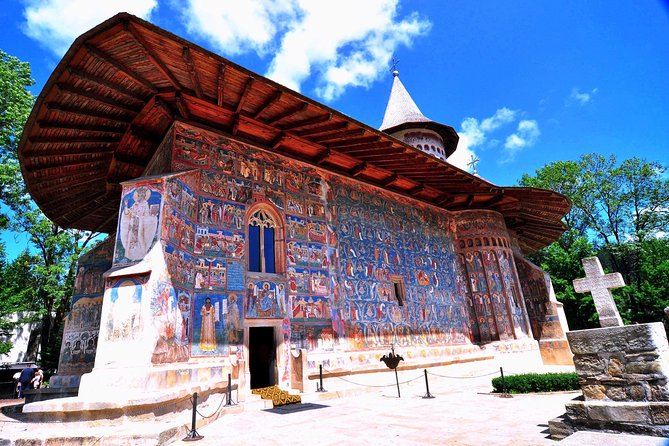
The route then turns toward Bucovina and the painted monasteries. Moldovita Monastery was founded by Petru Rares in the sixteenth century. Its exterior and interior frescoes are part of the region’s famous religious art, where Byzantine and Gothic influences meet local design.
Sucevita Monastery brings another variation. Founded by the Movila brothers in the seventeenth century, it is protected by walls that helped preserve the paintings on the northern facade. The combination of fortified architecture and religious imagery makes it different from a simple church visit.
At Marginea, you visit artisans who make black ceramics. The short 20-minute stop lets you see how the pots are made and gives you the chance to buy ceramics or painted eggs decorated in a Romanian style.
The final stop is Voronet Monastery, one of the best-known painted monasteries in Bucovina. The supplied description accidentally repeats the Vadu Izei whirlpool information here, so you should confirm exactly what you will see at Voronet. The monastery itself is clearly part of the planned route, but the written detail for this stop is unreliable.
This is a full day. The monasteries are spread out, and each visit involves standing, walking, and absorbing decorative detail quickly. I would bring water, wear comfortable shoes, and accept that you will not study every fresco at length.
Day 5: Bicaz Gorges, Red Lake, and a late arrival in Sighisoara
Piatra Neamt is a short stop, about 30 minutes. It is known as a ski resort and has links to a fifteenth-century citadel founded during the time of Stephen the Great. An eighteenth-century synagogue adds another layer to the city’s religious past.
The road then reaches the Bicaz Gorges. Cliffs rise beside a stream, and the road passes through a narrow mountain corridor. There is also a market selling handicrafts and souvenirs. The stop is brief, so your main reward is the view from the road and a chance to stretch your legs.
Red Lake formed after a landslide created a natural barrier. Tree trunks still rise from the water, giving the lake its unusual appearance. Local legends explain the name and add a story element to the visit.
You arrive in Sighisoara late in the evening, with only about 30 minutes listed for the initial stop. This is one of the itinerary’s hardest days because the route combines several mountain sights with a long transfer. The views help break up the drive, but you should not expect a leisurely mountain outing.
Day 6: Sighisoara, Bran Castle, and Brasov
Day 6 begins properly in Sighisoara’s historic center, a UNESCO-listed fortified town with colorful houses, churches, and the Clock Tower. Its connection to Vlad Dracula comes from the claim that Vlad was born here in 1431.
The town is compact and rewarding on foot. You have about two hours, enough to walk the main streets and see the clock tower area, but admission to listed attractions is not included. Sighisoara is one of the places where a guide adds real value, since the city’s Romanian, Saxon, and religious traditions overlap in a small space.
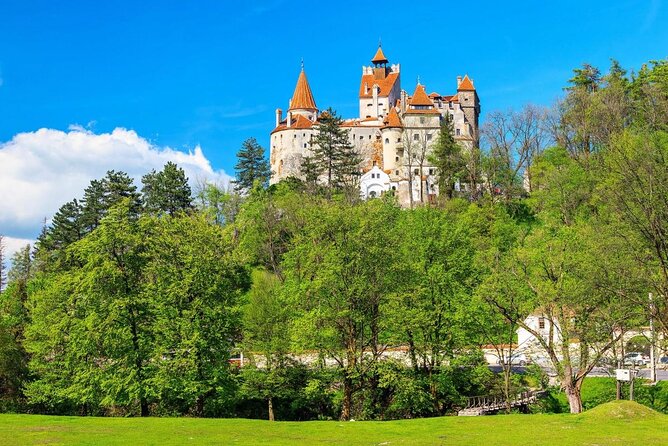
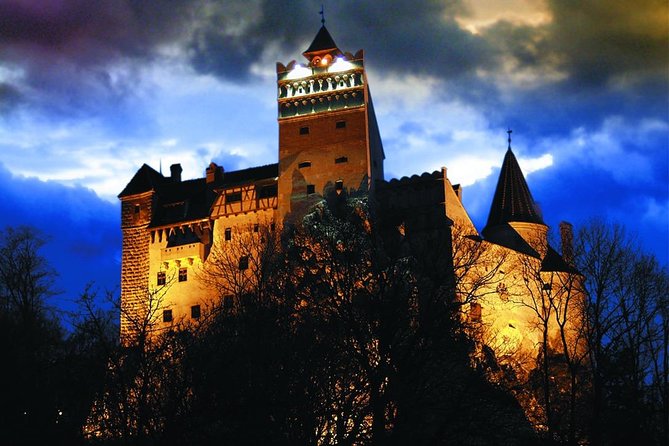
Bran Castle follows. Its Dracula reputation attracts attention, but the building’s original purpose was practical. It guarded a border route between Wallachia and Transylvania and served as a defensive stronghold for Brasov’s people.
Two hours allows time to explore the castle rather than simply photograph it. Admission is not included, and the castle can be busy, so keep your expectations focused on the building, its setting, and the Dracula connection rather than a direct link to the historical Vlad.
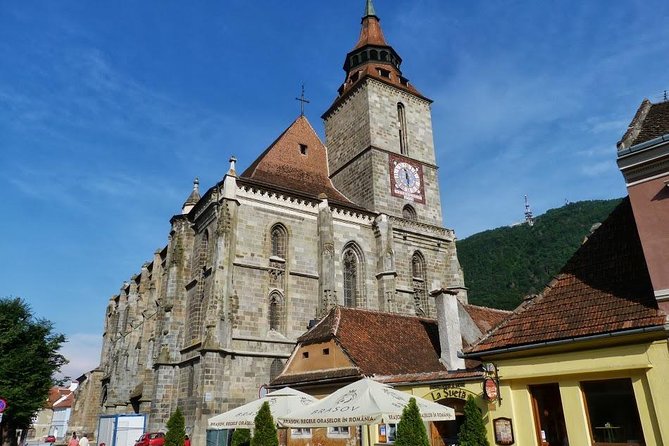
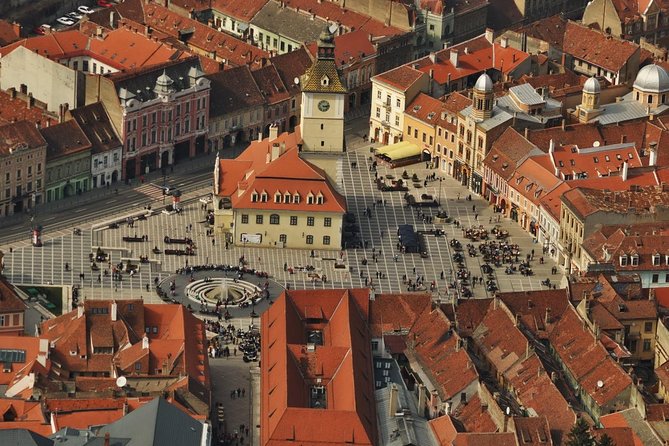
Brasov receives about three hours. The city combines German-style architecture with Gothic, Baroque, and Renaissance elements. You visit the Black Church and the First Romanian School in the Schei district, once the part of town inhabited mainly by Romanians.
Brasov is one of the tour’s best evening bases, but the schedule may leave little free time. If you want cafes, shops, or a slower look at the old streets, ask the guide how much of the three hours can be kept flexible.
Day 7: Peles Castle and a Bucharest overview
Peles Castle is the final major sight. Built as the summer residence of King Carol I, the castle was designed by a Czech architect and constructed between the nineteenth and twentieth centuries.
The interior is known for rooms that use different decorative styles. The Florentine room gives the tour an Italian Renaissance note, while the broader design reflects the ambitions of Romania’s first king. Two hours should give you a solid visit, although admission is listed as not included.
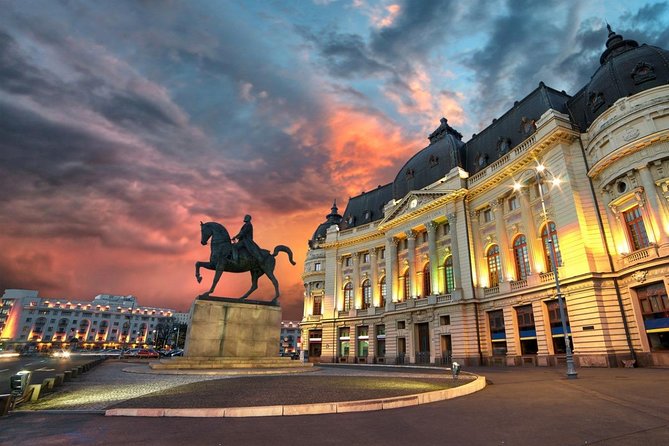
The route returns to Bucharest for a short panoramic tour. You see the Triumph Arch, the Romanian Athenaeum, Revolution Square, and the Parliament Palace. This is an overview, not a full city tour, so consider adding your own Bucharest time before or after the circuit if your schedule allows.
What the private format changes
A private tour is most useful here because the route crosses many regions and involves repeated short stops. You do not have to manage public transport between rural churches, mountain roads, and scattered monasteries.
You can also ask questions as they arise. A guide such as George or Liviu can connect the buildings and places to Romania’s changing borders, religious communities, royal period, and rural traditions. George was especially noted for helping with travel guidelines during a difficult period, while Liviu was praised for guiding the mountain roads, monasteries, and castles.
The tradeoff is that you are tied to one demanding route. A private vehicle does not make the distances shorter. It simply makes the connections easier.
Accommodation, meals, and extra costs
The package includes hotel pickup and drop-off, private transport, breakfast, a driver-guide, and accommodation described as six nights. Group discounts are offered, which may improve the per-person value for families or friends.
Breakfast is included, but other meals are not listed. Tips for the guide and driver are also excluded. A single-room supplement of 150 euros is payable locally by cash or card.
The biggest budget question is admission. Cozia, Sibiu, Alba Iulia, Cluj-Napoca, Vadu Izei, Piatra Neamt, Bicaz Gorges, Red Lake, and Bucharest are shown with free admission, but the salt mine, wooden churches, monasteries, Merry Cemetery, Sighisoara, Bran Castle, Brasov sights, and Peles Castle include fees or are explicitly marked as excluded.
Because the general description conflicts with the exclusions, confirm the exact ticket policy before booking. That one answer will tell you whether $1,719.59 feels reasonable for your group.
Who should book this Romania tour?
I would choose this trip if you want a broad first look at Romania and prefer a guide and private vehicle to independent planning. It suits people who enjoy churches, fortresses, regional customs, mountain roads, and historical explanation more than long periods of free time.
It is also a good match for families or friends who can share the vehicle and want a flexible private arrangement. The feedback attached to the tour includes strong praise from senior travelers, which suggests that the personal support can be useful on a demanding route.
I would hesitate if you want slow mornings, long meals, or several nights in each city. The schedule is ambitious, and some stops are short. I would also wait for clarification on the seven-day versus eight-day wording, the six-night lodging, and entrance fees.
FAQ
Is this a private tour?
Yes. Only your group participates, and transport is provided by private vehicle with a driver-guide.
Where does the tour start and finish?
The tour starts in Bucharest, with hotel pickup offered at 9:00 am, and returns to Bucharest for a panoramic city tour on the final day.
How long is the tour?
It is presented as a seven-day tour, but the overview refers to eight days. The included accommodation says six nights, so confirm the exact schedule before booking.
Are entrance fees included?
The information is inconsistent. One description says entrance fees are included, but the exclusions say they are not, and several stops are marked as requiring separate admission. Ask the provider for confirmation.
Is breakfast included?
Yes. Six breakfasts are listed as included.
Is there a single-room surcharge?
Yes. A supplement of 150 euros for a single room is payable locally by cash or card.
Should you book it?
Book this tour if you want Romania’s biggest range of sights in one organized circuit: Sibiu’s squares, Turda’s underground mine, Maramures churches, Bucovina’s painted monasteries, the Bicaz Gorges, Sighisoara, Bran Castle, Brasov, and Peles Castle.
Before committing, get the duration and ticket costs in writing. If those details are corrected to your satisfaction, the private vehicle, named driver-guides, hotel transfers, breakfasts, and access to remote cultural sites make this a strong choice for a first Romania visit. If you prefer a slower pace, book fewer regions and spend more nights in Sibiu, Sighisoara, Brasov, or Bucovina instead.
Newest Bucharest trips on the site
- Winery touring & private wine tasting – one day private tour★ 5.0 · 3 reviews
- Bucharest: Dealu Mare Winery Private Trip with Wine Tasting★ 4.9 · 6 reviews
- Village Museum Bucharest Guided Tour★ 5.0 · 6 reviews
- Private Transfer from Giurgiu Port to Bucharest★ 4.5 · 12 reviews
- Airport Henri Coanda (Otopeni) to Bucharest – Private Transfer – Driver★ 5.0 · 5 reviews
- Salt Mine Tour from Bucharest with Entrance Ticket★ 4.5 · 19 reviews
- Wine tasting in Bucharest Old town – bonus cheese platter★ 4.5 · 6 reviews
- Private Wine Tasting at Bucharest’s First Wine Bar★ 5.0 · 3 reviews
7-Day Experiences, compared.
4×4 Driving Experience at Flying Altitudes – 7 Days
Read our review →
7-Day Private Tour of Transylvania from Bucharest
Read our review →
Amazing Romania – Seven day private tour from Bucharest
Read our review →
7 Days Private Guided Tour in Romania from Bucharest
Read our review →
Discover Medieval Transylvania Small Group Tour – 7 days
Read our review →
7 Day Best of Transylvania Motorcycle Tour from Cluj
Read our review →
7-Day Dracula Tour in Romania from Bucharest including ‘The Ritual of Killing of a Living Dead’
Read our review →Browse the lists this tour appears in