
Reviewed · 7-DAY EXPERIENCES
Transylvanian week
The best part of this six-day private tour is its range. In one carefully planned loop, you see medieval towns, Saxon fortified churches, grand royal castles, Orthodox monasteries, and the mountain roads around Brasov. Guide Gelu Trandafir leads the journey, with private transport taking care of the long connections between places.
I like the mix of famous stops and quieter villages such as Malâncrav and Viscri. I also like the historical balance: Vlad the Impaler gets his Dracula moment, but John Hunyadi, the Saxons, the Teutonic Knights, and Romania’s royal family receive their due. The drawback is the pace. You cover a lot of ground, and some days include several major stops, so this suits curious sightseers more than anyone seeking a slow rural retreat.
Key things to know before you book
- Corvin Castle and Peles Castle give you two very different castle experiences: one is a medieval fortress, the other a lavish nineteenth-century royal residence.
- Sibiu, Sighisoara, and Brasov each have a distinct character: you get old squares, citadel walls, narrow streets, Gothic churches, and living city centers rather than a string of isolated monuments.
- The fortified churches are the tour’s special strength: Biertan, Malâncrav, Viscri, and Prejmer reveal the German Saxon culture that shaped Transylvania.
- Private transportation keeps the route practical: you avoid arranging trains, rural taxis, hotels, and complicated connections yourself.
- The tour includes six nights with breakfast: that matters because the route would be awkward to organize independently in this time frame.
- The price is $2,166.68 per person: it offers convenience and a private guide, but you should confirm exactly what is covered before paying.
A well-planned route from Bucharest to Transylvania
This is not a quick Dracula day trip. It is a full regional tour, beginning and ending in Bucharest and using a private air-conditioned vehicle throughout. That setup gives you flexibility that a large coach may not: your group travels together, the guide can explain what you are seeing on the road, and you do not have to keep checking train timetables.
The tour is designed for a private group, not a mixed bus party. That is useful if you are traveling with family or friends and want the guide’s attention. Gelu Trandafir is the named guide associated with the experience, and the company is run with his brother George. The supplied comments repeatedly praise Gelu’s care, adaptability, cultural knowledge, and ability to handle unusual requests, including taking one family to a shopping mall.
The route is full, so pack comfortable shoes and expect regular walking. Most travelers can participate, but the itinerary includes medieval stairs, old paving, fortress paths, and a possible cable-car outing at Poiana Brasov.
More week-long trips from Bucharest:
- 4×4 Driving Experience at Flying Altitudes – 7 Days
★ 5.0 · 13 reviews - Amazing Romania – Seven day private tour from Bucharest
★ 5.0 · 7 reviews - 7 days Private Romania Grand Tour from Bucharest
★ 5.0 · 6 reviews
Day 1: Cozia Monastery and Sibiu’s old squares
Your first morning begins with pickup at your Bucharest hotel or the airport. The road follows the Olt River Valley, a scenic start that quickly shifts the mood from capital city to mountain country.
Cozia Monastery is a fitting first stop. Founded in 1388 by Mircea the Elder, it connects the tour to Wallachian medieval history and to Vlad the Impaler’s family line. The visit is short, about 30 minutes, and admission is free, but it gives you an early sense of how religious sites, rulers, and military power overlap in Romanian history.
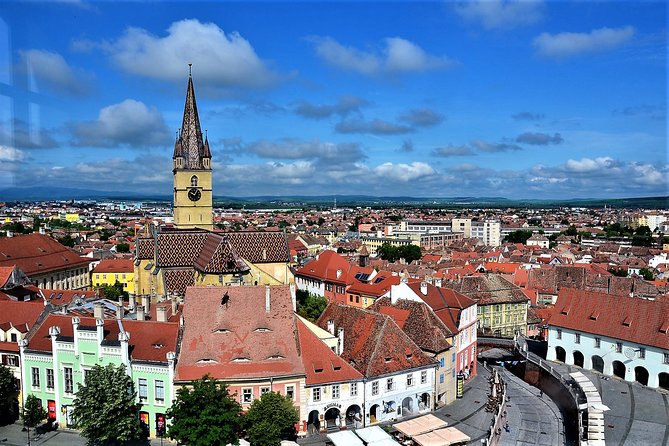
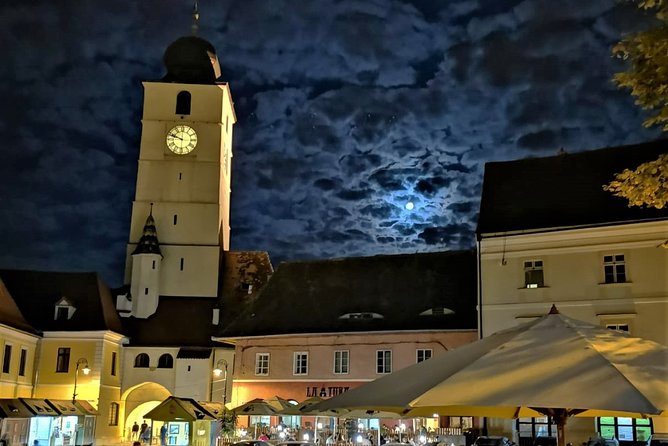
After lunch and a rest, you reach Sibiu. The guided walk takes about two hours and covers the Grand Square, Small Square, and Albert Huet Square, the oldest of the three, dating to the twelfth century. The city’s German Saxon character is easy to read in the architecture and orderly squares.
You also visit the Orthodox Cathedral and the Evangelical Church. Climbing the medieval stairs of the Council Tower is rewarded with a view over Sibiu, though you should be ready for a bit of exertion. This is a strong opening day because Sibiu gives you a real city to explore, not just a monument to photograph.
Day 2: Corvin Castle and Alba Iulia
The second day turns to military history. Corvin Castle, also called Hunyadi Castle, is one of the most dramatic buildings on the route. Its story centers on John Hunyadi, a major medieval commander who became regent of Hungary and fought the Ottoman Empire.
The castle’s connection begins with Hunyadi’s father, Voicu, a Wallachian boyar ennobled by King Sigismund of Luxembourg in 1409. That detail helps explain why this region cannot be reduced to a simple Romanian or Hungarian story. Power shifted across borders, and families moved through several political worlds.
Allow about an hour at Corvin Castle. The visit is compact, but the fortress setting and legends give the guide plenty to explain. If grand interiors are your main interest, remember that this stop is primarily about a medieval stronghold and its historic figures rather than royal luxury.
Next comes Alba Iulia, where you spend about two hours at the Alba Carolina fortress. The ancient Saint Michael Cathedral contains the tomb of John Hunyadi, while the Orthodox Coronation Cathedral reflects another major part of Romania’s national story. You also see the remains of the Roman castrum associated with the elite 13th Gemina Legion.
This is a day for connecting Roman, medieval, religious, and modern Romanian history. You return to Sibiu for a second night, which is practical. It avoids another hotel change and gives you more time in a city that deserves more than a rushed evening.
Day 3: Saxon villages, Biertan, and Sighisoara
From Sibiu, the route crosses the Hartibaciu Valley toward Sighisoara. The road passes through old Saxon villages and wooded country, making the journey itself part of the experience.
Biertan Fortified Church is the first major stop, with about an hour for the visit. These churches were not simply places of worship. They were built or reinforced to protect local communities during periods of attack, which explains the heavy walls and defensive design.
The smaller church at Malâncrav is one of the most distinctive stops. Its Gothic frescoes were found beneath a coat of chalk paint during restoration in 1914. The paintings survived the Lutheran Reformation and give you a close look at medieval religious art that could easily have been lost.
You spend roughly an hour there before continuing to Sighisoara. The citadel is a UNESCO site and one of the tour’s most atmospheric places. Its Clock Tower is the obvious landmark, but the real pleasure is walking the old streets and seeing the town after the day’s traffic has eased.
Sighisoara is also linked to Vlad the Impaler, who was born here. The guide can help separate the historical ruler from the later Dracula legend. You have about two hours in the citadel and evening time there, which is valuable because this is one place where a little unhurried wandering adds a lot.
A few more Bucharest trips worth a look
- Bucharest: Palace of Parliament Tickets and Guide
★ 4.3 · 3,182 reviews - Bucharest: Palace of Parliament Tickets and Guided Tour
★ 4.4 · 1,877 reviews - Bucharest: Parliament Palace Skip-the-line Ticket
★ 4.2 · 1,518 reviews - Bucharest: City Highlights Guided Walking Tour
★ 4.9 · 1,482 reviews
Day 4: Viscri, Prejmer, and Brasov
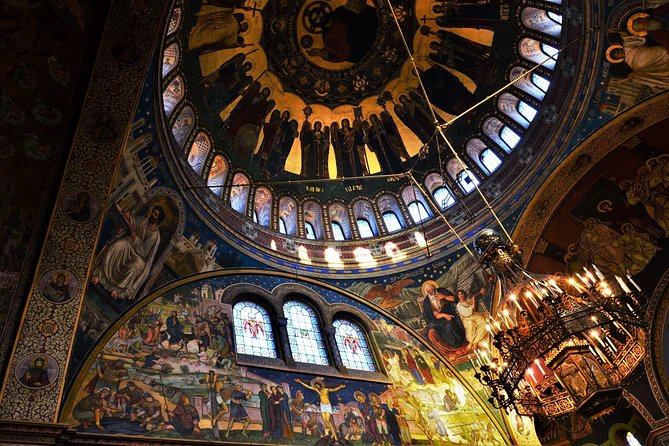
The route from Sighisoara to Brasov includes several stops, so this is one of the busier days. You first catch sight of Saschiz Fortified Church, a UNESCO World Heritage monument with a tower that recalls Sighisoara’s Clock Tower. It is a good roadside reminder that fortified churches were once common across this part of Transylvania.
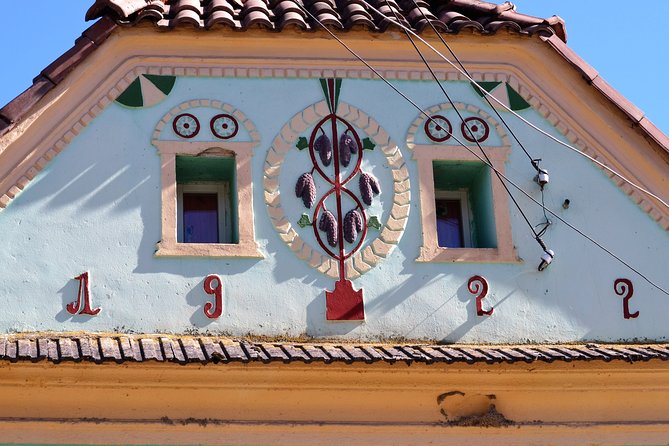
At Viscri, you have about two hours, including lunch. The village became widely known after Britain’s King Charles III, then Prince Charles, bought a Saxon home there. The old household at number 163 is described as a blue house built in 1753, and the village became associated with rural traditions, horse riding, and Saxon buildings.
Viscri is valuable because it changes the scale of the trip. After large castles and city centers, you see a smaller settlement where the appeal comes from the village itself. Do not expect a major urban attraction. You come here for the setting, old buildings, and connection to rural Transylvanian life.
On the road to Brasov, you see Rupea Fortress from a distance. It was built over earlier Roman and Dacian fortifications, making it another example of how many eras occupy the same ground.
Prejmer Fortified Church follows, with about an hour for the visit. The complex began after the Teutonic Knights were invited into southeastern Transylvania around 1200 to defend the area from attacks. Saxon settlers later completed the work after the military order fell out with the Hungarian king.
Prejmer is one of the seven Saxon fortified sites in Transylvania included on the UNESCO World Heritage List. Its walls make the defensive purpose especially clear, so this stop works well after Biertan and Malâncrav. You can compare how different communities protected their churches and homes.
The day ends in Brasov. After checking in, you walk through the historic center, seeing medieval fortifications, bastions, towers, and Rope Street, one of Europe’s narrowest streets. Brasov is a working city as well as a historic one, so this part of the tour feels less like an open-air museum and more like a place where old and modern Romania meet.
Day 5: Poiana Brasov, Bran Castle, and the Black Church
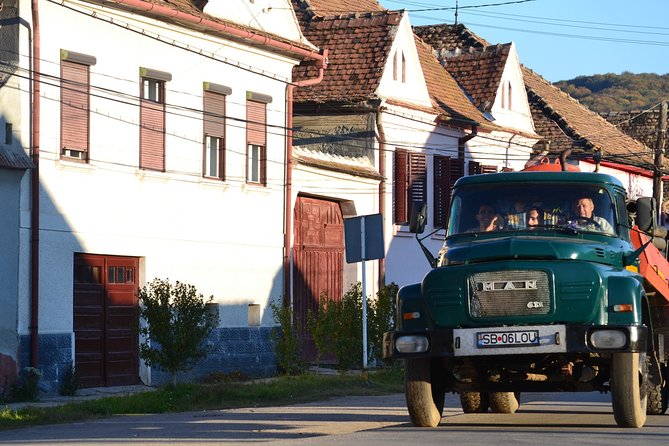
The fifth day brings the scenery and legends most people associate with Transylvania. At Poiana Brasov, you take the high road to the mountain resort and may ride a cable car up to 1,722 meters near Postavaru Peak, weather permitting.
The cable-car outing is listed as about two hours, but it depends on conditions. The views reach over the Carpathians and the Transylvanian plateau, so this is one of the itinerary’s more weather-sensitive moments. If clouds close in, the ride may not provide the full reward, but the mountain setting still adds variety to the week.
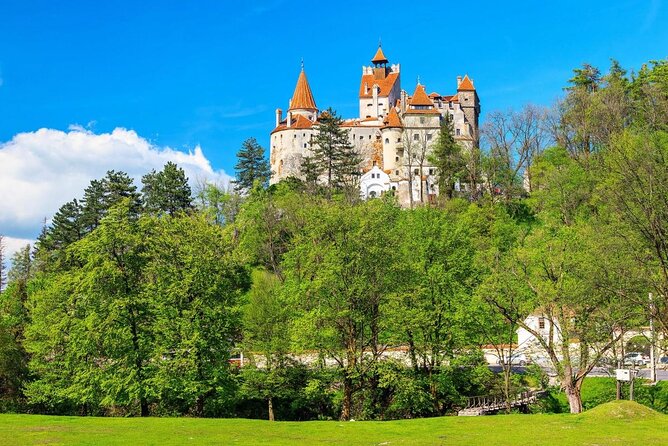
Bran Castle is the day’s headline stop. Built in the fourteenth century to guard the commercial route between Wallachia and Transylvania, it was later tied to the Dracula story because of its dramatic position on a rock above a pass.
The guide’s job here is especially important. Bran Castle has a strong popular image, but Vlad the Impaler’s actual connection to the building is limited compared with the legend. You get more from the visit if you enjoy the architecture and strategic location while keeping the vampire story in its proper place.
On the return to Brasov, you see Rasnov Fortress from afar. The thirteenth-century fortification is linked to the short period when the Teutonic Knights controlled the area around Brasov. It is a brief sight rather than a full visit, so do not book this tour expecting to explore Rasnov’s interior.
Back in Brasov, you visit the Black Church, an imposing Gothic building and one of the city’s main landmarks. This gives the day a useful final chapter after the Dracula material. The Black Church brings you back to the city’s Saxon and religious past.
Day 6: Peles Castle and Bucharest
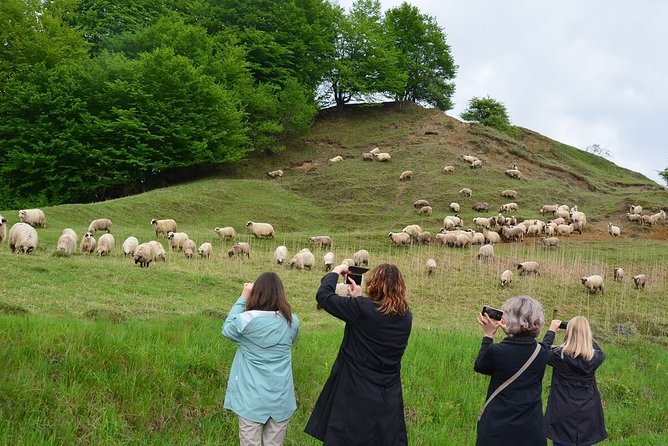
You leave Transylvania through the Prahova Valley toward Bucharest, stopping at Sinaia. Peles Castle is very different from Corvin Castle and Bran Castle. Built in the late nineteenth century, it was the residence of Carol I, Romania’s first king, who came from the German Hohenzollern-Sigmaringen family.
Carol I ruled for 48 years and pushed Romania toward modernization. The castle’s ornate character contrasts with the sober reputation of its founder, which makes the visit more interesting than a simple display of royal rooms. You have about two hours there, enough for a substantial look before continuing south.
The final Bucharest visit includes Stavropoleos Church, built in 1724. This small monastery in the city center provides a quieter ending after the castles and fortified churches. The evening guided tour of Bucharest lets you place Transylvania within the wider story of Romania rather than treating the region as a separate fantasy world.
What the $2,166.68 price buys you
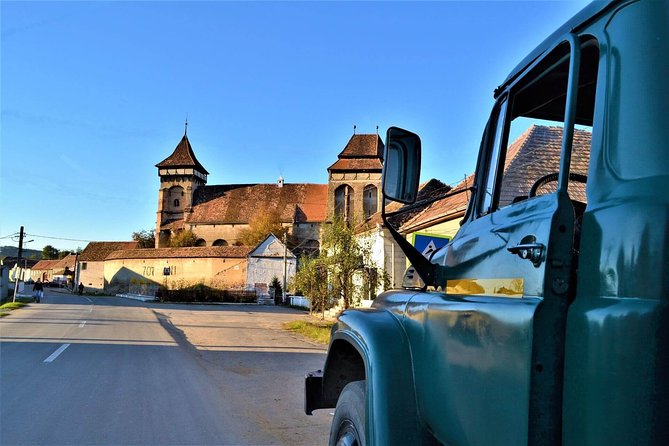
At $2,166.68 per person, this is not a budget trip. The value depends on how much you place on private guiding and reduced planning work.
The price includes private transportation, an air-conditioned vehicle, six nights in double-occupancy rooms at three-star superior hotels or guesthouses, breakfast, lunch, entrance fees, and taxes. It does not include flights, most meals, or photo fees.
That package removes several difficult tasks. You do not need to work out how to reach rural churches, find accommodation in several towns, or coordinate the long route between Bucharest, Sibiu, Alba Iulia, Sighisoara, Brasov, Sinaia, and Bucharest. For a private group, the cost may be sensible when divided against the time and transport involved.
Still, confirm the room arrangement, the exact number of included lunches, and the meaning of six nights versus the stated six-day duration before booking. The itinerary describes six tour days, while the accommodation information says six nights. That may be correct for the actual departure schedule, but it deserves clarification.
Who will enjoy this tour most
I would choose this trip if you want Romania’s major Transylvanian sights without driving yourself. It suits first-time visitors who want context at each stop and families or friends who prefer a private vehicle to a large group coach.
You should also enjoy history, churches, old towns, and scenic roads. The tour is not only about Dracula. Its strongest material may be the Saxon fortified churches, John Hunyadi’s story, Alba Iulia, and the contrast between medieval defenses and royal Peles Castle.
I would hesitate if you want long free periods in each town, nightlife, or a physically effortless holiday. The schedule includes walking, stairs, several hotel nights, and long road transfers. The non-refundable policy also means you should be certain of your dates before paying.
Should you book Transylvanian Week?
Book it if you want a private, guide-led introduction to Transylvania and value having the route, hotels, transport, and entrances arranged together. Gelu Trandafir’s personal attention and flexible approach are important advantages, especially for a private family or friend group.
Before committing, ask for a final day-by-day schedule and confirm the six-night arrangement, meals, room setup, and cable-car plans. If you accept the busy pace, this tour gives you a notably broad view of Romania: not just Dracula, but monasteries, Saxon villages, medieval commanders, royal ambitions, and the ordinary roads between them.
FAQ
Where does the tour begin?
Pickup is offered at your hotel in Bucharest or at Bucharest Airport.
How long does the tour last?
The tour is described as six days, approximately, with six nights of accommodation included.
Is this a private tour?
Yes. Only your group participates in the private activity.
Who is the guide?
The named guide is Gelu Trandafir. The tour company is operated with his brother George.
What type of transportation is used?
You travel in a private, air-conditioned vehicle.
Which accommodation is included?
Six nights in double-occupancy rooms at three-star superior hotels or guesthouses are included, with breakfast.
Are entrance fees included?
Entrance fees and taxes are included for the listed paid attractions. Photo fees are not included.
Is lunch included?
Lunch is included, but the provided information does not specify every included lunch. Other meals are not included.
Can I cancel for a refund?
No. The experience is non-refundable and cannot be changed for any reason according to the stated policy.
Newest Bucharest trips on the site
- Winery touring & private wine tasting – one day private tour★ 5.0 · 3 reviews
- Bucharest: Dealu Mare Winery Private Trip with Wine Tasting★ 4.9 · 6 reviews
- Village Museum Bucharest Guided Tour★ 5.0 · 6 reviews
- Private Transfer from Giurgiu Port to Bucharest★ 4.5 · 12 reviews
- Airport Henri Coanda (Otopeni) to Bucharest – Private Transfer – Driver★ 5.0 · 5 reviews
- Salt Mine Tour from Bucharest with Entrance Ticket★ 4.5 · 19 reviews
- Wine tasting in Bucharest Old town – bonus cheese platter★ 4.5 · 6 reviews
- Walking tour of Bucharest★ 5.0 · 3 reviews
7-Day Experiences, compared.
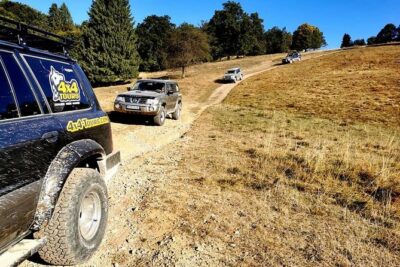
4×4 Driving Experience at Flying Altitudes – 7 Days
Read our review →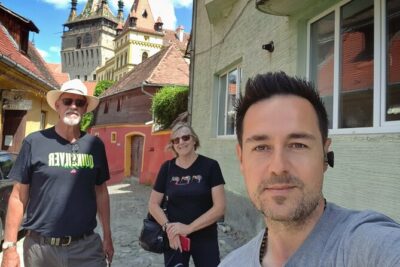
7-Day Private Tour of Transylvania from Bucharest
Read our review →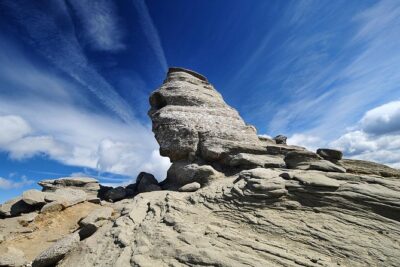
Amazing Romania – Seven day private tour from Bucharest
Read our review →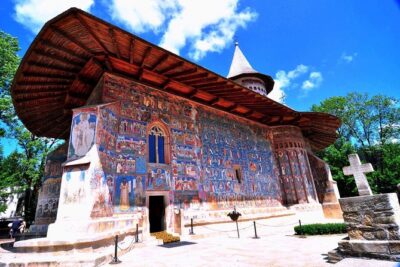
7 days Private Romania Grand Tour from Bucharest
Read our review →
7 Days Private Guided Tour in Romania from Bucharest
Read our review →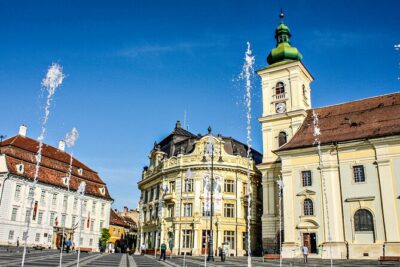
Discover Medieval Transylvania Small Group Tour – 7 days
Read our review →
7 Day Best of Transylvania Motorcycle Tour from Cluj
Read our review →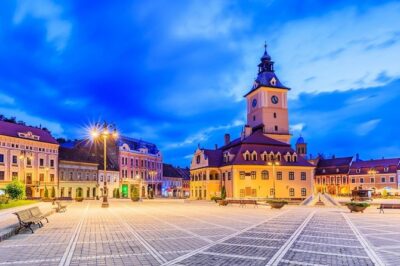
7-Day Dracula Tour in Romania from Bucharest including ‘The Ritual of Killing of a Living Dead’
Read our review →Browse the lists this tour appears in