

Reviewed · COMMUNIST HISTORY TOURS
Private Tour -The Last Day of Nicolae Ceaușescu in a Romanian Car
Ceaușescu’s last day is best understood from the road. On December 22, 1989, he and Elena fled the Communist Party headquarters by helicopter as roughly 100,000 people gathered below. This private tour follows their route toward Târgoviște in a fully restored Dacia 1300 or 1310, turning a political collapse into a six to seven-hour journey you can physically follow.
I like two things right away: the small private format, which lets your guide adjust the conversation to your questions, and the old Dacia itself, a real piece of communist-era daily life rather than a modern tour van. The main drawback is comfort. These cars are from the 1970s and 1980s, with no air conditioning, ABS, GPS, power steering, or automatic transmission.
Key points to know
- Follow the December 22 route: Travel roughly 180 kilometers toward Târgoviște and back, tracing the escape and capture of Romania’s former ruler.
- Ride in a restored Dacia: The cars are lovingly restored and meet current traffic safety rules, but they still feel like classic cars.
- Visit Palatul Primăverii: Tour Ceaușescu’s private residence with a guide, an unusual look at the lifestyle behind the public austerity.
- Begin at Revolution Square: See the place where the regime’s final public crisis unfolded before heading out of Bucharest.
- Expect a private experience: Only your group participates, with pickup offered and a 9:00 a.m. start.
- Know the age rule: Red Patrol does not allow children under 10 or pets on this tour.
Why Ceaușescu’s last day works as a road trip
Many Bucharest history tours stay inside the city. This one gives the story a direction and a deadline. You begin where the regime lost control, then head west toward the places where Ceaușescu hoped to find support from workers and the army.
That movement matters. In the morning, he was still Romania’s president and Communist Party leader. By the end of the day, he had been captured near Târgoviște. The changing scenery helps you grasp how quickly authority broke apart once the crowd outside the party headquarters turned against him.
The tour covers about 180 kilometers toward Târgoviște and back, although one guide describes a similar route as roughly 220 kilometers. The exact road distance may vary, but the point is the same: this is not a short city circuit. Allow most of your day, from the 9:00 a.m. start until the return later in the afternoon.
I especially like the way the tour links geography and emotion. You are not simply told that Ceaușescu fled. You follow the line of escape and consider what he was trying to do next: regroup, reach loyal forces, and hold on to power.
More communist-era history walks in Bucharest:
- The Real tour of Communism
★ 5.0 · 666 reviews - Life under Communism
★ 5.0 · 358 reviews - 3-Hour Guided Tour of Communist Bucharest
★ 4.9 · 303 reviews
Revolution Square and the sound of a regime collapsing
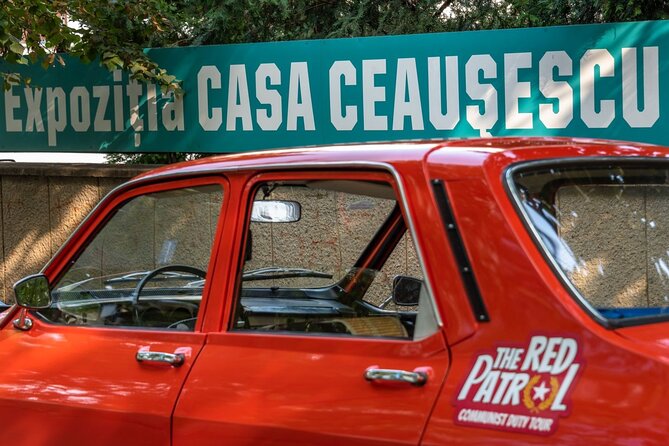
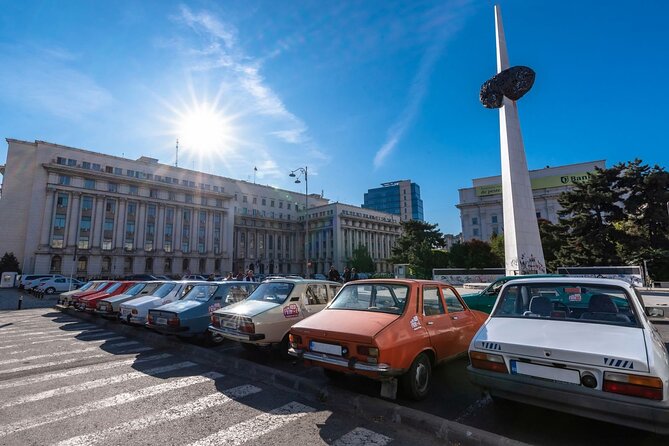
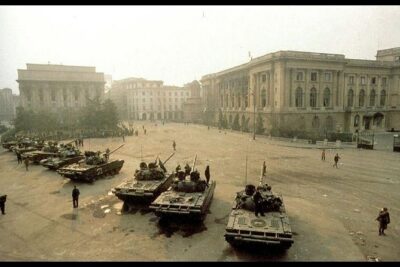
The day begins with the place where Ceaușescu’s final public appearance unraveled. Revolution Square is the natural starting point because it connects the political center of communist Bucharest with the events of December 1989.
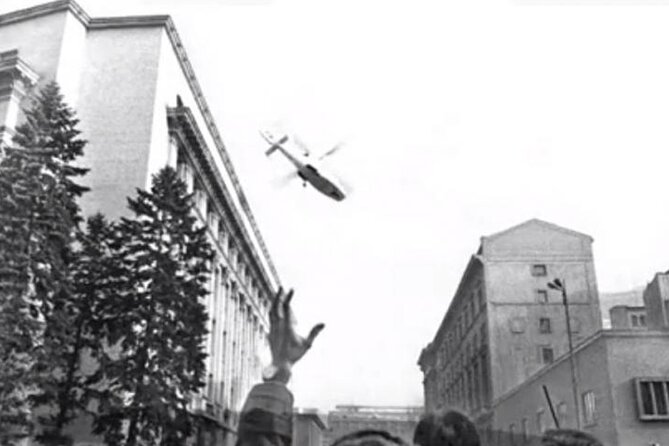
On December 22 at 12:07 p.m., Nicolae and Elena Ceaușescu left the roof of the Communist Party headquarters by helicopter. The crowd below had gathered to demand his resignation. The departure marked the moment when the old order lost its grip on the capital.
Your guide uses this setting to explain what happened before the couple left and why the escape became necessary. Guides named in the tour’s experiences include Ivan and Crinu. The quality of this stop depends heavily on the guide’s storytelling, so ask questions if you want more detail about the people, buildings, and sequence of events.
This is also where the classic car adds something useful. A restored Dacia is not a random prop. The model belongs to the same period as the events you are studying. Sitting in one while hearing about the final hours of a communist government gives the visit a physical connection to ordinary Romanian life.
Do not expect a museum-style presentation at every corner. The appeal is the combination of a real location, a guide, and the route ahead. If you prefer long indoor exhibits with labels and timelines, this tour may feel more conversational than formal.
Palatul Primăverii and the private world behind the public image
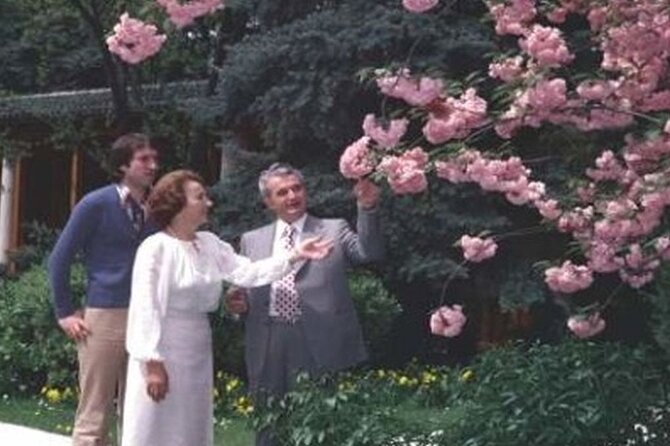
One of the most valuable stops is Palatul Primăverii, Ceaușescu’s private residence. You visit the house on a guided tour, which adds a different side to the day’s story.
The residence helps you compare the public image of communist Romania with the private life of its ruling couple. Much of the country lived under shortages and strict control, while the leadership occupied a protected world. Seeing the residence gives that contrast a physical setting.
I would pay close attention to how the house changes your understanding of the man you are following. Revolution Square shows his political collapse in public. Palatul Primăverii shows the private environment from which he and Elena operated. Together, the two stops prevent the tour from becoming only a dramatic escape story.
The visit also breaks up the drive. Since the full experience lasts six to seven hours, a stop with a guided indoor visit gives the day a useful rhythm. You will not spend every hour sitting in the Dacia.
The supplied information does not list the exact rooms, exhibits, or length of the residence visit, so do not book this expecting a fixed room-by-room program. The sure point is that Palatul Primăverii is included as a guided visit.
Out of Bucharest, toward Pitesti and Târgoviște
After the capital, the tour follows the direction Ceaușescu took after the helicopter escape. He wanted to reach Pitesti and find support among the working class and army. Instead, he was captured near Târgoviște later that day.
This part of the experience is where the tour becomes less about monuments and more about sequence. Your guide can explain how the plan to regain control failed as the couple moved farther from Bucharest. The road turns an abstract political crisis into a chain of places and decisions.
You should expect stops along the route, not one continuous drive without explanation. The experience is described as a private drive and stop tour. That means your guide can explain the significance of each point and respond to your interests instead of following a large group’s fixed pace.
The trip is especially suited to you if you enjoy political history, Cold War stories, cars, or local context that does not fit neatly into a standard city tour. It also works well for people who want to understand Romania beyond the grand government buildings in central Bucharest.
The limitation is that the route does not turn Târgoviște into a separate full sightseeing day. The focus remains Ceaușescu’s final day. If you want a broad tour of every attraction in the area, you would need another outing.
A few more Bucharest trips worth a look
- Bucharest: Palace of Parliament Tickets and Guide
★ 4.3 · 3,182 reviews - Bucharest: Palace of Parliament Tickets and Guided Tour
★ 4.4 · 1,877 reviews - Bucharest: Parliament Palace Skip-the-line Ticket
★ 4.2 · 1,518 reviews - Bucharest: City Highlights Guided Walking Tour
★ 4.9 · 1,482 reviews
What the restored Dacia adds, and what it does not
The car is central to the experience. Red Patrol uses fully restored Dacia 1300 and 1310 models, including cars with names such as Domnica, Letitia, and Malvina. One described vehicle, Domnica, dates from 1989. Another experience used two Dacias for a group of three adults and two teenagers.
These are the kinds of cars that shaped everyday Romanian transport during the communist period. Riding in one makes the tour feel tied to the period rather than packaged in a generic vehicle. The old controls, compact cabin, and classic styling are part of the fun.
You will not drive the car on this tour. You ride as a passenger while the guide or driver handles the road. If driving a Dacia is your main goal, the separate Red Patrol Communist Tour of Bucharest is the appropriate option.
Comfort requires realistic expectations. The cars do not have air conditioning, ABS, GPS navigation, power steering, or automatic transmission. They are heated during winter, and the company says the vehicles meet current traffic safety regulations. Still, a restored classic is not the same as a modern minivan.
In warm weather, the lack of air conditioning matters. In cold weather, heating is provided, but you are still in an older car for a long day. I would dress for the season and avoid choosing this experience only because the vehicle looks good in photographs.
The guide can make the long day work
The guide is more important here than on a short sightseeing loop. You have several hours together, a long route, and a story with many names and dates. A guide who can explain the political system in plain language will help you connect the stops.
Ivan is described as friendly, helpful, and experienced. Crinu is praised for keeping the conversation interesting during difficult weather and making the hours pass quickly. Those details point to the kind of guiding that suits this tour: personal, story-led, and willing to explain Romanian life beyond a textbook account.
The tour can also work for a mixed-age group. One family group included two teenagers, and the guide made the information understandable for them. That does not mean every child will enjoy a full day about a fallen dictator, but older children with an interest in cars or dramatic real events may stay engaged.
Because this is a private activity, you can ask about subjects that interest you. You might want more on the 1989 Revolution, the Dacia’s place in Romanian life, the residence, or the route through the countryside. You are not locked into the questions of a busload of strangers.
Price, timing, and practical comfort
The listed price is $223.55 per person. That is a serious price for a day tour, but the comparison is not with a basic city bus. You are paying for a private vehicle, a dedicated guide, pickup if offered for your booking, the long return route, and the Palatul Primăverii visit.
For two people, the cost buys a tailored experience that combines transport, guiding, and a specialist subject. For a larger private group, group discounts may improve the value. A party of three or four people interested in Romanian history could find the cost easier to justify than a solo visitor looking for a cheap introduction to Bucharest.
The 9:00 a.m. start is practical. It gives you a full day without pushing the return into the evening as quickly as a later departure would. The total duration is approximately six to seven hours, though traffic and the exact route can affect the timing.
Hotel pickup is offered, and the meeting area is near public transportation. Confirmation is sent at booking unless you book within five days of departure. In that case, confirmation is expected within 48 hours, subject to availability.
The private format is important for value. You are not paying for a large vehicle or a rushed commentary. You have the car and guide for your own group, which is useful if you want to stop for questions or need explanations adjusted for older children.
Who should book this Dacia tour?
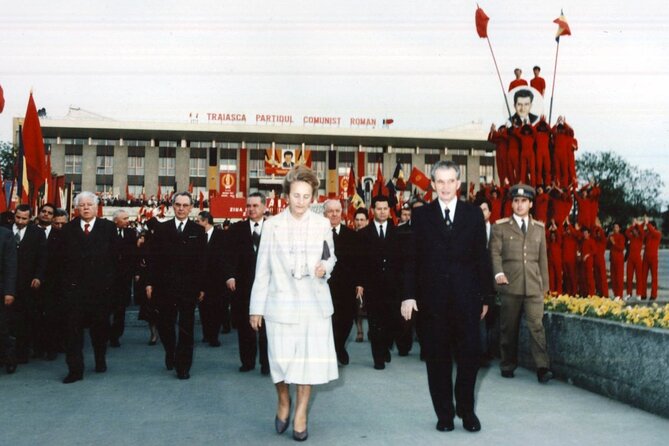
I would choose this tour for a visitor who wants more than central Bucharest’s major buildings. It is a strong match for:
- People interested in the 1989 Revolution and communist Romania
- Classic-car fans who enjoy historic vehicles as part of the experience
- Couples or small groups who prefer a private guide
- Visitors who have six to seven hours available for a longer outing
- Families with children aged 10 or older who can follow a serious historical story
- Anyone who wants to connect a political event with the actual road taken
I would think twice if you need modern vehicle comfort or air conditioning. I would also skip it if you want to drive the Dacia yourself, since this experience does not include that option.
Pets are not allowed, and children under 10 cannot participate. Most other participants can take part, and the tour is near public transportation, but the long sitting time may still matter if you find older cars uncomfortable.
Booking terms deserve attention. You can cancel for a full refund up to 24 hours before the local start time. Cancellations or changes made less than 24 hours before departure are not accepted and are not refunded. Treat the reservation as firm once you are inside that window.
Should you book The Last Day of Nicolae Ceaușescu?
Book it if you want a focused, personal account of Romania’s 1989 collapse and like the idea of following the route in a period car. The Dacia and the road itinerary are the real draw, while Revolution Square and Palatul Primăverii give the story important bookends.
Skip it if your priority is a short, low-cost Bucharest tour, a modern vehicle, or the chance to drive a classic car. For the right audience, though, the $223.55 price buys more than transport. It gives you a full day with a guide, a specific historical route, and a car that belongs to the era being discussed.
FAQ
How long does the tour last?
The experience lasts approximately six to seven hours.
What time does the tour start?
The stated start time is 9:00 a.m.
Where does the tour go?
The route begins in Bucharest, follows the direction of Ceaușescu’s escape toward Pitesti and Târgoviște, and returns to Bucharest. The route covers roughly 180 kilometers toward Târgoviște and back, with another description noting an itinerary of about 220 kilometers.
Will I drive the Dacia?
No. You ride as a passenger on this tour. If you want to drive a Dacia, the Red Patrol Communist Tour of Bucharest is the separate option identified for that purpose.
Does the tour include Palatul Primăverii?
Yes. You visit Nicolae Ceaușescu’s private residence, Palatul Primăverii, on a guided tour.
Are the cars comfortable and modern?
The Dacia 1300 and 1310 cars are restored classics from the 1970s and 1980s. They do not have air conditioning, ABS, GPS navigation, power steering, or automatic transmission. The cars are heated during winter and meet current traffic safety regulations.
Can I bring children or pets?
Children under 10 and pets are not allowed on the tour. Most other participants can take part.
Newest Bucharest trips on the site
- Winery touring & private wine tasting – one day private tour★ 5.0 · 3 reviews
- Bucharest: Dealu Mare Winery Private Trip with Wine Tasting★ 4.9 · 6 reviews
- Village Museum Bucharest Guided Tour★ 5.0 · 6 reviews
- Private Transfer from Giurgiu Port to Bucharest★ 4.5 · 12 reviews
- Airport Henri Coanda (Otopeni) to Bucharest – Private Transfer – Driver★ 5.0 · 5 reviews
- Salt Mine Tour from Bucharest with Entrance Ticket★ 4.5 · 19 reviews
- Wine tasting in Bucharest Old town – bonus cheese platter★ 4.5 · 6 reviews
- Walking tour of Bucharest★ 5.0 · 3 reviews
Communist History Tours, compared.


Bucharest Essential Tour: Old Town, Calea Victoriei & Communism
Read our review →
Communism in Bucharest – Landmarks, Museum & Communist Appetizers
Read our review →


Museum of Communism Ticket with Communist Coffee
Read our review →Browse the lists this tour appears in