
Reviewed · CITY TOURS
Cluj-Napoca Walking City Tour
Cluj-Napoca’s best story is told on foot, one square and one old facade at a time. This two-hour walk links Museum Square, St. Michael’s Church, Banffy Palace, and the National Theatre, while your guide explains how Romanian, Hungarian, and Saxon influences shaped the city.
I like the small group of no more than 10 people, which gives you room to ask questions. I also like the mix of major sights and small street details, plus the final city view, often associated with the Fireman Tower. The main drawback is simple: two hours goes quickly, and the route is not suitable for wheelchair users.
Key points at a glance
- Start at the Obelisk: Meet your English-speaking guide in front of this landmark before walking into Cluj’s old center.
- Museum Square sets the tone: See the Franciscan Church and the building that houses the National Art Museum.
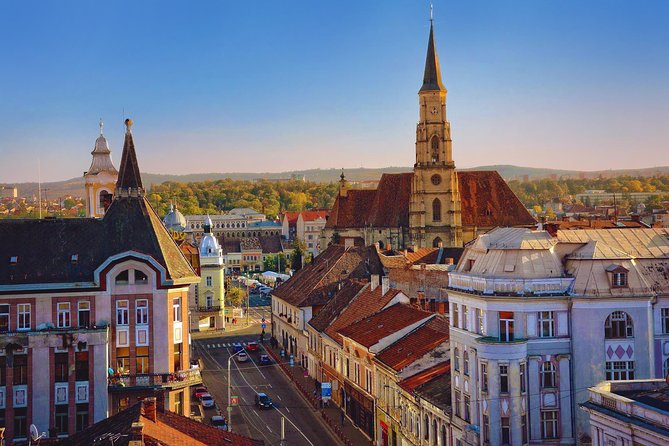
- St. Michael’s Church is the Gothic centerpiece: Union Square gives you the clearest look at one of Cluj’s defining buildings.
- Banffy Palace adds Baroque style: The former palace now houses the National Art Museum, tying architecture to local art.
- The city’s layers are the real subject: Your guide connects Romanian, Hungarian, and Saxon influences with stories of people and places.
- A viewpoint closes the walk: The Fireman Tower may provide the final look over Cluj, according to the route experience described by past participants.
Why this two-hour walk is a good first look at Cluj
Cluj-Napoca can feel confusing at first. Its center carries several languages, faiths, architectural styles, and political eras, and a casual stroll may show you attractive buildings without explaining why they matter. This tour gives those details a clear order.
The route moves through the historic center chronologically. You begin with older religious and civic landmarks, then see how later cultural layers changed the city. That approach is more useful than a simple parade of photo stops because it helps you understand why a Gothic church can sit close to Baroque buildings and newer cultural institutions.
The English-speaking guide is central to the experience. Adrian has been praised for making the city’s history easy to follow while adding local details, and Catalin has been described as clear, friendly, and good at using amusing stories. You should expect interpretation rather than a silent walk from one attraction to the next.
The group limit of 10 matters. You are not being herded through the center in a large crowd, and you should have a fair chance to ask about architecture, local customs, or Cluj’s complicated past. That is especially useful here, since the tour aims to explain Romanian, Hungarian, and Saxon influences rather than present the city as a single, simple story.
More Walking Tours in Cluj-Napoca
- Cluj-Napoca: 2.5-Hour Guided Walking Tour
★ 4.8 · 104 reviews - Cluj-Napoca: 2.5-Hour Guided Walking Tour
★ 4.5 · 29 reviews - Cluj-Napoca Walking City Tour
★ 4.5 · 16 reviews
Museum Square and the Franciscan Church
The meeting point is in front of the Obelisk. From there, the walk begins around Museum Square, one of the most useful places to start getting your bearings in central Cluj.
Museum Square brings together several themes that run through the tour. The Franciscan Church points to the city’s religious past, while the nearby art museum represents Cluj as a cultural center. You are not only looking at isolated monuments. You are seeing how public spaces collected different buildings and institutions over time.
The square is also a good place to listen for the guide’s method. The tour uses visual materials to support the explanation, so you may see images that help show how buildings or streets looked in earlier periods. That can make the changes easier to understand than a spoken date alone.
If you enjoy architecture, this opening section should be rewarding. If you prefer a tour with long interior visits, keep your expectations in check. The experience is primarily a walking and storytelling tour, and the information provided does not promise extended admission time inside each site.
Banffy Palace and Cluj’s art scene
Banffy Palace gives the route one of its most handsome architectural stops. This Baroque building now houses the National Art Museum, linking the city’s aristocratic past with its present cultural life.
The palace matters for more than its facade. It shows how a grand private residence can later take on a public role, and it gives your guide a natural opening to discuss art, power, and the changing use of central buildings. The tour lists Banffy Palace and the National Art Museum among its main highlights, so you should expect this to be an important part of the walk.
The museum’s presence also helps explain why Cluj feels like more than a preserved old town. The city center remains a place for culture and public life, not just a collection of old walls. That distinction is worth noticing as you walk.
Photography fees are not included, and meals are not part of the experience. In practical terms, this means you are paying for the guide and the walking interpretation, not for food, museum extras, or a packaged sightseeing bundle. Bring your own water if needed, though the tour details do not specify refreshment stops.
St. Michael’s Church in Union Square
St. Michael’s Church is the Gothic high point of the route. In Union Square, its scale and vertical lines give you a sharp contrast with the Baroque forms of Banffy Palace.
The church is also a useful key to Cluj’s cultural mix. Its place in the center reflects the city’s long connection to Hungarian and Central European traditions, while the surrounding square shows how later Romanian civic life grew around older foundations. Your guide’s job is to connect those layers without reducing them to a list of dates.
The tour treats architecture as a record of change. You may hear how styles developed, who used these buildings, and how the city’s people shaped its public spaces. That sort of explanation is where a small walking tour earns its price.
You will want comfortable shoes. The route covers the historic center on foot, and even a short tour can feel longer if your footwear is poor. The activity is not suitable for wheelchair users, so anyone needing step-free access should choose another way to explore the center.
More walking tours in Cluj Napoca:
- Cluj : Must-See Attractions Walking Tour
★ 4.8 · 8 reviews - Cluj : Private Walking Tour with A Guide ( Private Tour )
★ 5.0 · 7 reviews - From Cluj: Winter Walking Trip on the Great Mountain
★ 5.0 · 5 reviews - Cluj: Private City Walking Tour
★ 4.4 · 4 reviews
From Gothic churches to the Baroque National Theatre
The route then moves through later cultural layers, including the Baroque-style Cluj National Theatre. This change in style helps you see the city as a place that kept adding to itself rather than replacing everything that came before.
A good guide makes these shifts readable. Instead of saying only that one building is Gothic and another is Baroque, the explanation can show how design, public taste, and civic ambition changed over time. That is especially helpful if architectural terms are not already familiar to you.
The theatre also broadens the tour beyond churches and palaces. Cluj’s identity includes performance, art, and public debate, and the theatre points to that cultural side. You get a more rounded view of the city than you would from a route focused only on medieval remains.
The walk continues through the old town’s smaller streets, where the atmosphere changes from grand squares to more intimate passages. This is where the tour’s promise of local details becomes most useful. Your guide can point out features you might otherwise pass without noticing and explain how ordinary streets fit into the larger story.
Romanian, Hungarian, and Saxon influences in the old town
Cluj-Napoca’s appeal comes partly from its cultural overlap. Romanian, Hungarian, and Saxon influences appear in the architecture and in the city’s wider culture, and the tour gives you a framework for seeing those connections.
That subject deserves care. Cluj has a complicated past, and a quick walk cannot cover every political shift or social dispute. Still, two hours is enough to introduce the main layers and show why the city cannot be understood from one national viewpoint alone.
The guide also brings people into the story. You should hear about figures from the past and present, along with anecdotes that make the buildings less remote. Catalin, one of the named guides connected with the experience, has been praised for using humor while keeping his explanations clear. Adrian is also known for placing Cluj in a wider cultural and historical setting.
This human touch is one of the tour’s strongest features. Dates and styles help you organize information, but stories help you remember it. You may finish the walk with a better sense of how Cluj became a modern university and cultural city, not just a place with old architecture.
The final viewpoint and the Fireman Tower
The walk ends at a spot with a broad view over Cluj. One account specifically identifies the Fireman Tower as a memorable high point, describing its bird’s-eye view of the city.
That final look is a smart way to finish. After walking through squares and narrow streets, you can step back and see how the center fits together. Buildings that seemed separate on the ground begin to form a clearer pattern.
The viewpoint also gives the tour a practical ending. You can use what you have learned to decide which parts of Cluj you want to revisit on your own. The tour does not include a meal or a separate photography package, so plan to continue your day independently after the walk.
Because the information does not guarantee every detail of the final stop, I would treat the viewpoint as part of the route’s intended finish rather than assume a long visit inside a specific tower. Ask your guide at the start if the Fireman Tower is included on your departure date.
What the $62 price gets you
At $62 per person, this is not the cheapest way to spend two hours in Cluj. You can walk through the center without paying for a guide, and many of the principal sights can be seen from public squares.
The value comes from the interpretation. You are paying for a professional English-speaking guide, a planned route, historical context, visual material, and the chance to ask questions in a small group. If you are new to Cluj, that can save time and prevent the center from becoming a blur of impressive but unexplained buildings.
The price makes more sense for a first visit, a short stay, or anyone interested in history and architecture. It is less compelling if you already know Cluj well or prefer to explore at your own pace with a guidebook.
The five-star score attached to the experience reflects the aspects I would value most: clear explanations, personal attention, local pride, and lively anecdotes. That does not mean every participant will want the same pace or level of historical detail. The tour is best for someone who wants a guided introduction, not a long museum visit or a food-focused walk.
You can reserve now and pay later, and cancellation is free up to 24 hours before the start for a full refund. Those terms help if your Romanian itinerary is still changing.
Who should book this Cluj walking tour?
I would choose this tour if you have only a short time in Cluj and want a useful orientation. The route gathers the major central landmarks into two hours, then adds context that is hard to pick up from a quick self-guided walk.
It also suits you if architecture is your main interest. Gothic, Baroque, religious, civic, and cultural buildings all appear, and the route explains how they relate to one another.
The tour works well for curious adults, solo visitors, couples, and small groups who like asking questions. The group cap of 10 keeps it more personal than a large city walk.
I would be more cautious if you use a wheelchair, dislike walking, or want guaranteed access inside every building. Pets are not allowed, and meals are not included. Bring comfortable shoes and expect the experience to focus on streets, squares, facades, stories, and views.
Should you book it?
Book this tour if you want Cluj explained rather than simply photographed. The strongest reason to go is the combination of a small group and a guide who can connect the city’s Romanian, Hungarian, and Saxon threads with its architecture and modern culture.
Skip it if you already know the historic center well or want a relaxed café-and-shopping stroll with no fixed route. For a first introduction, though, $62 buys a focused two-hour lesson in how Cluj grew, changed, and became the lively cultural center you see today. Ask at the start whether the Fireman Tower is included, wear comfortable shoes, and keep some time afterward to revisit the places that caught your eye.
FAQ
How long is the Cluj-Napoca Walking City Tour?
The tour lasts two hours.
Where does the tour meet?
You meet the guide in front of the Obelisk.
What language is the tour conducted in?
The tour is conducted in English by a live English-speaking guide.
What sights are included on the route?
The route includes Museum Square, the Franciscan Church, St. Michael’s Church, Banffy Palace and the National Art Museum, the Cluj National Theatre, historic old-town streets, and a final location with a city view.
Is the tour suitable for wheelchair users?
No. The experience is listed as not suitable for wheelchair users.
What should I bring, and are pets allowed?
Bring comfortable shoes. Pets are not allowed.
Newest Cluj Napoca trips on the site
- Private tour to Turda Salt Mine, Rimetea and Alba Iulia★ 4.8 · 5 reviews
- Turda salt mine and Corvin Castle day tour from Cluj★ 5.0 · 9 reviews
- Turda Salt Mine, Gorge & Rimetea Village (private from Cluj)★ 5.0 · 5 reviews
- 1250cc Motorcycle Rental from Turda★ 5.0 · 4 reviews
- Day Trip to Turda Salt Mine and Corvin Castle from Timisoara★ 5.0 · 10 reviews
- Discover Apuseni Mountains – Scarita Summit,Sipote Waterfall and Dumesti Village★ 5.0 · 17 reviews
- CLUJ ADVENTURE TOUR ! ZIP LINE and HIKE★ 5.0 · 15 reviews
- Turda salt mine, Rimetea village and Alba Iulia, from Cluj★ 5.0 · 11 reviews
City Tours, compared.

Bucharest Panoramic Sightseeing – Private City Tour
Read our review →
SB01 – City Tour Sibiu: Exploring the Heart of Transylvania
Read our review →
City Tour Sighisoara Legends & Landmarks A Walk Through Time
Read our review →Browse the lists this tour appears in