
Reviewed · CRUISES & BOAT TOURS
Orsova: Entire Area Boat Tours with Audio Guide
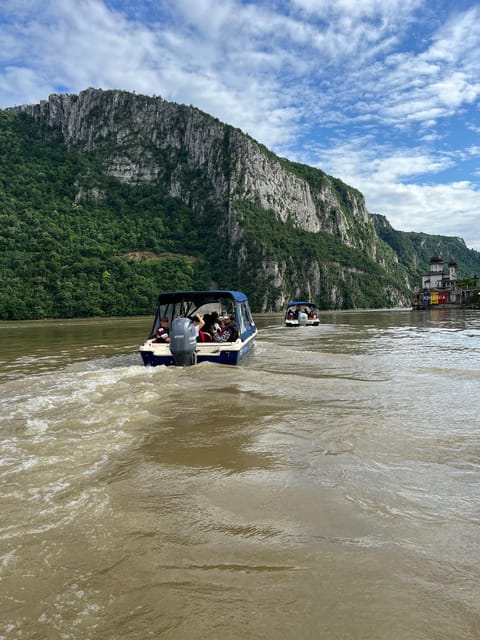
The striking part of this Orșova cruise is how quickly the Danube changes from a calm bay into a narrow mountain corridor filled with Roman ruins, caves, monasteries, and enormous rock walls. The route reaches the Danube Cauldrons, Decebalus Rock, Tabula Traiana, Iron Gates, and the underwater remains of Ada-Kaleh.
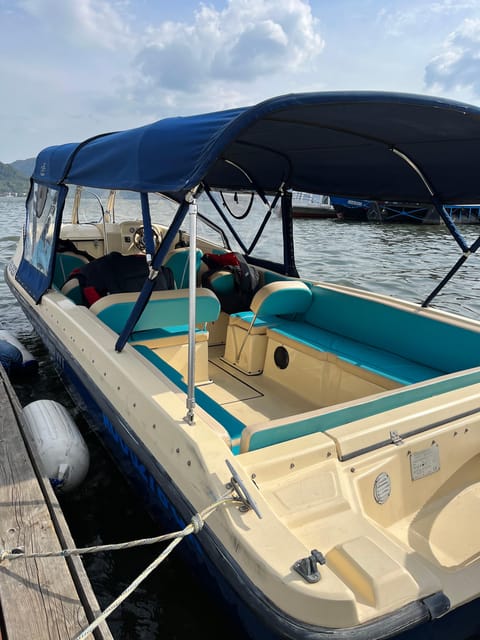
I like the small private group, capped at six people for this booking, and the photo stops that let you look instead of simply racing past. The boat holds 14, has a sunroof, and provides life jackets. The main consideration is the timing: the tour is listed as both 140 minutes and about 2.5 hours, while a 40-minute downstream extension is also described, so confirm exactly what your booking includes.
Key points at a glance
- Decebalus Rock Sculpture: See Europe’s tallest rock carving from the water, cut into the cliff above the Danube.
- Eight major sights: The route covers Roman stonework, two caves, a monastery, Iron Gates, and the vanished island of Ada-Kaleh.
- Veterani Cave costs extra: Entry is about $2, and the cave visit is led by another guide if security conditions allow.
- Private value for six: At $392 per group, a full group pays about $65 per person for a dedicated boat outing.
- Audio guide onboard: English, Hungarian, Spanish, and German commentary supplements the English and Romanian host service.
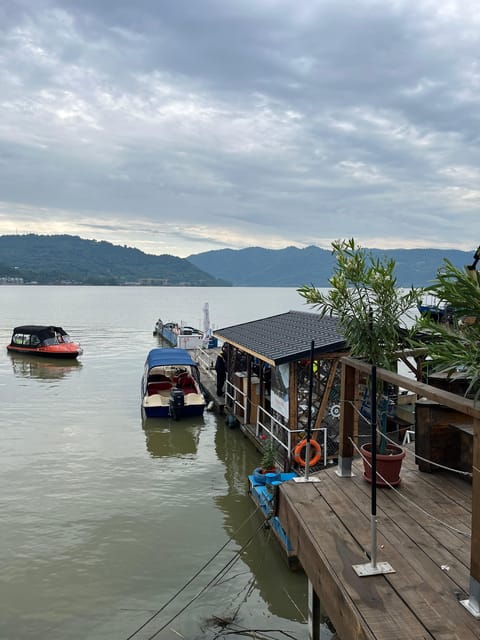
- Orșova departure: Find the black-roofed pontoon near Hotel Apolodor, along the waterfront walking path.
Why this Danube trip is worth your time
Orșova is more than a departure point. The town sits beside Cerna Bay, the broad water area formed after the Iron Gates I Dam was completed in the early 1970s. That altered shoreline gives the town a calm, open waterfront, but the boat soon carries you toward a much narrower and more dramatic stretch of the Danube.
I like this outing because it brings together several kinds of sightseeing in one compact trip. You get Roman history, modern engineering, religious architecture, caves, mountain views, and the memory of a town that now lies below the reservoir. It is not just a scenic ride.
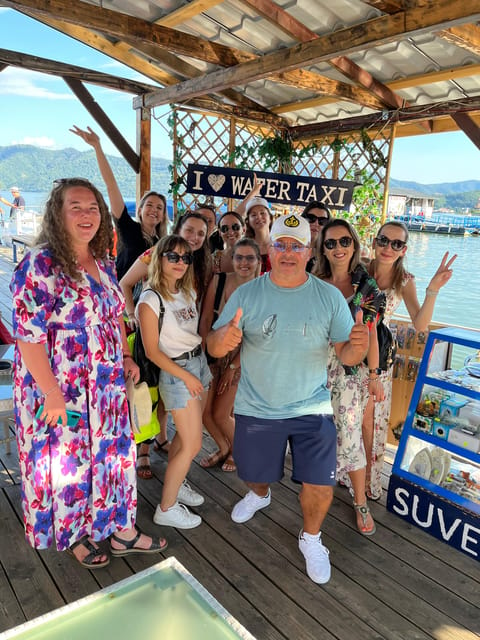
The private-group format also changes the feel of the trip. You are not joining a large excursion vessel with dozens of people competing for the best view. The booking is for up to six people, although the boat itself carries 14. That leaves room for a relaxed ride and makes it easier to take photos at the stops.
The price is $392 per group. For six people, that works out to roughly $65 each. For two people, it becomes a much steeper $196 per person, so this is best value for families or friends who can fill most of the available group places.
More boat trips from Romania:
- Orsova: Danube’s Cauldrons Boat Tours with Audio Guide
★ 4.8 · 28 reviews - Danube Delta – Private Tour with Boat Trip & Traditional Lunch
★ 4.5 · 24 reviews - Boat Trip to Caraorman Forest – Danube Delta (6–7 hours)
★ 4.8 · 21 reviews
Finding the black-roofed pontoon in Orșova
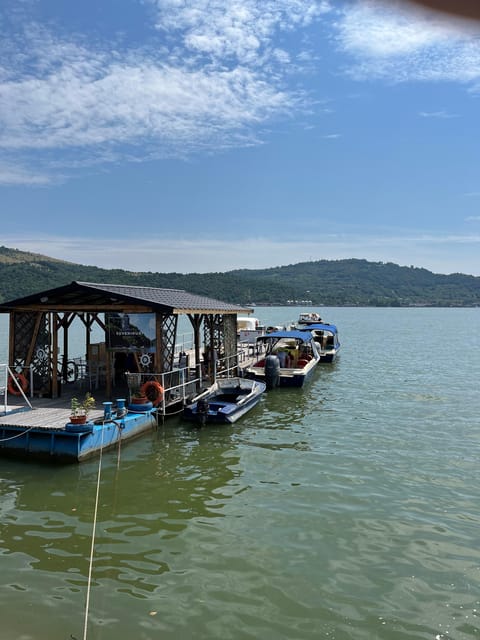
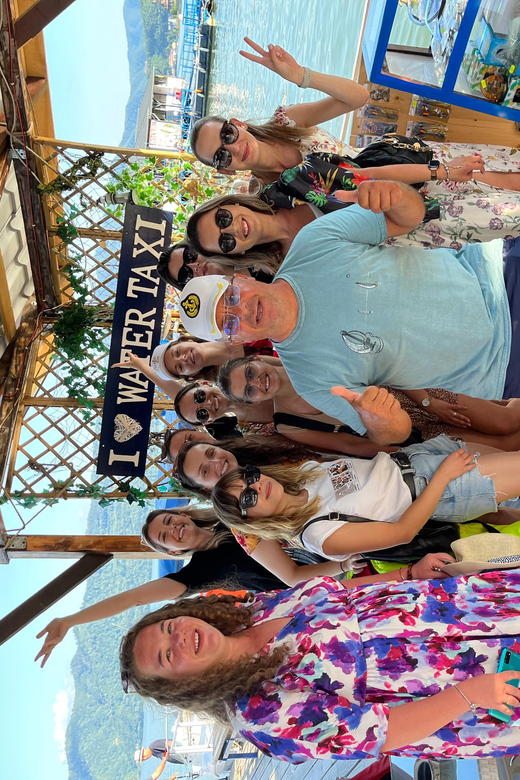
The departure point is called Debarcader WT. Look for a wooden platform beside the shore walking path, a black-roofed pontoon, and two banners with the operator’s logo. It is a short distance from Hotel Apolodor.
You need to arrange your own way to the waterfront. Transport to the meeting point is not included, and the boat does not collect you from a hotel. Arrive ready to board rather than carrying large luggage, since oversize bags and big suitcases are not allowed.
Wear shoes that you can walk in comfortably, along with light clothing, sunglasses, and sunscreen. Bring cash for the optional cave entry. Headphones are also listed among the recommended items, useful if you prefer to listen to the audio guide without competing with engine noise or conversation.
The operator has run boat tours in this part of Romania since 2005. That long presence matters here because the route involves more than simply pointing out cliffs. The Danube around Orșova carries layers of Roman, Ottoman, religious, and modern industrial history.
Trajan’s Plaque and the first Roman marker
One of the first important stops is Trajan’s Plaque, also known as Tabula Traiana. This Roman inscription has watched over the Danube for more than 2,000 years.
The plaque records Roman road-building work from the time of Emperor Trajan. From the water, you can see how awkward this frontier must have been for ancient engineers. The rock face and river corridor make the inscription feel less like an isolated museum object and more like part of the setting it was built to mark.
This is a photo stop and guided sightseeing stop rather than a long land visit. The audio guide helps explain what you are seeing, but keep realistic expectations. You are viewing the plaque from a boat, not walking up to touch the stone.
Decebalus Rock: the tour’s big visual moment
The Decebalus Rock Sculpture is likely to be the most memorable sight on the route. The face of the Dacian king Decebalus is carved into a cliff above the Danube. It is described as Europe’s tallest rock sculpture and the third-largest rock monument in the world.
The scale is hard to appreciate in a photograph. As the boat approaches, the carved face grows out of the cliff, and the surrounding rock gives you a useful sense of size. This is the kind of stop where you will want your camera ready before the boat reaches the best angle.
You get time for photographs and an explanation through the guide. Since the sculpture is viewed from the river, the quality of your experience depends on visibility, light, and where you sit. The sunroof gives shelter from strong sun, but if clear photos matter to you, ask about the best side of the boat before departure.
The carving also connects the modern Danube route to the ancient Dacian and Roman conflict in this region. That context adds meaning to what could otherwise be just an impressive face cut into stone.
More self-guided walks and quests in Romania:
- Sibiu Old Town Exploration Game and Self-Guided Tour
★ 4.5 · 82 reviews - Sighisoara Fortress Quest: Exploration Game and Tour
★ 4.5 · 33 reviews - King Matia Secret Treasure Exploration Game in Cluj-Napoca
★ 4.5 · 30 reviews - Brasov’s Haunted Past: Self-Guided Tour & Quest
★ 5.0 · 7 reviews
Mraconia Monastery beside the water
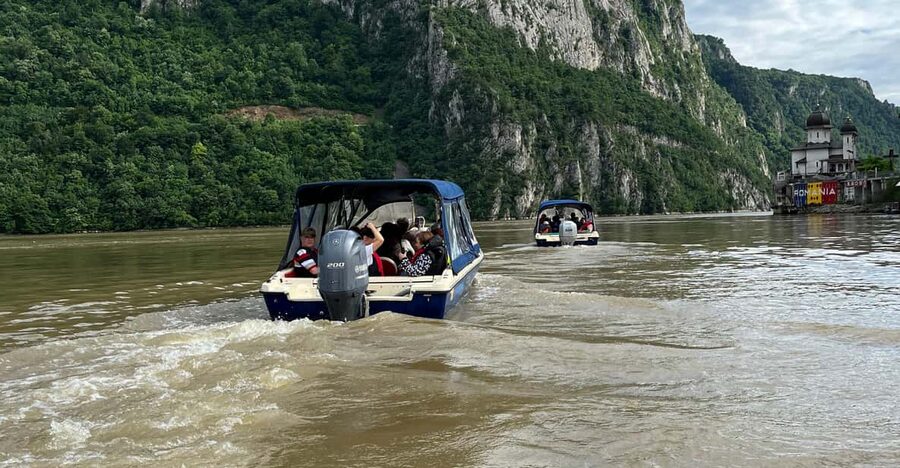
Mraconia Monastery offers a quieter change of pace after the huge cliff sculpture. The monastery sits close to the Danube and has become one of the area’s familiar waterfront sights.
The current monastery is associated with an older religious site affected by the reservoir’s creation. Its position beside the water makes it especially photogenic, with the building framed by cliffs and river.
This stop is mainly for photographs and guided sightseeing. You should not expect a long monastery visit or an extended religious program. Instead, treat it as a short chance to connect the dramatic natural setting with the spiritual life of the region.
The stop also shows how the modern reservoir reshaped old places. Around the Iron Gates, water covers former settlements and roads, while newer waterfront viewpoints bring attention to what remains visible.
Veterani Cave and the extra entrance fee
Veterani Cave has a different story. It was used as a strategic military shelter, giving the cave a practical role in the region’s past rather than a purely geological one.
The boat may stop at a pontoon, but the cave visit depends on security measures. Everyone in the group must agree to visit. Entry costs about $2 and is paid separately at the entrance.
An important detail is that the cave tour is led by other guides, not by the boat company. If you choose not to go inside, you can remain with the boat’s audio guide instead. This arrangement is worth knowing before you arrive, especially if your group has mixed interests or anyone dislikes uneven access points.
The listed cave stop lasts about 20 minutes. That is enough for a brief visit, but not for a lengthy exploration. Wear practical shoes, and keep your expectations modest. The value here comes from the combination of the cave’s military past and its location along a dramatic river corridor.
Ponicova Cave, a passage through the mountain
Ponicova Cave is notable because of its through-and-through formation. The Danube has access to the cave system, creating a rare relationship between river and rock.
The boat stop gives you a chance to see the cave and hear about its formation. The exact viewing experience can depend on water conditions and access arrangements, so treat it as a sightseeing visit rather than a full caving trip.
I like the contrast between Ponicova and Veterani. Veterani is tied strongly to military use, while Ponicova is chiefly a natural feature. Seeing both helps you understand how people used and adapted to the Danube corridor over time.
The cave stops also break up the cruise. You are not sitting in the same position for 140 minutes while landmarks pass in the distance. There are points where you can focus on the rock, the waterline, and the details the audio guide identifies.
Tabula Széchenyi and the engineering story
Tabula Széchenyi recalls István Széchenyi, the Hungarian statesman associated with efforts to improve navigation on the Danube. The marker connects the river’s natural obstacles with the long struggle to make this route safer and more useful for shipping.
This is a smaller historical sight than Decebalus Rock, but it adds an important layer to the trip. The Danube was never just scenery. It was a transport route, a border, a military corridor, and an engineering challenge.
The guide’s commentary is especially useful here because a stone marker can be easy to miss without context. You get a photo stop and a short explanation rather than a long visit on land.
Iron Gates and the extended downstream views
The route continues toward the Iron Gates, the major dam and river passage associated with the modern reshaping of the Danube. The dam gives you a clear look at the scale of twentieth-century engineering in this part of Europe.
The 40-minute extra portion is described as a downstream ride near Iron Gates, with added historical information and views connected to Ada-Kaleh. This is not simply more time on the same stretch of river. It broadens the story from ancient monuments to modern infrastructure and a lost island.
Because the tour information describes both a 140-minute duration and a 2.5-hour journey, ask the operator whether the Iron Gates extension is included in your selected departure or added as part of the full route. This is the one practical point I would clarify before paying, especially if you have a tight schedule.
Ada-Kaleh, the island beneath the reservoir
Ada-Kaleh gives the trip its most haunting historical note. The island once had a Turkish character, but it now lies about 30 meters underwater after the reservoir was created.
You will not see the original island above the surface. Instead, the boat route and audio commentary explain what was lost. That may sound less dramatic than a visible ruin, but the submerged island adds emotional weight to the otherwise grand views.
This is also where the trip moves beyond simple sightseeing. The dam brought major benefits for power and navigation, but it also changed settlements, shorelines, and cultural places. Ada-Kaleh is a reminder that large engineering projects have human costs as well as impressive results.
Boat comfort, sound, and the best seat
The vessel holds 14 people and includes a sunroof. For a private group of up to six, that means you should have reasonable room to move your attention from one side of the river to the other.
The sunroof is helpful on bright days, although it does not remove the need for sunscreen. The boat has an engine designed for smooth sailing, but you are still on a river, so people with back problems or recent surgery should take the restrictions seriously.
Life jackets are supplied for every passenger. Alcohol and drugs are not permitted, and large bags cannot come aboard.
The multilingual audio guide is available in English, Hungarian, Spanish, and German. The host or greeter service is listed in English and Romanian. Since no individual guide’s name is provided, you should expect the audio system to carry much of the historical explanation rather than a named live guide delivering a full commentary.
Who gets the best value from this cruise
I would choose this trip if you want to see many of the Danube’s major sights without arranging separate visits. It suits families, couples, photographers, nature lovers, and people interested in Roman or regional history.
It is particularly good for a group of six. The private price becomes much easier to justify when divided among several people, and you can enjoy the route without being tied to strangers’ preferences.
I would be more cautious if you need wheelchair access, have limited mobility, are pregnant, or have a back condition. The experience is not suitable for wheelchair users, people with mobility impairments, pregnant women, or people recovering from recent surgery.
The tour is also not ideal if you want a long cave expedition or substantial time at each site. This is a moving overview, with short stops and a lot to see in one outing.
Free cancellation is available up to 24 hours before departure, and you can reserve now and pay later. Those terms help if your Orșova schedule depends on weather or other plans, but they do not replace checking the exact departure time and duration.
Should you book the Orșova boat tour?
Book it if you want a compact, private introduction to the Danube Cauldrons and the wider Iron Gates area. The strongest reasons are the unusual mix of sights, the small-group setup, the boat’s sunroof, and the chance to connect visible cliffs with places such as Ada-Kaleh that now lie underwater.
Before booking, confirm whether the 40-minute downstream section is part of your chosen 140-minute outing. Also budget the small cash fee for Veterani Cave, and decide in advance whether everyone in your group wants to make that optional visit.
For six people who want history, scenery, and easy photo stops, this is a good-value way to see the river. For a couple paying the full group price, the cost is harder to defend unless the private boat and full route are important to you.
FAQ
Where does the boat tour depart from?
It departs from Debarcader WT, on a wooden platform beside the waterfront walking path in Orșova. Look for a black-roofed pontoon and two banners near Hotel Apolodor.
How long does the tour last?
The activity is listed as 140 minutes, while the description also calls it a 2.5-hour journey. A separate 40-minute downstream section near Iron Gates and Ada-Kaleh is also described, so confirm the exact timing when booking.
What is included in the price?
The price includes the round-trip boat ride from Orșova, guided sightseeing along the Danube, stops at eight main attractions, photo opportunities, a multilingual audio guide, and use of the comfortable boat with sunroof.
Is the tour private?
Yes. The booking is for a private group, with a maximum of six people per group. The boat itself can carry up to 14 passengers.
Is the Veterani Cave visit included?
No. Entry to Veterani Cave costs about $2 and is paid separately. The visit depends on security measures, everyone must agree to go, and the cave visit is led by guides from outside the boat company.
Which languages are available?
The audio guide is available in English, Hungarian, Spanish, and German. Host or greeter service is listed in English and Romanian.
What should I bring?
Bring comfortable shoes, sunglasses, sunscreen, comfortable clothing, headphones, and cash. Large bags and oversize luggage are not allowed.
Who should avoid this boat tour?
The activity is not suitable for pregnant women, people with back problems, people with mobility impairments, wheelchair users, or people with recent surgeries.
Newest Romania trips on the site
- Winery touring & private wine tasting – one day private tour★ 5.0 · 3 reviews
- Private tour to Turda Salt Mine, Rimetea and Alba Iulia★ 4.8 · 5 reviews
- Bucharest: Dealu Mare Winery Private Trip with Wine Tasting★ 4.9 · 6 reviews
- Village Museum Bucharest Guided Tour★ 5.0 · 6 reviews
- Transylvania Tour: Dracula’s Castle, Peles Palace & Brasov★ 5.0 · 19 reviews
- Turda salt mine and Corvin Castle day tour from Cluj★ 5.0 · 9 reviews
- Turda Salt Mine, Gorge & Rimetea Village (private from Cluj)★ 5.0 · 5 reviews
- PRIVATE 8h tour: Mila23 and SULINA – the end of the Danube★ 5.0 · 3 reviews
Cruises & Boat Tours, compared.
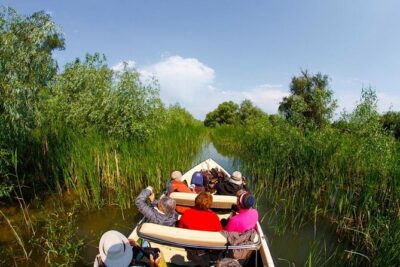
Danube Delta – Private Tour with Boat Trip & Traditional Lunch
Read our review →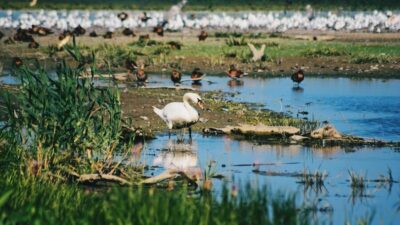
Danube Delta: Boat Tour Through the Water Lily Reserve
Read our review →
Danube Delta PRIVATE boat trip to Letea Forest (guided tour)
Read our review →
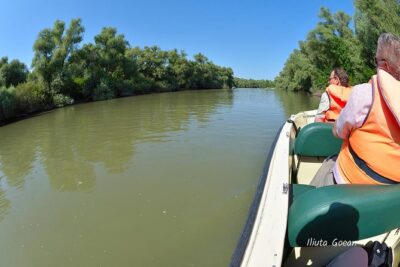
Danube Delta PRIVATE boat trip to Mila23 Village (guided tour)
Read our review →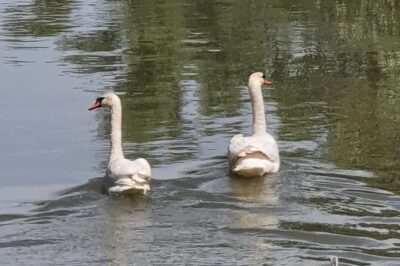
Browse the lists this tour appears in