
Reviewed · COMMUNIST HISTORY TOURS
Relics of Communism: 3-Hours Walking Tour (Small groups)
Bucharest’s communist past is easiest to grasp when you see it in the streets, not just in a museum. This three-hour walk follows the path from Ceausescu’s final speech at Revolution Square to the enormous Palace of Parliament, showing how power reshaped the city and daily life. I especially like the small group, capped at 10, and the way guides Mara and Elena connect buildings to personal stories. The main drawback is that it is a walking tour with no museum admissions, so you will get context rather than indoor exhibits.
Key points to know before booking
- Revolution Square puts you at the center of the 1989 uprising, beginning where Ceausescu gave his last public speech.
- The route explains both the communist period and its aftermath, including the neo-communist era after 1989.
- Unirii Square and Unirii Boulevard reveal Ceausescu’s city planning, on a scale that is hard to understand from photographs.
- Mihai Voda Monastery adds a religious side to the story, showing how churches survived major urban changes.
- A small group of no more than 10 people gives you a better chance to ask about life under communism.
- One Romanian snack from the communist period is included, while museum entry and Palace of Parliament admission are not.
Why this Bucharest walk matters
Bucharest can feel confusing at first. One block has ornate older buildings, the next has broad avenues and huge government structures. The contrast is not random. It reflects a city reshaped by Nicolae Ceausescu’s political ambitions, forced redevelopment, and the violent events of December 1989.
This tour gives you a useful framework for reading those streets. Instead of treating the Palace of Parliament as a giant photo stop, you learn why it was built, what it displaced, and how it fit into Ceausescu’s idea of absolute power.
I like the route because it deals with communism as a lived period, not just a collection of dates. The stories cover political control, public demonstrations, religion, architecture, and the daily meaning of a system that shaped several generations.
The start time is 11:00 a.m., which gives you a practical morning activity without requiring an early rise. The route ends in Constitution Square, directly in front of the Palace of Parliament. That finish gives the walk a clear visual payoff, although the tour does not include entry to the building.
More Walking Tours in Bucharest
- Bucharest: City Highlights Guided Walking Tour
★ 4.9 · 1,482 reviews - Bucharest Highlights Walking Tour
★ 5.0 · 469 reviews - Bucharest: Ghost Stories & Romanian Mythology Walking Tour
★ 4.9 · 287 reviews
Revolution Square and the final speech
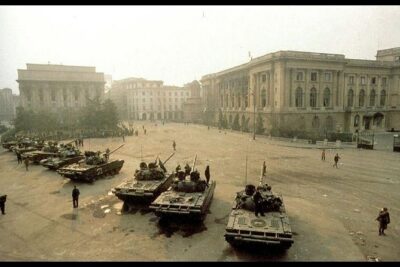
The tour begins at Revolution Square, in front of the balcony where Ceausescu delivered his last speech. This is the right place to start because the square links the public image of communist power with the sudden collapse of that power.
You spend about 20 minutes here. The guide explains what happened during the 1989 Revolution and how the crowd reacted as Ceausescu addressed the nation. Seeing the exact setting helps you understand why the speech became such a powerful moment in Romanian history.
This is also a useful stop for learning how public space worked under the communist government. A balcony, a square, and a large gathering could project authority. In December 1989, the same setting became a place where that authority was challenged.
You will not enter a museum at this stop, and there is no admission fee. The value comes from the guide’s explanation and the location itself. If you had only a short time in Bucharest, this would still be a worthwhile place to visit, but the tour gives the square much more meaning than a quick photograph would.
Guide Mara has been praised for answering detailed questions about life during communism and for making the subject personal without losing the wider story. Elena is also named as a guide who provides a detailed overview of the era. If your guide is one of them, you should have a good opportunity to ask about points that interest you.
Piața 21 Decembrie 1989 and the cost of change
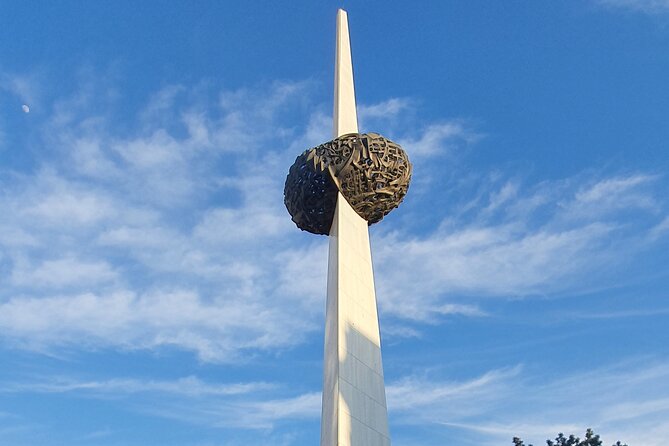
The next stop is Piața 21 Decembrie 1989, where you spend another 20 minutes. The name itself commemorates the date when the revolution reached a decisive point, and the guide uses this square to explain the incidents of December 21.
This part of the tour focuses on the people involved in the uprising, the heroes of the revolution, and the complicated period that followed. The story does not simply end with the fall of Ceausescu. You also hear about the neo-communist era, which helps explain why political change did not produce an instant break with the past.
That distinction is important. A visitor can easily think of 1989 as a single dramatic day followed by a clean new beginning. The tour instead gives you a more careful picture of what changed and what remained.
I find this stop especially useful if you know little about Romanian politics after the revolution. It gives you a bridge between the old regime and modern Bucharest. The subject can be difficult, but a small group makes it easier to pause and ask for clarification.
Unirii Square and Ceausescu’s rebuilt center
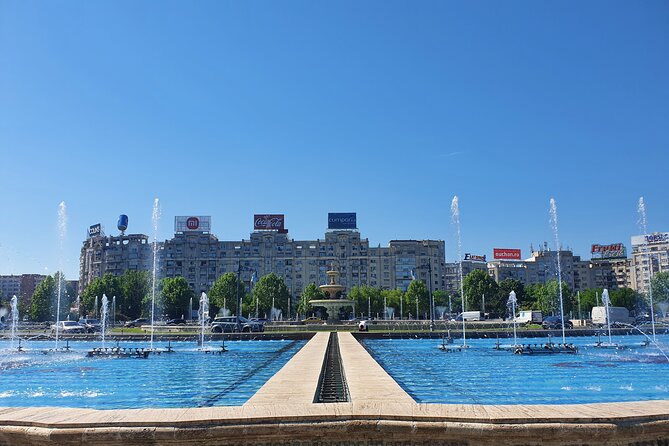
At Unirii Square, the tour shifts from political events to urban planning. This was built as the new city center during the communist period and is cut through by the broad Unirii Boulevard.
You spend about 20 minutes here learning about the rise of Romania’s communist party and Ceausescu’s cult of personality. The scale of the square and boulevard helps explain how architecture was used to display control. Wide avenues and open spaces can move crowds, frame official buildings, and make the individual feel small.
This is one of the places where a guide adds real value. On your own, you might notice the size of the boulevard but miss the reasons behind it. The story turns an oversized road into evidence of a political system.
The stop also helps you read Bucharest as a city altered by demolition and reconstruction. You get a clearer sense of why the center looks so different from older parts of the city. The tour does not present redevelopment as a simple modernization project. It connects the new center to political power and the leader’s public image.
If you enjoy architecture, city planning, or modern European history, Unirii Square may be one of the strongest parts of the walk. If you prefer interiors and artifacts, you may find the stop less satisfying because the experience remains outdoors and interpretive.
More communist-era history walks in Bucharest:
- The Real tour of Communism
★ 5.0 · 666 reviews - Life under Communism
★ 5.0 · 358 reviews - 3-Hour Guided Tour of Communist Bucharest
★ 4.9 · 303 reviews - Bucharest Essential Tour: Old Town, Calea Victoriei & Communism
★ 5.0 · 142 reviews
Mihai Voda Monastery and religion under communism
Mihai Voda Monastery provides a change of subject and pace. Here, the guide discusses Bucharest’s less obvious churches and the relationship between the communist government and religion.
You spend about 20 minutes at this stop. Its importance is not only religious. It shows that communist redevelopment affected places of worship as well as homes, streets, and government buildings.
The stop gives the tour a needed human dimension. Politics and monumental architecture can dominate a story about communism, but faith remained part of life for many people. The guide explains how the authorities treated religion and how churches fit into a city undergoing major reconstruction.
The supplied details do not promise entry inside the monastery, so you should think of this as an outdoor historical stop rather than a church visit. You also should not expect a full religious tour. Its purpose is to add another angle to the political story.
I like this pause because it breaks up the sequence of squares and boulevards. It also reminds you that Bucharest is not only a city of state buildings. Older religious sites survived alongside the massive new center, sometimes in ways that are easy to miss unless someone points them out.
The Palace of Parliament and the final view
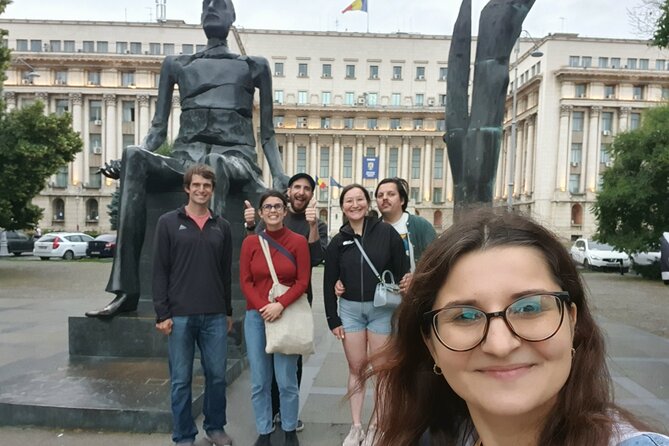
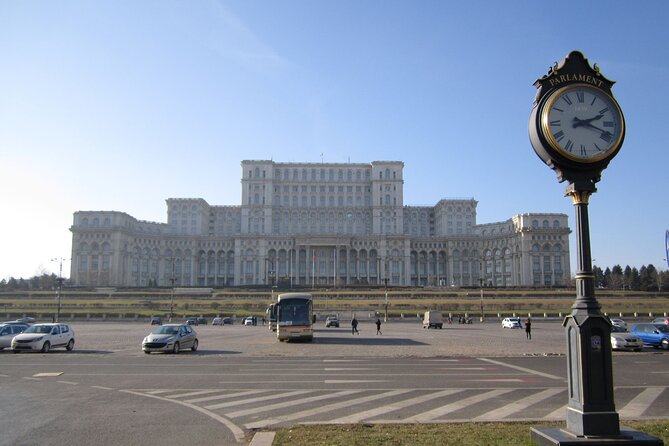
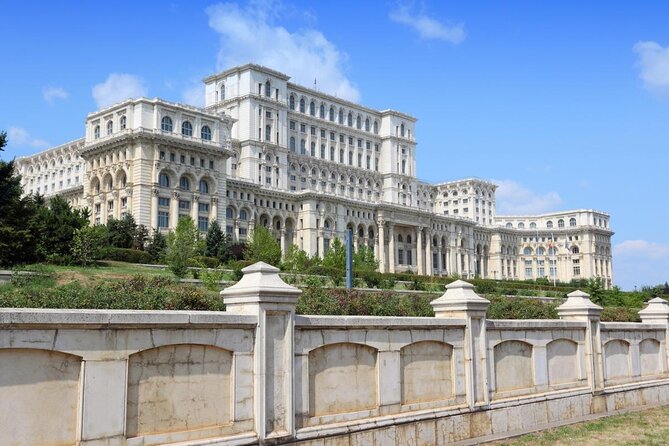
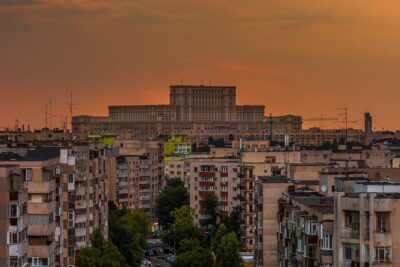
The final major stop is the Palace of Parliament, reached through Constitution Square. The tour explores the new districts associated with socialist realism, the rebuilding around Unirii Boulevard, and the Palace’s role as the center of Ceausescu’s power.
You spend about 20 minutes here learning about what is described as the world’s second-largest administrative building. The guide also shares its less obvious details and explains why the building mattered politically, not just architecturally.
The Palace is difficult to absorb from a distance. Its size is obvious, but its connection to the reshaping of Bucharest is less so. The tour helps you link the building to the broad avenues, the new districts, and the leader’s wish to create a setting suited to centralized rule.
This is the point where the route comes together. Revolution Square showed power losing its grip. Unirii Square showed power remaking the city. Constitution Square places you before the structure built to express that power at its greatest scale.
Admission to the Palace of Parliament is not included. No museum admissions are included anywhere on the walk, so you will need a separate visit if you want to see the interior. That is a genuine limitation for anyone hoping for a complete Palace experience, but it also keeps the tour focused and within three hours.
The ending is practical. You finish in front of the Palace, with access to public transportation nearby. From there, you can continue exploring the area or make your own plans without returning to the starting point.
A small group changes the experience
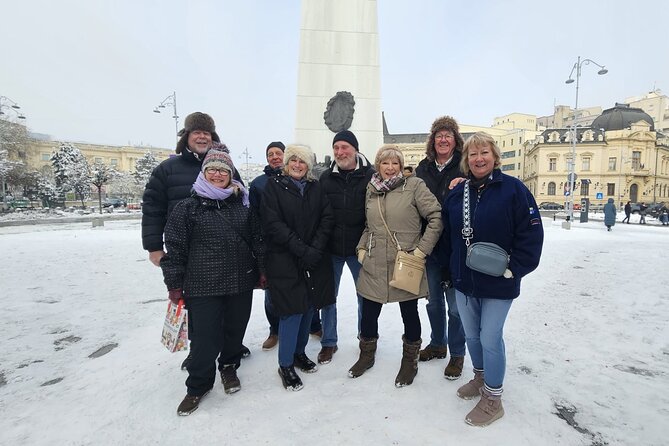
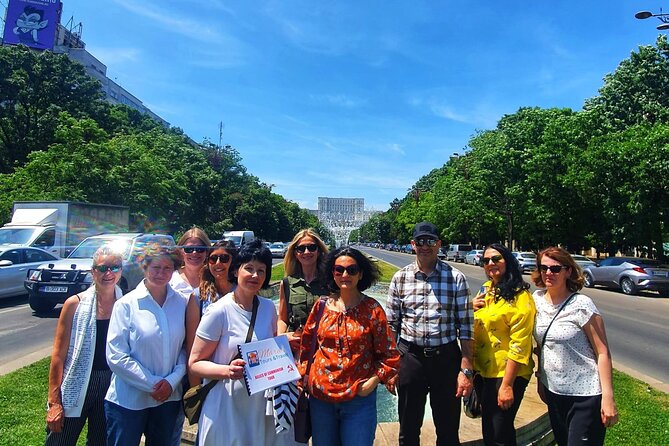
The tour allows a maximum of 10 people. That is a useful size for a subject that often produces questions, especially when the guide is discussing political repression, the revolution, or personal life under Ceausescu.
A larger group can make a city walk feel like a moving lecture. Here, you have a better chance to hear clearly and ask about a detail that catches your attention. The small format also suits the route, since several stops depend more on explanation than on a formal site visit.
The guide is central to the experience. Mara is described as personable and able to answer detailed questions about life under communism. Elena is described as giving a thorough account of the period. Those details matter because this is not a tour where you simply follow a route and take pictures.
The tour is offered in English. Confirmation arrives when you book, and service animals are allowed. You should have a moderate level of physical fitness, since the activity lasts about three hours and takes place on foot.
What the $48.06 price gets you
At $48.06 per person, this is not the cheapest way to see central Bucharest. You can visit the squares and view several buildings without paying for a guide. The question is whether the historical explanation is worth the extra cost.
For me, the answer depends on your interests. If you want to understand why Bucharest has such broad avenues, imposing government buildings, and sharp contrasts between old and communist-era districts, the price is reasonable. You are paying for a focused route, a guide who can answer questions, and a clear account of events that are not always easy to piece together alone.
The small group improves the value. A private tour would cost more, while a large group might offer less opportunity for questions. This sits in the middle: a shared experience with a limited number of people.
The included Romanian snack is modest, but it adds a small connection to daily life during the period. It should not be the reason you book. Think of it as a useful break during a three-hour walk and a chance to discuss food and ordinary life under communism.
No museum or Palace admission is included. Keep that in mind when planning your budget. If you want to enter the Palace of Parliament, you will need to arrange that separately, and this tour will not replace an interior visit.
Who should book this walk?
I would recommend it most strongly if you are visiting Bucharest for the first time and want a historical overview early in your stay. It gives you a map of the city’s communist center and makes later sightseeing easier to interpret.
It also suits anyone interested in twentieth-century Europe, political history, architecture, or the 1989 revolutions. The route does not treat the past as a collection of grand buildings. It connects public spaces with political events and ordinary life.
The tour is less suitable if you dislike walking, want extensive interior access, or prefer a general introduction to Romanian culture beyond the communist period. It is tightly focused on communism, the revolution, and the city changes linked to that era.
Plan for comfortable walking clothes and shoes. The weather matters because the experience takes place outdoors, and poor weather can lead to a new date or a full refund. Free cancellation is available until 24 hours before the 11:00 a.m. start time. Changes or cancellations within 24 hours are not accepted for a refund.
Should you book Relics of Communism?
Book it if you want the political story behind Bucharest’s oversized streets and buildings, and if you value a guide who can answer questions in a small group. The route from Revolution Square to the Palace of Parliament is logical, and the stops build toward a strong final view.
Skip it if you mainly want to tour the Palace interior or visit museums. Those admissions are not included, and the experience stays outdoors.
For most first-time visitors with a moderate walking ability, this is a useful three-hour introduction. The perfect score from 17 reviews and a 100 percent recommendation rate fit the tour’s strongest qualities: clear explanations, personable guides such as Mara and Elena, and a route that gives Bucharest’s communist-era center a meaning you might otherwise miss.
FAQ
How long is the Relics of Communism walking tour?
The tour lasts approximately three hours.
Where does the tour begin?
It begins at Revolution Square, Piața Revoluției, in Bucharest.
Where does the tour end?
It ends in Constitution Square, in front of the Palace of Parliament.
What time does the tour start?
The scheduled start time is 11:00 a.m.
What language is the tour offered in?
The tour is offered in English.
How large is the group?
The tour has a maximum of 10 participants.
Is admission to the Palace of Parliament included?
No. Admission to the Palace of Parliament is not included, and no museum admissions are included.
Is food included?
Yes. One famous Romanian snack from the communist era is included.
Can I cancel for a full refund?
Yes, if you cancel at least 24 hours before the experience begins. Cancellations or changes made less than 24 hours before the start time are not refundable.
Newest Bucharest trips on the site
- Winery touring & private wine tasting – one day private tour★ 5.0 · 3 reviews
- Bucharest: Dealu Mare Winery Private Trip with Wine Tasting★ 4.9 · 6 reviews
- Village Museum Bucharest Guided Tour★ 5.0 · 6 reviews
- Private Transfer from Giurgiu Port to Bucharest★ 4.5 · 12 reviews
- Airport Henri Coanda (Otopeni) to Bucharest – Private Transfer – Driver★ 5.0 · 5 reviews
- Salt Mine Tour from Bucharest with Entrance Ticket★ 4.5 · 19 reviews
- Wine tasting in Bucharest Old town – bonus cheese platter★ 4.5 · 6 reviews
- Walking tour of Bucharest★ 5.0 · 3 reviews
Communist History Tours, compared.
Bucharest Essential Tour: Old Town, Calea Victoriei & Communism
Read our review →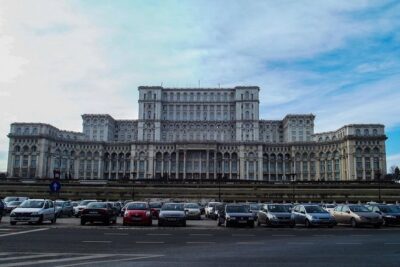
Communism in Bucharest – Landmarks, Museum & Communist Appetizers
Read our review →


Museum of Communism Ticket with Communist Coffee
Read our review →Browse the lists this tour appears in