
Reviewed · SAXON VILLAGE TOURS
SB02-Half day Surroundings of Sibiu:Saxon Heritage &Villages
The striking idea here is to pair Romania’s famous Transfăgărășan Road with two Saxon villages that many visitors would struggle to reach efficiently on their own. In one outing, you move from high mountain scenery and a glacial lake to medieval churches built for worship and defense.
I like the contrast between Bâlea Lake and the old villages, and I like the guide-led format. Guides such as Mihai, Ilie, Alex, and Marius have been praised for clear English, careful driving, and explanations that range from church architecture to modern Romanian life. The main consideration is the schedule: the experience is advertised as four hours, yet the published day runs from 9:00 AM until about 4:00 PM. Confirm the exact timing before you book.
Key points to know before booking
- Bâlea Lake gives you mountain scenery: Reach a high glacial lake on the Transfăgărășan and have free time around the water.
- The route combines nature and culture: You see the Făgăraș Mountains, then visit the Saxon churches of Cisnădie and Cisnădioara.
- The churches are genuinely old: Cisnădie began as a 12th-century Romanesque basilica, while Cisnădioara has one of Transylvania’s oldest Romanesque churches.
- The guide adds local context: Expect information about medieval defense, Romanian society, the economy, environmental protection, and village life.
- Transport is simple: You meet at the Sala Thalia Hall parking area in Sibiu and ride in an air-conditioned car or van.
- Budget for extras: Food, drinks, entrance fees, photo fees, and personal purchases are not included in the $88 price.
Why this Sibiu day trip works so well
Sibiu is one of Romania’s most rewarding bases for exploring Transylvania, but the surrounding sights are spread out. The Transfăgărășan is a mountain road, Cisnădie is a small town, and Cisnădioara sits on a hill above its village. A private group with a driver and guide saves you from piecing together several buses or worrying about mountain-road directions.
The strongest feature is the range of the day. The Transfăgărășan brings dramatic mountain views and a sense of motion. The churches slow things down. Their thick stone walls, towers, and hilltop settings explain how medieval communities used religious buildings as places of refuge when invasions threatened.
I also like that the experience is private rather than a large coach outing. The supplied information does not give a fixed maximum group size, but it identifies the format as a private group. That usually makes it easier to ask questions, adjust the pace within reason, and hear the guide while standing inside or beside a church.
The price is $88 per person. That is not a bargain-basement bus trip, but it covers a modern air-conditioned vehicle, an English-speaking guide and driver, parking taxes, road taxes, and a map of Romania. Since this route is difficult to arrange neatly without a car, the price can make sense for a first visit to the area. Still, you must add any entrance charges, food, drinks, photo fees, and souvenirs.
More Saxon village and fortified church trips:
- Small Group Tour to Viscri Church Sighisoara Town Rupea Fortress
★ 5.0 · 225 reviews - From Brasov: Sighisoara and Viscri UNESCO Day Tour
★ 4.8 · 86 reviews - Secrets of the Citadels: Brașov, Viscri, Sighișoara and Sibiu
★ 5.0 · 52 reviews
The Transfăgărășan: Romania’s great mountain road
The first major part of the outing heads from Sibiu toward the Transfăgărășan, also known as DN7C. The road cuts through the Făgăraș Mountains, the highest range in the Carpathians, and was built as a strategic military route in the 1970s during Nicolae Ceaușescu’s rule.
That background gives the drive more weight than a simple scenic road trip. You are looking at an ambitious piece of infrastructure with a political and military past, not just a collection of curves and viewpoints. The guide can help connect the road to Romania’s recent history and explain what you are seeing along the way.
The route is often promoted as one of the world’s great driving roads. That description is understandable, but the value for you is not only the road itself. The mountain setting, changing views, waterfall, and lake provide the visual reward. You can enjoy the route without being the person behind the wheel.
The schedule allows about 1.5 hours for the Transfăgărășan section, including Bâlea Waterfall and Bâlea Lake. That is enough for a scenic stop, photographs, and a little time beside the lake, but it is not a full mountain outing. If you want long walks or extended time outdoors, this tour may feel brisk.
Bâlea Waterfall and Bâlea Lake
Bâlea Waterfall is one of the listed attractions along the road. The description does not promise a long hike to the waterfall, so expect sightseeing rather than a dedicated trek. Your guide can point out the main natural features, and you should have time to take photographs.
Bâlea Lake is the main mountain stop. It is a glacial lake surrounded by the Făgăraș peaks, giving the visit an alpine feel that is very different from Sibiu’s old town. You receive free time here, which matters. Not every minute is filled with commentary, and you can look around at your own pace.
Bring sensible shoes and an extra layer. This is practical advice rather than a claim about a specific weather forecast: mountain conditions can feel very different from those in Sibiu, and one October outing took place in wintry conditions. The mountain stop may be cold, wet, or windy even when the morning in town feels mild.
The season is important. The stated operating period is June through October, on Mondays, Wednesdays, Fridays, and Saturdays. The Transfăgărășan can be affected by mountain conditions, so confirm that the road and lake section are operating for your chosen date. The supplied experiences from January, February, and March show that similar private outings have taken place outside the stated period, but those older examples should not be treated as a guarantee for this current schedule.
Cisnădie and its fortified church
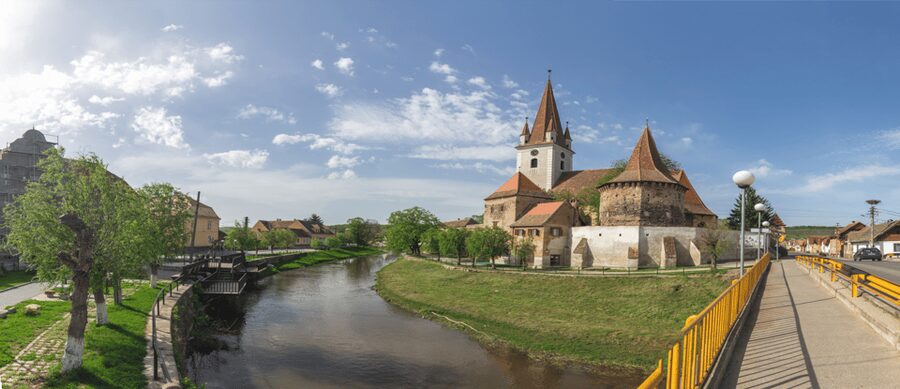
After the mountain section, the route turns toward Cisnădie. The church here began in the 12th century as a Romanesque basilica and was fortified in the 15th century. This change tells you something important about medieval Transylvania: a church could also serve as a defensive center for the local community.
Cisnădie’s church is known for defensive towers and a clock tower. It also houses one of the first mechanical clocks in Transylvania, installed in the 14th century. That detail makes the stop more than an architectural photo opportunity. You are seeing a building connected to both religious life and the practical organization of a medieval town.
The visit is scheduled for about one hour. That gives the guide time to explain the church, its Saxon background, and the reasons fortified churches appeared across the region. It should also leave you enough time to look carefully at the stonework and defensive features instead of rushing through in a few minutes.
The Saxon connection is central. German-speaking settlers shaped many villages and towns in Transylvania, leaving behind churches, settlement patterns, and local traditions. Your guide can help you understand that heritage as part of a living region rather than as a collection of isolated medieval monuments.
More history tours around Sibiu:
- Bucharest: 3-Hour Dark History Tour with a Local
★ 4.9 · 301 reviews - Bucharest: Small Group History, Art & Secrets Tour
★ 4.7 · 152 reviews - Guided Walking Tour of Historical Bucharest
★ 5.0 · 84 reviews - Bucharest Jewish Heritage | Holocaust Memorial | Private Car Tour
★ 5.0 · 38 reviews
Cisnădioara and Michelsberg Fortress
Cisnădioara is smaller and quieter in feel. Its fortified church, also known as Michelsberg Fortress, dates from the 12th century and is described as one of the oldest Romanesque-style churches in Transylvania.
The building is made of stone and retains a simple Romanesque character. Its thick, sturdy walls are less about decoration than endurance. The hilltop position gives the church a commanding view of the surrounding area, which makes the defensive purpose easy to understand.
The stop is planned for about 30 minutes. That is brief, but it suits the scale of the visit. You can see the church, take in the hilltop setting, and hear the main historical points. Do not expect a long museum visit or a slow village walk. The appeal is the combination of the old stone church and the view around it.
For me, this is where the tour’s theme comes together. Cisnădie shows a larger fortified church with a clock tower and a longer civic story. Cisnădioara offers an older, more stripped-back building in a setting that helps you picture why the location mattered. Seeing both makes the Saxon heritage easier to grasp.
What the guides add to the day
The guide is a major part of the value. The English-speaking guides named in past outings include Mihai, Ilie, Alex, and Marius, so the assigned person may vary. Their strengths are not limited to memorized dates.
Mihai was praised for explaining nature, culture, environmental protection, Romanian history, monuments, the economy, society, and heritage in clear English. Ilie was described as a relaxed driver with a wide range of knowledge, including hydropower, Roma life, and current economic conditions. Alex led an interesting private outing during a quieter February period, while Marius was noted for fluent English, local history, and small details about Romanian life.
That range is useful because the route passes through more than scenic countryside. You are moving through a region shaped by Saxon settlement, medieval defense, communist-era infrastructure, rural communities, and present-day economic changes. A good guide can connect those subjects without turning the ride into a lecture.
The experience also seems suited to questions. If you want only photographs from the window, a guide may add less value. If you want to understand why a church is fortified, how the mountain road came to be built, or what rural life is like today, the added explanation is a strong reason to choose this outing.
Timing, transport, and what to bring
The meeting point is the Sala Thalia Hall parking area in Sibiu, with departure listed at 9:00 AM. You return to the same location. The vehicle is described as a modern, air-conditioned car or van, and parking and road taxes are included.
There is an important timing mismatch in the supplied information. One section calls the activity four hours and gives a sequence of 1.5 hours on the Transfăgărășan, one hour in Cisnădie, and 30 minutes in Cisnădioara. Another schedule places the return at 4:00 PM, which makes the full outing about seven hours. Ask the provider which version applies to your date. This matters if you have a train, dinner reservation, or another afternoon booking.
The minimum for a guaranteed departure is two participants. Solo visitors are asked to contact the provider about availability. The group is private, but the exact vehicle capacity is not supplied.
Bring a passport or ID card. Wear shoes suitable for uneven ground and carry warm clothing for Bâlea Lake. Food and drinks are not included, and no meal stop is promised, so plan accordingly. Smoking is not allowed in the vehicle, and alcohol and drugs are prohibited.
The outing is not suitable for people over 95 years old. The information does not provide detailed accessibility guidance, so anyone with mobility concerns should ask about the church approaches, hilltop access, and vehicle arrangements before paying.
Who should book this experience?
I would recommend it most strongly if you have a few days in Sibiu and want one outing that combines nature, history, and local interpretation. It is also a good choice if you do not want to drive the Transfăgărășan yourself or arrange separate transport to two smaller communities.
The outing suits people who prefer explanation over a simple transfer. The guides have been praised for speaking fluent English and making subjects such as history, society, and the economy approachable. That gives the drive real value, especially if you want a broader understanding of Romania.
It is less suitable if you want a long hike, an unhurried day at Bâlea Lake, or extensive time inside each church. The route covers several distinct places, so each stop has a clear limit. The uncertain four-hour versus seven-hour timing is another reason to confirm details before booking.
The seasonal schedule also narrows your choices. The stated operation is June through October on four days each week. If you are visiting outside that period, contact the provider rather than assuming the trip runs.
Should you book the Sibiu Saxon villages tour?
Book it if you want an efficient private outing that joins the Transfăgărășan with two meaningful Saxon heritage sites. The mountain road and Bâlea Lake provide the big scenery, while Cisnădie and Cisnădioara give the day its historical depth. The guides’ strong English and broad local knowledge are important advantages.
Skip it if your priority is a relaxed full day in one place, serious hiking, or a clearly defined four-hour schedule. Before booking, confirm the operating date, road conditions, exact duration, entrance charges, and the guide assigned. For the right visitor, $88 buys more than transport: it gives you context for a part of Romania that is difficult to understand from a quick stop alone.
FAQ
Where does the tour start and finish?
It starts at the Sala Thalia Hall parking area in Sibiu and returns to the same location.
What time does the tour depart?
Departure is listed for 9:00 AM.
How long does the tour last?
The activity is advertised as four hours, but another schedule shows departure at 9:00 AM and return at 4:00 PM. Confirm the exact duration with the provider before booking.
Which places are visited?
The route includes the Transfăgărășan Road, Bâlea Waterfall, Bâlea Lake, Cisnădie Fortified Church, and Cisnădioara Fortified Church.
Is an English-speaking guide included?
Yes. An English-speaking specialized guide and driver are included.
What does the price cover?
The $88 price includes transport in a modern air-conditioned car or van, the English-speaking guide and driver, parking taxes, road taxes, and a map of Romania.
Are meals and entrance fees included?
No. Food, drinks, entrance fees, photo fees, souvenirs, and other personal costs are not included.
What should I bring?
Bring a passport or ID card. Warm clothing and suitable shoes are sensible for the mountain stop, particularly during cooler conditions.
More Half-Day Trips Around Sibiu
- Bucharest: Half Day Bike Tour
★ 4.9 · 379 reviews - Half-Day Private Food and Wine Walking Tour Oradea Romania
★ 5.0 · 55 reviews - Private Half Day Trip to Snagov Monastery & Mogosoaia
★ 4.1 · 29 reviews - Bucharest: Half-Day Sightseeing Tour
★ 4.5 · 29 reviews
Newest Sibiu trips on the site
- Transfagarasan, Vidraru and Poenari Fortress Tour from Sibiu★ 4.5 · 5 reviews
- Private Transfagarasan&Balea Lake★ 5.0 · 3 reviews
- City Tour Sibiu in English★ 4.5 · 12 reviews
- Sambata de Sus: E-Bike Guided Tours★ 5.0 · 16 reviews
- Sibiu City Tour – Private Day Trip from Bucharest★ 5.0 · 4 reviews
- Day Trip to Sibiu Transylvania from Bucharest★ 4.5 · 11 reviews
- Day Trip to Sibiu and Fagaras Fortress from Bucharest★ 4.5 · 4 reviews
- PRIVATE Day tour to Sibiu – European Capital of Culture 2007★ 3.5 · 3 reviews
Saxon Village Tours, compared.
Small Group Tour to Viscri Church Sighisoara Town Rupea Fortress
Read our review →
Secrets of the Citadels: Brașov, Viscri, Sighișoara and Sibiu
Read our review →
Sighisoara and Viscri Private Full-Day Tour from Brasov
Read our review →

UNESCO TOUR :Sighisoara ,Viscri and Rupea Tour from Brasov
Read our review →
Transylvania Gems: Sighisoara, Medias, Biertan & Gypsy life
Read our review →Browse the lists this tour appears in