
Reviewed · HISTORICAL TOURS
Guided Walking Tour of Historical Bucharest
Bucharest makes more sense when you see its old churches, grand avenues, communist monuments, and Revolution sites in one continuous walk. This tour links them all, from Manuc’s Inn and the Old Princely Court to the Palace of Parliament and the balcony where Nicolae Ceaușescu gave his final speech.
I like the private format, since your guide can answer questions and adjust the pace. I also like the focus on living history, especially the way Ceaușescu’s dictatorship and the Cold War changed the city. The main drawback is the amount of walking: one guest recorded more than 17,000 steps, and some tours run longer than the advertised three hours.
Key points at a glance
- A private walk through central Bucharest: Only your group takes part, with an English-speaking guide.
- A wide historical sweep: The route moves from medieval Wallachia through monarchy, communism, the 1989 Revolution, and modern Bucharest.
- Big sights and small details: You see the Palace of Parliament, but also old passages, churches, courtyards, banks, and former inns.
- Strong guide-led storytelling: Alina is the guide most often named, with Elena also mentioned in one account.
- A serious physical outing: Bring water and wear comfortable shoes, especially in hot weather.
- Good first-day orientation: The walk gives you a useful map of central Bucharest before you explore on your own.
What this Bucharest walk is really about
This is not simply a parade of buildings. The route uses Bucharest’s streets to explain how power reshaped the city.
You begin in the Old Town, among buildings tied to medieval rulers and merchant life. From there, the walk heads toward the enormous boulevards and open spaces created under communist leader Nicolae Ceaușescu. Later, you pass through the city center where the 1989 Revolution unfolded, ending with monuments and landmarks linked to Romania’s return to democracy.
I like that range. In three hours, you get more than old façades and photo stops. You see how Bucharest shifted from a Wallachian capital to a royal city, then to a heavily controlled communist capital, and finally to a modern European city still carrying visible marks of its past.
The guide is central to the experience. Alina is repeatedly praised for her energy, personal memories, and broad command of Romanian history. Her style is lively and strongly opinionated. That can make the walk memorable, but you should expect a great deal of political discussion, especially around communism, the monarchy, government, and the changes Romania has gone through.
More Historical Tours in Bucharest
- Bucharest: 3-Hour Dark History Tour with a Local
★ 4.9 · 301 reviews - Bucharest: Small Group History, Art & Secrets Tour
★ 4.7 · 152 reviews - Bucharest Jewish Heritage | Holocaust Memorial | Private Car Tour
★ 5.0 · 38 reviews
Starting at Manuc’s Inn and the old religious quarter
The meeting point is outside the main entrance of Manuc’s Inn, Hanul lui Manuc, at 62 Strada Franceză. This is a smart place to start. The inn is one of Bucharest’s oldest and best-known historic buildings, and its courtyards and restored spaces give you an immediate sense of the city before the grand boulevards appear.
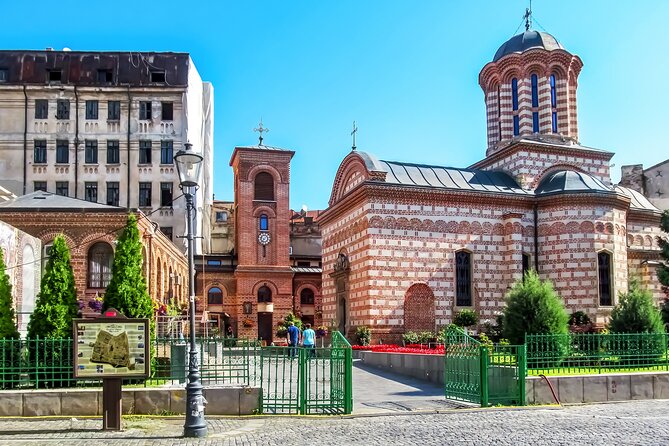
The tour also covers St. Anton Orthodox Church, once associated with the coronation of Wallachian rulers. Another church on the route dates from 1724, giving you a chance to see how religious buildings survived alongside later political and commercial changes.
These opening stops are useful because they place Bucharest in its earlier setting. You are not beginning with Ceaușescu or the Palace of Parliament. You first get the medieval and religious foundations of the city, then watch the capital change around them.
The Old Princely Court and Vlad the Impaler
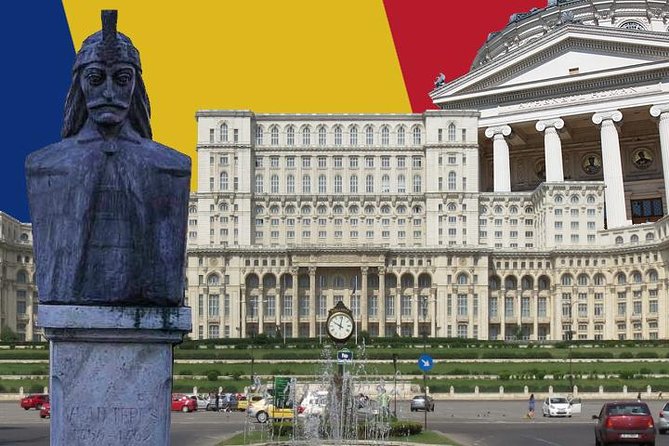
At the Old Princely Court, you see the remains of the palace used by Wallachian rulers. It is also linked with Vlad the Impaler, the historical figure who later inspired the Dracula legend.
Do not expect a vast palace complex. The stop is brief, and what remains is more archaeological site than grand royal residence. Its value comes from the story. This is one of the oldest sites in Bucharest, and it connects the modern city to the rulers who governed Wallachia centuries ago.
The guide uses the ruins to explain Bucharest’s early political importance. That context matters because later buildings on the route can otherwise feel disconnected. The city’s monumental avenues were not created from nothing. They replaced and redirected an older capital.
Unirii Square and the boulevard built for power
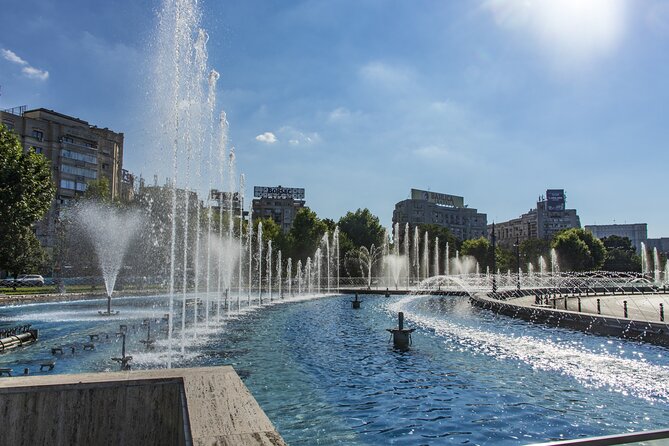
Piata Unirii is one of the route’s most useful orientation points. Its refurbished fountains make it a good place for photographs, but the real lesson is the scale of the space.
From here, you follow Bulevardul Unirii, once called the Boulevard of Socialist Victory. It was designed as Romania’s answer to the grand ceremonial avenues of other capitals and is sometimes compared with the Champs-Élysées.
The comparison tells you more about ambition than appearance. This is a broad, formal avenue meant to display state power. The guide explains how the boulevard and surrounding district were shaped during Ceaușescu’s rule, when entire neighborhoods were demolished to make room for monumental government architecture.
You may find the scale impressive, but it can also feel stark. This is one of the points where the tour’s political background becomes essential. Without it, the avenue is simply wide. With it, you understand what was removed to create it and why the city still debates this period.
More Walking Tours in Bucharest
- Bucharest: City Highlights Guided Walking Tour
★ 4.9 · 1,482 reviews - Bucharest Highlights Walking Tour
★ 5.0 · 469 reviews - Bucharest: Ghost Stories & Romanian Mythology Walking Tour
★ 4.9 · 287 reviews - Bucharest: Guided Walking Tour with Romanian Snack
★ 4.9 · 228 reviews
The Palace of Parliament and Constitution Square
The Palace of Parliament is the visual heavyweight of the walk. It overlooks Unirii Boulevard and dominates the surrounding open spaces.
The tour does not list an interior visit, so you should treat this as an exterior viewing and photography stop rather than a palace tour. That is still worthwhile. The building’s size is difficult to grasp from photographs, and Constitution Square gives you the space needed to see its relationship with the boulevard.
At Piata Constitutiei, directly in front of the parliamentary buildings, the guide explains the political purpose behind the district. This is one of the clearest places to discuss Ceaușescu’s dictatorship, centralized power, and the way architecture became political theatre.
I find this section especially useful for first-time visitors. You see the result of a single ruler’s attempt to reshape the capital, then later walk through locations where that system began to collapse. The route turns architecture into a history lesson without requiring an indoor museum visit.
Churches, the CEC Palace, and Calea Victoriei
The walk then returns to more traditional city streets. You hear about another historic church, the CEC Palace, and part of Calea Victoriei, one of Bucharest’s best-known central avenues.
The CEC Palace provides a contrast with the communist monuments. Its ornate exterior reflects an earlier period of banking, commerce, and national ambition. You also pass the National Bank of Romania, where the guide explains the institution’s place in the country’s financial and political story.
This part of the route is less about one famous sight and more about contrasts. A few blocks can take you from a church to a bank, from a restored historic façade to a major avenue lined with shops. I like this because Bucharest is not a city that can be understood through one architectural style. Its center is a patchwork of periods, rulers, demolitions, restorations, and new construction.
The old center, Macca-Villacrosse Passage, and the National Bank
You enter Bucharest’s Old Town, an area with more than five centuries of urban history. The streets and lanes here are a good change of pace after the open spaces around Parliament.
Macca-Villacrosse Passage is one of the more distinctive stops. The covered passage has an unusual shape and a past tied to the city’s commercial life. It is also a reminder that Bucharest’s older center was designed for movement through narrow lanes, courtyards, restaurants, and trading spaces, not for giant state ceremonies.
The guide may take you inside restored taverns or restaurants and point out buildings that are easy to miss if you walk alone. This is one of the tour’s more authentic strengths. You are not only checking off major sights. You are being shown the details between them.
The Old Town can be busy, and the narrow streets may make it harder to keep your bearings. One useful improvement would be clearer references to earlier locations as you move through the lanes. If you are new to Bucharest, pay attention to where you are in relation to the main squares.
University Square and Bucharest’s civic center
University Square brings you into a more modern civic area. You see the University of Bucharest, founded in 1864 under Alexandru Ioan Cuza, along with Suțu Palace, now associated with the history museum of Bucharest.
Nearby are Colțea Hospital and its church, the National Theatre of Bucharest, and other central buildings. The theatre is worth hearing about because its design has changed several times in a relatively short history. That detail captures the broader character of Bucharest: buildings are often altered, rebuilt, or repurposed as the city changes.
This section works well for visitors who want more than medieval stories. The guide connects institutions such as the university, hospital, theatre, and museum with the growth of Bucharest as a modern capital.
You will also see different architectural moods close together. Suțu Palace has a more aristocratic feel, the university represents education and civic life, and the theatre reflects the city’s changing public culture. The result is a useful snapshot of Bucharest’s development beyond the Old Town.
Kretzulescu Church and the 1989 Revolution
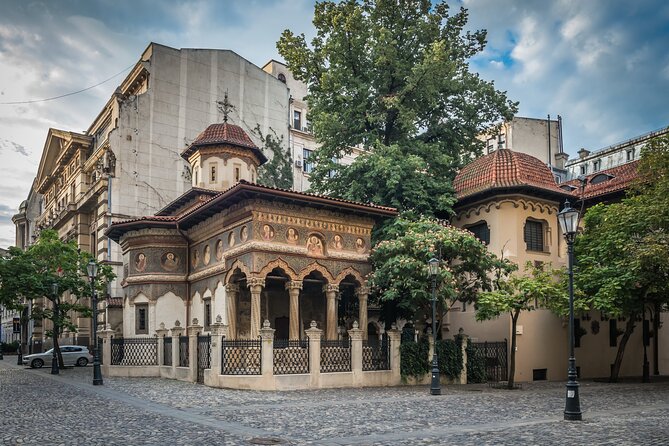
Biserica Kretzulescu is one of the route’s most attractive church stops. Its history gives the guide another chance to explain how religious buildings endured through changing political eras.
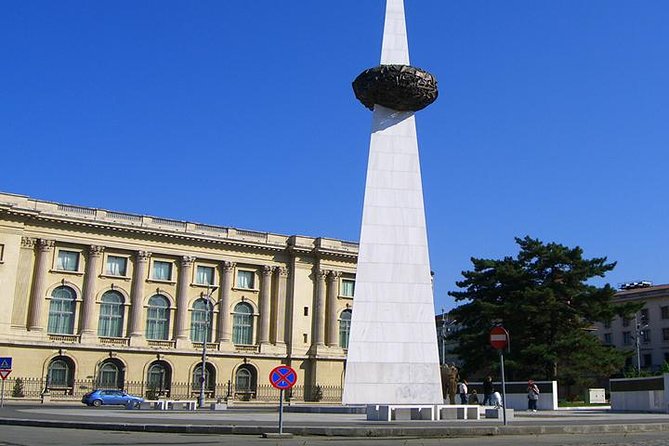
The most serious section comes next, around Revolution Square and the sites linked to December 1989. You see the area where the Romanian Revolution began, including the balcony connected with Ceaușescu’s final public speech, the former Communist Party headquarters, the University Library, King Carol I’s equestrian statue, and the Memorial of Rebirth.
The Memorial of Rebirth is a 25-meter monument dedicated to the struggles and victims of the Revolution. It is visually striking and has also become one of the city’s most debated modern monuments. The guide explains the events and the memorials rather than treating the square as just another photo stop.
This part may be the most valuable for understanding present-day Romania. The Revolution is not a distant medieval tale. It shaped the country many people still remember personally, and the city’s streets retain physical reminders of that change.
The guide’s personal perspective can add weight here, especially when she discusses growing up in Romania and life during the communist period. At the same time, I would listen critically. Some accounts describe strong political opinions and discussion of disputed claims. If you prefer a strictly neutral presentation, make that clear at the start.
Military Circle and Sărindar Fountains
The route continues to the Military Circle and the Sărindar Fountains. These landmarks provide a final look at Bucharest’s ceremonial center and military history.
The tour also includes a historic building and gardens created for the people of Bucharest more than a century ago. The supplied details do not identify the site by name, so I would ask your guide to explain its background when you arrive. It is described as a good place for photographs, with a notable historic building and attractive grounds.
By this stage, you will have seen a large part of central Bucharest. The final stretch is less about one single headline attraction and more about tying together the royal, military, civic, and communist layers of the capital.
The pace, group size, and physical demands
The advertised duration is about three hours, but allow extra time. Some walks last closer to four hours when the guide spends longer on questions or adds extra stops.
The pace can be brisk, and the route covers a lot of ground. One account measured more than 17,000 steps, even without fast walking. That is a serious half-day outing, not a gentle stroll between nearby sights.
I would wear reliable shoes and carry water. Heat can make the walk demanding, and there are many outdoor stops. Children can take part, but they must be accompanied by an adult. You should also have a moderate level of fitness.
The private format is a major benefit. Only your group participates, so you can ask about architecture, politics, religion, or daily life without holding up a large party. It may also make it easier to request a short pause, though the overall route remains active.
What the $30.77 price gets you
At $30.77 per person, this is a reasonable price for a private, English-language introduction to central Bucharest, especially if two or more people share the experience.
You are paying mainly for the guide’s time and interpretation, not admission tickets. The listed stops are generally viewed from outside, and several are brief five-minute photo or orientation stops. If you want to enter the Palace of Parliament, museums, or church interiors at length, you will need separate plans.
The value is strongest if you are staying in Bucharest for a few days and want a clear starting point. The route covers enough ground to help you decide where to return for a longer visit. It can also save you from wandering past significant buildings without understanding them.
The value is weaker if you want a slow architectural tour with long interior visits. The walk moves quickly and gives you a broad story rather than deep time inside each attraction.
Guide style and how to get the best experience
Alina is the guide most often identified with this tour. Her strongest qualities are energy, personal experience, humor, and a clear desire to explain Romania from a local point of view. Elena is also named in one account, so the guide may vary.
English is offered, but one person found parts of the guide’s speech difficult to follow. Most of the praise focuses on the amount of information and enthusiasm, yet the presentation can be fast and dense. Ask for clarification when needed.
You should also know that political discussion is part of the experience. Ceaușescu, communism, monarchy, government, and modern political life come up naturally because they are written into the city itself. A few accounts found the guide’s political views distracting, while others valued the unusual perspective.
I would begin by telling the guide what interests you most. You can ask for more architecture, more daily life, or more detail about the Revolution. That small conversation may help shape a private tour that suits your group.
Pickup is offered, but the stated meeting point is outside Manuc’s Inn, and the activity details say the tour ends back at the meeting point. Confirm the pickup and return arrangement before setting out, especially if you need to connect with a bus or hotel afterward.
Who should book this Bucharest tour?
I would choose this walk if you want a fast, serious introduction to the city and enjoy learning how politics shaped architecture. It is especially useful on your first day, when you need a mental map of the center and ideas for the rest of your stay.
It suits adults, history fans, and visitors who prefer a local guide’s personal interpretation to a standard audio script. The private setup is also a good fit for couples or small groups with their own questions.
I would hesitate if you dislike long walks, heat, political discussion, or a quick stream of historical detail. You may also prefer another option if your main goal is entering museums and monuments rather than seeing many places from the street.
You can cancel for a full refund up to 24 hours before the start time. The experience requires good weather, and poor conditions may lead to a new date or a full refund.
Should you book it?
Book this tour if you want Bucharest’s old center, communist-era avenues, Palace of Parliament views, and Revolution sites explained as one connected story. The strongest reason to go is the guide-led context, particularly if you have Alina and appreciate an energetic, personal presentation.
Go prepared for plenty of steps, a brisk pace, and opinions alongside facts. Carry water, wear good shoes, and confirm pickup details. At $30.77, it offers solid value for a private overview, provided you want a broad outdoor history walk rather than a slow museum visit.
FAQ
How long does the Bucharest walking tour last?
The advertised duration is approximately three hours. You should allow extra time, since some tours run longer when the guide answers questions or adds detail.
Where does the tour begin?
The meeting point is outside the main entrance of Manuc’s Inn, at 62 Strada Franceză in Bucharest’s Old Centre.
Where does the tour end?
The activity details state that it ends back at the meeting point.
Is hotel pickup available?
Pickup is offered, and the tour information also mentions hotel pickup and drop-off. Since the stated meeting and end point is Manuc’s Inn, confirm the exact arrangement before the tour.
Is the tour private?
Yes. Only your group participates in this activity.
Is the tour offered in English?
Yes. English is the listed tour language and a mobile ticket is provided.
How much does the tour cost?
The listed price is $30.77 per person.
How much walking is involved?
A lot. The tour requires a moderate level of physical fitness, and one account recorded more than 17,000 steps. Bring water and wear comfortable shoes.
Can I cancel for a full refund?
Yes. You can cancel at least 24 hours before the start time for a full refund. Cancellations or changes made less than 24 hours before the start time are not accepted for a refund.
More History Tours Around Bucharest
- Private Bucharest: History & Food with Traditional Meal
★ 5.0 · 34 reviews - Bucharest Historical Food Tour in Old Center
★ 5.0 · 21 reviews - Half-Day Jewish Heritage Walking Tour in Bucharest
★ 5.0 · 20 reviews - Private Tour – Food, Culture, History & Traditions
★ 5.0 · 18 reviews
Newest Bucharest trips on the site
- Winery touring & private wine tasting – one day private tour★ 5.0 · 3 reviews
- Bucharest: Dealu Mare Winery Private Trip with Wine Tasting★ 4.9 · 6 reviews
- Village Museum Bucharest Guided Tour★ 5.0 · 6 reviews
- Private Transfer from Giurgiu Port to Bucharest★ 4.5 · 12 reviews
- Airport Henri Coanda (Otopeni) to Bucharest – Private Transfer – Driver★ 5.0 · 5 reviews
- Salt Mine Tour from Bucharest with Entrance Ticket★ 4.5 · 19 reviews
- Wine tasting in Bucharest Old town – bonus cheese platter★ 4.5 · 6 reviews
- Walking tour of Bucharest★ 5.0 · 3 reviews
Historical Tours, compared.
Bucharest Jewish Heritage | Holocaust Memorial | Private Car Tour
Read our review →
Private Bucharest: History & Food with Traditional Meal
Read our review →

Discover Romania’s Wine Heritage in Brasov’s Historic Center
Read our review →
Experience the History of Bran Castle and Saxon Fortifications in Burzenland
Read our review →Browse the lists this tour appears in