

Reviewed · FOOD & DRINK
Private Bucharest: History & Food with Traditional Meal
Bucharest’s past is served here in edible form. You’ll begin with a salty covrig, hear how Ottoman, Russian, Balkan, and Austro-Hungarian influences shaped Romanian cooking, then finish at a historic hanu, or inn, with a three-course meal.
I like the private format, which lets your guide slow down for questions, family needs, or photo stops. I also like the clear route through Revolution Square, Victory Street, and Old Town, since it gives you a useful first look at the city instead of keeping you inside one district.
The main thing to consider is the food format. This is not a long series of separate tastings. Apart from the covrig, the main culinary experience comes at the final restaurant, and one past description of the tour appears to promise more small samples than the actual meal provides.
Key points at a glance
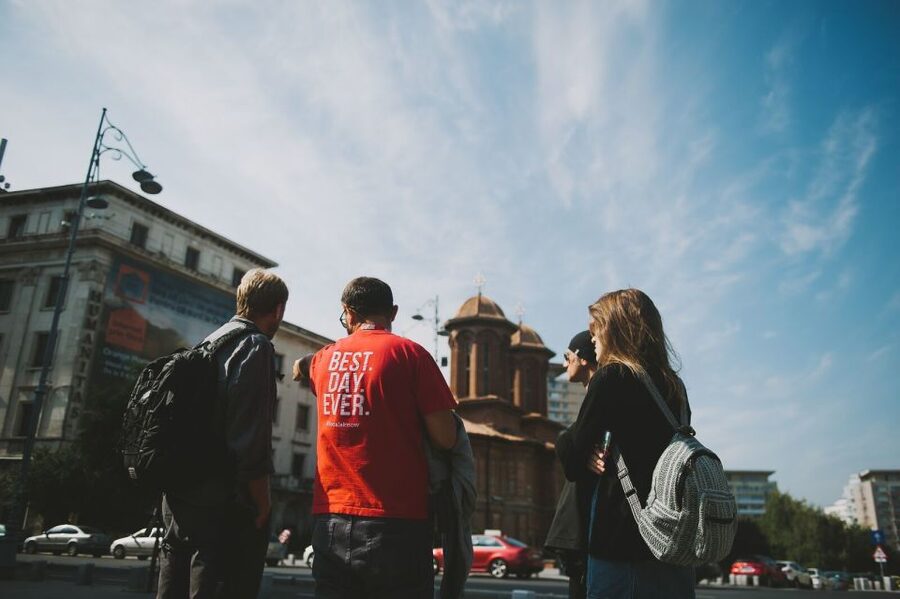
- Revolution Square sets the political scene: Learn how the 1989 uprising began around Ceausescu’s failed speech.
- Romanian cuisine comes with a map: Your guide explains why Moldova, Transylvania, and Muntenia developed different flavors.
- Old Town supplies the texture: See medieval lanes, princely courts, churches, Manuc’s Inn, and the old meeting point of East and West.
- The final meal is substantial: Expect three courses of traditional Romanian food, with house beer, wine, or a soft drink included.
- A private guide changes the pace: Guides including Elaina, Andra, Mara, Ioanna, Monica, and Andrei have led this experience, with strong attention to history, food, and family groups.
- The tour supports a lighter footprint: It is carbon neutral and run by a B Corp certified operator.
Why the food tells Bucharest’s story
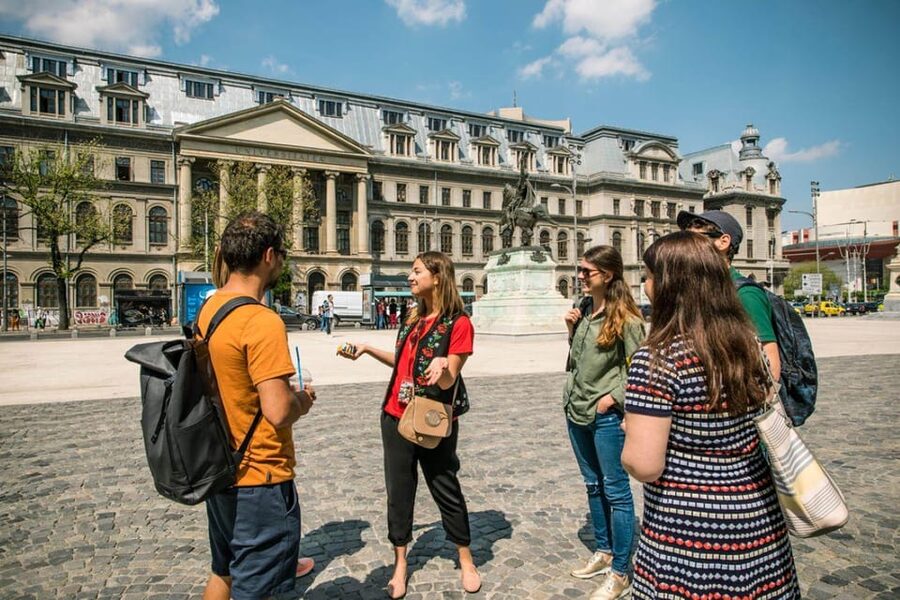
Romanian food is not one neat regional style. It reflects centuries of trade, migration, empire, and shifting borders. This tour makes that point in a practical way, using dishes and snacks as clues to Romania’s past.
You’ll hear that Moldova tends toward sweeter flavors, Transylvania toward earthy food, and Muntenia, the region around Bucharest, toward spicier tastes. Those are broad guideposts, not hard rules, but they help explain why Romanian cooking can feel familiar and foreign at the same time.
The tour also connects dishes to outside influences. Mici, the skinless grilled sausages, carry a Balkan character. Sarmale, stuffed cabbage leaves, show Ottoman influence. Sour soups such as ciorba and borscht point toward Slavic traditions, while schnitzel recalls the Austro-Hungarian world.
That makes the meal more than a stop at a restaurant. By the time you sit down, you have heard why the food looks the way it does. The meal becomes a small geography lesson, served in courses.
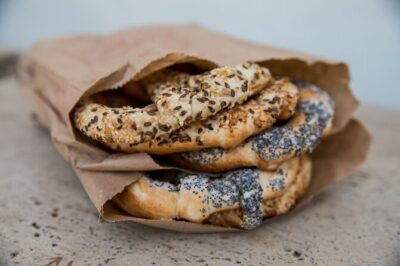
You also get a taste of Romanian daily life with the covrig at Revolution Square. This salty ring-shaped snack is an everyday favorite and may have entered Romanian culture through Hapsburg or German merchants in medieval times. It is a modest item, but that is part of its value. You are not starting with a fancy dish designed only for tourists.
More Historical Tours in Bucharest
- Bucharest: 3-Hour Dark History Tour with a Local
★ 4.9 · 301 reviews - Bucharest: Small Group History, Art & Secrets Tour
★ 4.7 · 152 reviews - Guided Walking Tour of Historical Bucharest
★ 5.0 · 84 reviews
Revolution Square and the memory of 1989
The tour begins at the Equestrian Statue of Carol I in Revolution Square, a central meeting point in Sector 1. This is a good place to begin because the square gathers several important buildings and one of the clearest stories in modern Romanian history.
The square was once called Palace Square. In 1989, Nicolae Ceausescu addressed a crowd here, expecting the usual display of public support. Instead, the crowd turned against him, helping set Romania’s revolution in motion.
Your guide uses the square to explain the final days of the Communist regime and the way Bucharest’s political center changed. The story is not just about a speech or a dictator. It is about the sudden collapse of public obedience in a country that had lived under Ceausescu’s rule for decades.
Around the square, you’ll see the former Royal Palace, now associated with Romania’s royal and artistic past. The Romanian Athenaeum adds another layer, with its role as one of the city’s best-known concert halls. Athenee Palace brings in the atmosphere of the interwar years, when diplomats, political figures, spies, and journalists crossed paths in Bucharest.
This mix is one of the tour’s strengths. A single square lets your guide move from monarchy to interwar intrigue to Communist rule and then to the 1989 revolution. If you are new to Bucharest, it gives you a usable timeline right away.
Victory Street and Bucharest’s French-facing years
From Revolution Square, the route continues south along Victory Street, known in Romanian as Calea Victoriei. Its name refers to Romania’s victory in the 1871 War of Independence, though political unification of the three Romanian principalities came later, in 1918.
This stretch helps explain why Bucharest is sometimes called a city of mixed architectural personalities. You may see grand formal buildings, older churches, practical Communist structures, and newer commercial spaces within a fairly short distance.
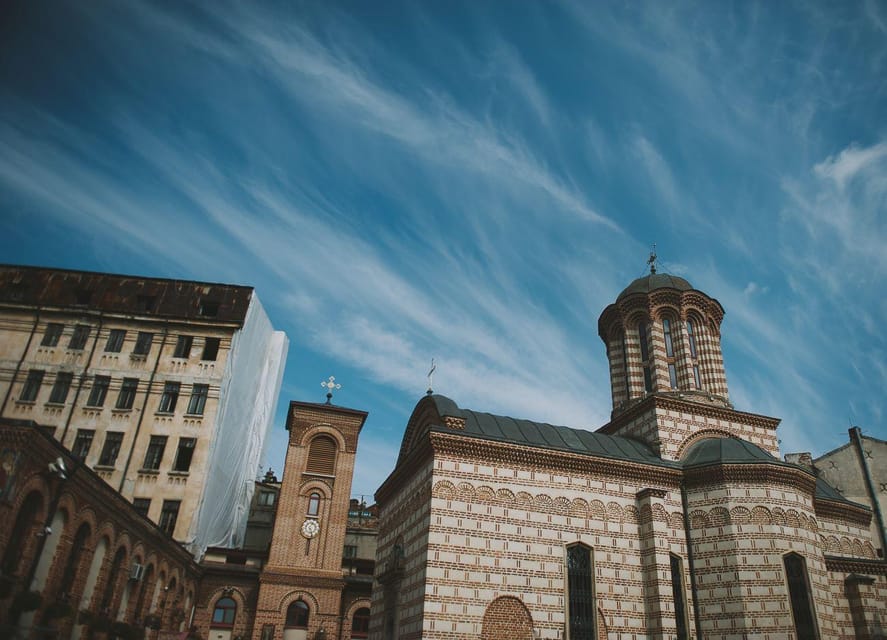
The tour points out landmarks from the interwar period, including the Telephone Palace, the Military Circle, and the former National Theatre. The Kretzulescu Church adds a different note, with its ornate exterior and Orthodox character.
I like this part because it counters the easy idea that Bucharest is simply a collection of Communist-era buildings. The city has plenty of scars and awkward gaps, but it also has royal, religious, commercial, and early modern layers. Your guide can show how those layers sit beside one another rather than presenting the city as a single-style capital.
The architecture also supports the food story. Bucharest spent long periods looking toward different cultural centers, and its cuisine reflects that same exchange. French influence is part of the city’s modern identity, while Balkan, Ottoman, Slavic, and Austro-Hungarian habits remain visible on the plate.
Old Town, from medieval trade to nightlife

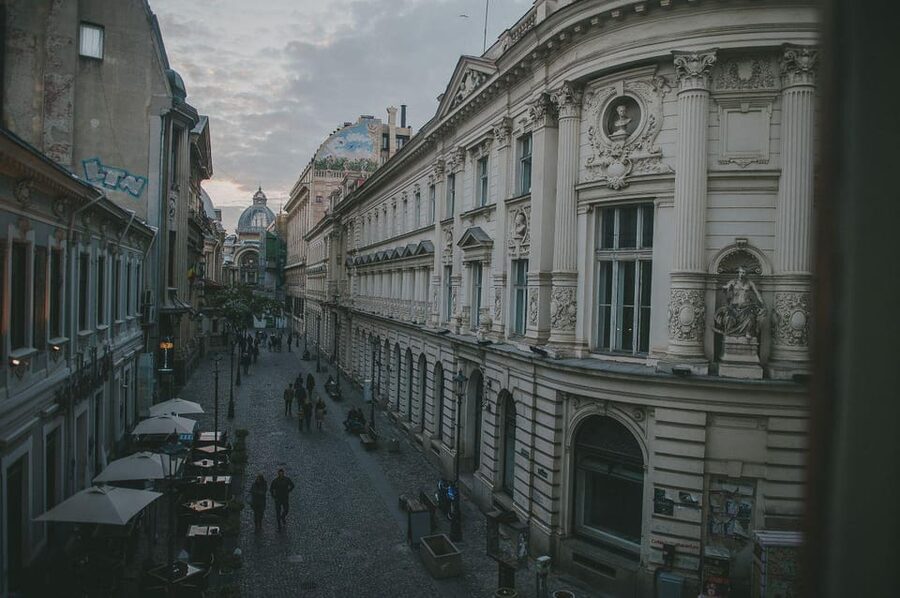
The route then turns into Bucharest’s Old Town, where the scale becomes smaller and the story older. Passageways, courtyards, churches, and old commercial routes replace the grand avenue.
This was medieval Bucharest’s meeting point between East and West. Ottoman pashas, Transylvanian princes, merchants, clergy, and local rulers all passed through the wider region. The area’s food traditions grew from this movement of people and goods.
You’ll see examples of princely courts, carefully decorated interiors, and an Orthodox monastery that offers a quieter pause from the busy streets. Hanul lui Manuc, the famous wooden inn, is another major sight. Its courtyards and timber construction recall the time when inns were places for trade, food, lodging, and political talk.
Old Town also lets your guide explain how the district changed over time. It moved from a medieval commercial center to an area marked by neglect and decay, then toward its current role as a center of restaurants and nightlife. That change is useful to understand, but it also means the district can feel more commercial than historic in places.
Do not expect every lane to look polished. Part of Bucharest’s character comes from unfinished repairs, mismatched facades, and buildings that show the cost of rapid change. If you want a perfectly preserved old quarter, this may feel rough around the edges. If you want to see how a historic center keeps changing, it is a more honest experience.
More food tours in Bucharest:
- Taste Bucharest: A Food Lover’s Tour of Markets & Neighbourhoods
★ 5.0 · 689 reviews - Street Food’n’Culture Tour
★ 5.0 · 209 reviews - Wine Tasting in Bucharest
★ 5.0 · 183 reviews - Discover Bucharest: Private Highlights and Traditional Food Tour
★ 5.0 · 86 reviews
The People’s Palace and the cost of grand plans
On the way to the meal, you get a look at the People’s Palace, the enormous building associated with Ceausescu’s attempt to remake Bucharest. It is commonly described as the second-largest building in the world, after the Pentagon.
The palace is important less for its appearance than for what it represents. Ceausescu’s redevelopment plan changed large sections of the city and displaced existing neighborhoods. The building’s vast scale makes the political message clear: power was meant to be seen from every angle.
The tour does not appear to include a full interior visit. You should think of this stop as an exterior look and a chance to discuss Communist urban planning, not as a palace admission tour. That distinction matters if you want a detailed architectural visit inside the building.
Still, seeing it after Revolution Square creates a strong contrast. At the start, you hear about a regime losing control in front of a crowd. Later, you see one of its grandest physical statements. The two stops help connect political history to the city you are walking through.
A three-course meal at a traditional hanu
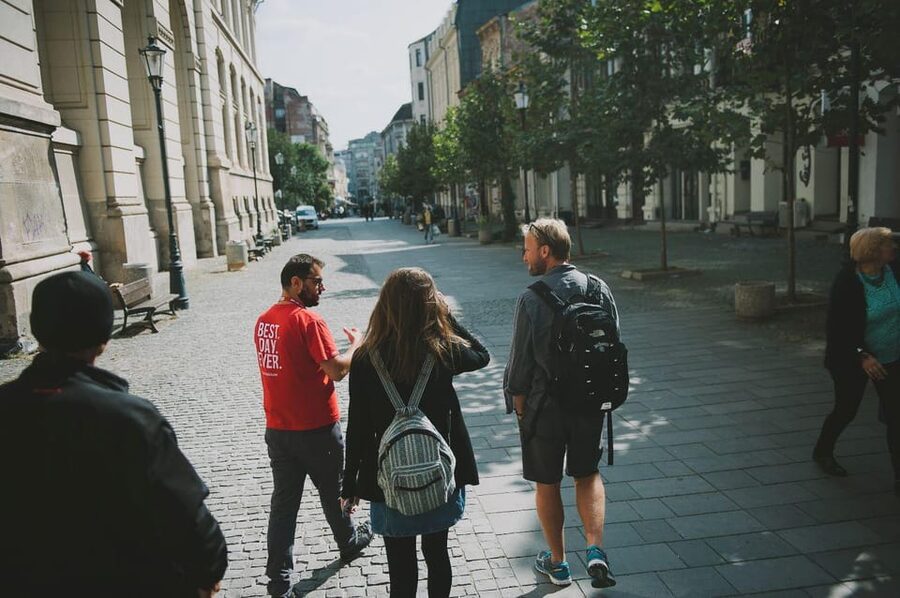
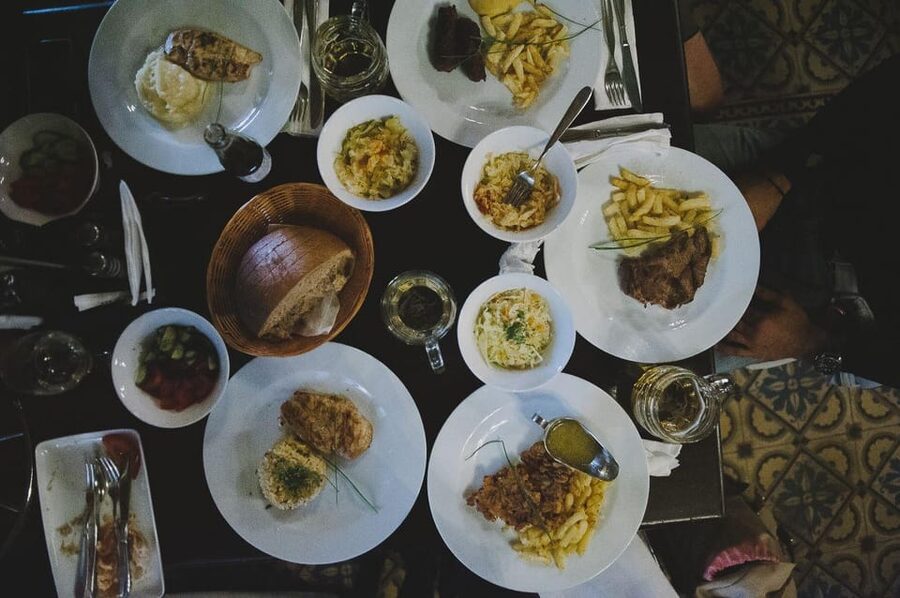
The final stop is a traditional hanu, or inn, described as one of Bucharest’s most charming dining settings. You’ll sit down to a three-course Romanian meal with platters of local specialties, followed by house beer, wine, or a soft drink.
The included drink is a useful detail. Romanian wines and locally brewed beer are both part of the experience, and the guide may explain the old story of the Dacian leader Burebista, who reportedly banned wine production because so much was being consumed. The Dacians then turned to brewing beer, at least according to the tale.
You should expect a proper meal rather than a quick snack stop. That makes the food portion satisfying, especially after several hours of city sightseeing. It also means the tour is best for someone who wants context and a sit-down meal, not for someone seeking a dozen small bites from markets and stalls.
The included food and drink cover the basic meal, but additional food and drinks cost extra. If you have dietary restrictions, ask about them when booking, since the supplied details do not specify vegetarian, vegan, allergy, or gluten-free options.
The meal is also where the tour’s value becomes easiest to judge. A restaurant meal in Bucharest will cost less than a similar meal in many Western European capitals, so $140 per person is not a cheap way to buy lunch. You are paying for a private guide, four hours of explanation, a planned route, the meal, and the convenience of bringing the city’s history together.
For a couple or family who wants an efficient first day in Bucharest, that can be sensible. For a solo visitor on a tight budget, or someone happy to explore independently, it may feel expensive. The private format is the main reason to pay more.
The guide makes the private format worthwhile
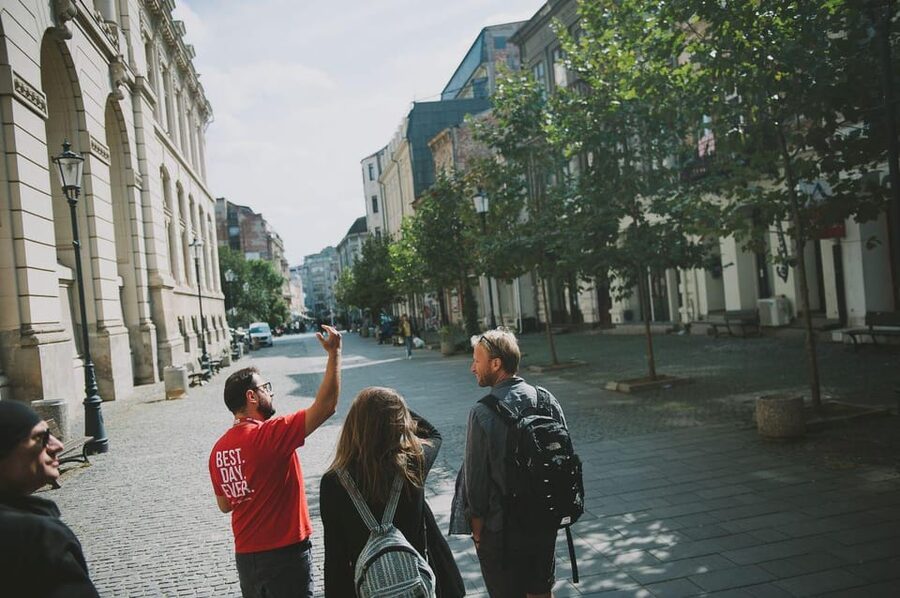
The guide is the part that can shape this experience most. Several named guides have led it over the years, including Elaina, Andra, Mara, Ioanna, Monica, Andrei, and Dana. The descriptions of their approach point to strong command of Romanian history, city architecture, food, and present-day Bucharest.
A private guide also gives you room to ask the questions that make a city tour useful. You can ask how Communist rule changed daily life, why buildings look different from one street to the next, or which Romanian foods to order later in your trip.
The pace can work well for families. One guide, Andra, was especially good at including an eight-year-old, allowing time for information and photo stops without rushing. Children under six can join free, but you need to tell the supplier when booking.
The language is English, and the tour is set up for a private group. That means you do not have to keep up with strangers or listen to a lecture designed for a large crowd. It also means the quality of the day depends more heavily on the particular guide assigned to you, so it is worth treating the guide as a key part of the booking rather than a minor detail.
Timing, price, and practical fit
The experience lasts four hours. That is enough time for a city introduction and a full meal, but not enough for a detailed visit inside every landmark. You will be moving between major areas and hearing a steady stream of history, so comfortable casual clothing is the sensible choice.
The meeting point is the Equestrian Statue of Carol I in Revolution Square. Check the starting time when booking, since several departure times may be available. The route appears suited to exploring on foot, though the supplied details do not promise a specific walking distance or transport arrangement.
At $140 per person, the cost is best viewed as a private orientation day rather than a food tour alone. I would compare it with the price of hiring a private city guide plus paying for lunch. The included three-course meal, house drink, and route through the city make the package easier to justify for two or more people who value personal attention.
The tour is also carbon neutral and operated by a B Corp certified company. That does not change what you see, but it may matter if you prefer to book with an operator that measures its environmental impact and frames tourism as a force for good.
Free cancellation up to 24 hours before the start and reserve-now, pay-later booking add useful flexibility. You still need to check the final booking conditions, but these terms make it easier to place the tour early in your schedule.
Who should book this Bucharest experience
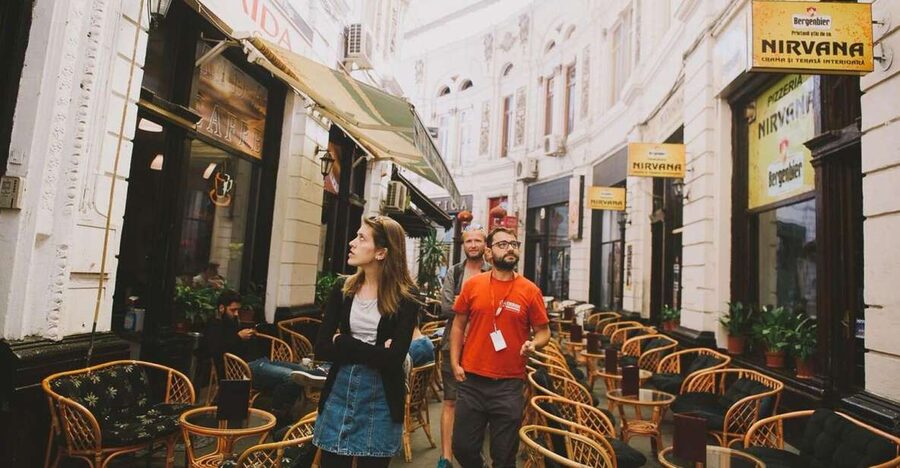
I would choose this tour for a first visit, especially if you have only a few days in Bucharest. The route gives you a basic city map, a political timeline, a look at older streets, and a traditional meal in one half-day block.
It also suits families who want a private pace. The guide can adjust explanations and pauses more easily than a large group leader can. The child-friendly approach is a real advantage, especially when jet lag or short attention spans enter the picture.
Food-focused visitors should book with the right expectation. You will learn a great deal about Romanian cuisine and eat a full traditional meal, but the experience is not built around constant tasting. If your priority is market food, pastry shops, or many tiny samples, you may want a different format.
History lovers will get the most from the tour. The strongest thread runs from medieval trade and foreign influence to royal Bucharest, interwar intrigue, Communist power, the 1989 revolution, and the city’s new nightlife economy.
Should you book it?
Book this private Bucharest history and food tour if you want a well-paced first look at the city, personal access to an English-speaking guide, and a traditional meal tied to the places you have just seen. The guide-led storytelling and private format are its best features.
Skip it if you want a low-cost walk, a full interior tour of the People’s Palace, or a long sequence of independent food tastings. At $140 per person, the value depends on using the guide well. Ask questions, discuss food preferences, and treat the four hours as your introduction to Bucharest rather than just a meal with sightseeing attached.
FAQ
How long does the Bucharest history and food tour last?
The tour lasts four hours.
Where does the tour begin?
It begins at the Equestrian Statue of Carol I in Revolution Square, Sector 1, Bucharest.
Is the tour private?
Yes. It is operated as a private group experience.
What language is the tour offered in?
The live tour guide speaks English.
What food and drink are included?
You receive a three-course Romanian meal and one house beer, wine, or soft drink. Additional food and drinks are not included.
Can children join the tour?
Yes. The tour is child-friendly, and children under six may join free of charge. You need to tell the supplier when booking if you are bringing a child under six.
Can I cancel the booking?
You can cancel up to 24 hours in advance for a full refund. Reserve-now, pay-later booking is also available.
More History Tours Around Bucharest
- Bucharest Jewish Heritage | Holocaust Memorial | Private Car Tour
★ 5.0 · 38 reviews - Bucharest Historical Food Tour in Old Center
★ 5.0 · 21 reviews - Half-Day Jewish Heritage Walking Tour in Bucharest
★ 5.0 · 20 reviews - Private Tour – Food, Culture, History & Traditions
★ 5.0 · 18 reviews
Newest Bucharest trips on the site
- Winery touring & private wine tasting – one day private tour★ 5.0 · 3 reviews
- Bucharest: Dealu Mare Winery Private Trip with Wine Tasting★ 4.9 · 6 reviews
- Village Museum Bucharest Guided Tour★ 5.0 · 6 reviews
- Private Transfer from Giurgiu Port to Bucharest★ 4.5 · 12 reviews
- Airport Henri Coanda (Otopeni) to Bucharest – Private Transfer – Driver★ 5.0 · 5 reviews
- Salt Mine Tour from Bucharest with Entrance Ticket★ 4.5 · 19 reviews
- Wine tasting in Bucharest Old town – bonus cheese platter★ 4.5 · 6 reviews
- Walking tour of Bucharest★ 5.0 · 3 reviews
Food & Drink, compared.

Taste Bucharest: A Food Lover’s Tour of Markets & Neighbourhoods
Read our review →
Discover Bucharest: Private Highlights and Traditional Food Tour
Read our review →
Half-Day Private Food and Wine Walking Tour Oradea Romania
Read our review →
Traditions in Bucharest: Village Museum and Wine Tasting Tour
Read our review →Browse the lists this tour appears in