
Reviewed · COMMUNIST HISTORY TOURS
The Grand Tour of Communist Ages at Timisoara
Timișoara’s communist past is easiest to understand away from polished old-town facades. This tour takes you into Șagului, then to the sites where the 1989 uprising began, linking ordinary housing, household objects, church steps, bullet holes, and the public square where Romania’s first free city was proclaimed.
I like the way the tour joins daily life with political history, rather than treating communism as a list of dates. I also like the small group size, the comfortable vehicle, and the chance to learn from guides such as Dan and Ludovic, who explain both the regime and the revolution. The main drawback is that much of the experience depends on spoken explanation, so it suits you best if you enjoy history and can follow detailed English commentary.
Key points to know before booking
- Șagului shows communist life at neighborhood level, not just in grand public buildings.
- The Communist Consumer Museum uses household objects to explain how the regime shaped ordinary life.
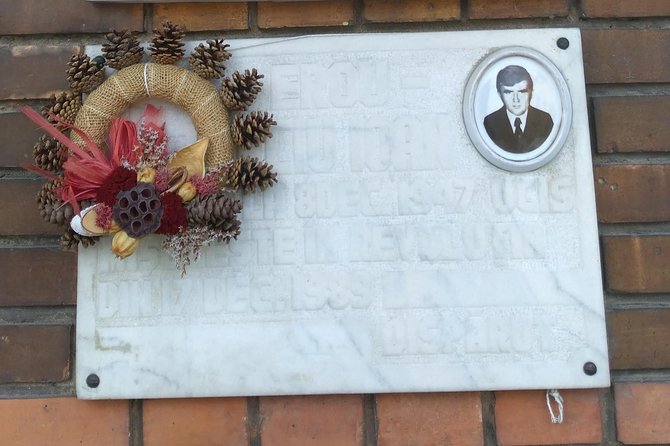
- The Reformed Church marks the first spark of the 1989 uprising in Timișoara.
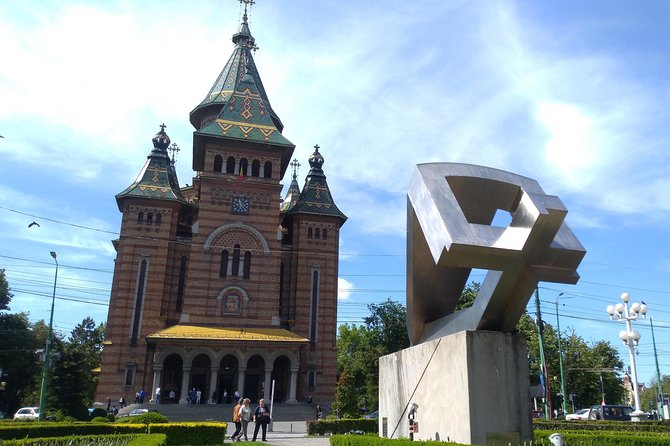
- Bullet holes remain visible near the Orthodox Cathedral and Victory Square.
- A comfortable vehicle connects at least eight locations in roughly 3 to 4 hours.
- The group is limited to 10 people, with English commentary and free cancellation up to 24 hours before departure.
Why Timișoara is the right place to study communist Romania
Many city tours focus on Timișoara’s grand squares, Habsburg buildings, and café life. This one asks a harder question: what was the city like under a system that controlled work, housing, shopping, speech, and public space?
That question matters because the 1989 Revolution did not begin as a planned national event. It grew from a local confrontation around the Reformed Church, then spread through streets and squares. The tour helps you see how an ordinary city became the first place in Romania to declare itself free of communism.
I find this approach useful because it connects the large story to physical places. A church entrance, a tram, an apartment district, and a line of damaged buildings can tell you more than a long political lecture. You will not simply hear that the regime was restrictive. You will look at the places where that pressure became visible.
The tour is offered in English and lasts about 3 to 4 hours. That is long enough to develop a real narrative without taking up your entire day. It is also an efficient choice if you want to cover several parts of Timișoara without arranging separate taxis or trying to match distant sights with public transport.
More communist-era history walks in Timisoara:
- Timisoara: Grand Communism Tour
★ 4.9 · 13 reviews - The Real tour of Communism
★ 5.0 · 666 reviews - Life under Communism
★ 5.0 · 358 reviews
Șagului: starting with ordinary communist life
The first major stop is Șagului, one of Timișoara’s neighborhoods. You spend about two hours here, making it the longest part of the experience.
That time allocation tells you what this tour values. The focus is not only on Ceausescu, party slogans, or the final days of the regime. You look at the setting where people lived and dealt with the system day after day. The neighborhood becomes a way to discuss housing, work, family life, shortages, and the routines of communist Romania.
For me, this is one of the strongest parts of the tour. Political history can feel distant when it stays inside official speeches and dates. A residential area makes the subject more immediate. You can better understand how a government affected people through the places they lived, the goods they could obtain, and the limits placed on ordinary choices.
The information supplied for the tour does not specify a fixed walking route within Șagului, so you should expect the guide to use the neighborhood as a setting for explanation rather than as a conventional sightseeing stop. Admission is free, and the visit takes place as part of the guided experience.
The drawback is that this section may feel less visually dramatic than the Revolution sites in central Timișoara. If you want a tour made almost entirely of famous monuments, Șagului may seem slow. If you want context, it gives the later stops more meaning.
The Communist Consumer Museum and the objects people used
The Muzeul Consumatorului Comunist, or Communist Consumer Museum, is a private collection of objects made in Romania during the communist era. You spend about 30 minutes here.
This stop gives the political story a household scale. Instead of hearing only about the rise of the Communist Party, you see the products and possessions associated with the period. The collection helps explain what was made locally and how consumer life developed under the regime.
I like museums of this kind because objects often prompt better questions than slogans do. What did people buy? What did they repair rather than replace? What did local production reveal about the wider economy? The guide can use the collection to explain how the communist system was installed and how it changed over time.
Admission is free, and the visit is short enough to keep the overall tour moving. Still, you should not treat the museum as a large national institution with hours of exhibits. It is a private collection, and its value comes from the guide’s explanation and the way the objects fit into the wider story.
This is also a helpful stop for younger visitors or anyone who grew up outside Romania. One person joined the tour so a daughter raised abroad could understand the environment of the parent’s youth, while the parent also learned that some memories had been distorted by the regime. That is an important warning: personal memory and official history do not always line up neatly.
The Reformed Church and the first spark of revolt
The Reformed Church, or Biserica Reformata, is presented as the place where the Timișoara uprising began. You spend about 15 minutes here.
The key dates are December 15 and 16, 1989. In the afternoon of December 16, a young man stopped a tram, and his friend climbed aboard and called for Ceausescu to step down. The moment sounds small, almost improvised, which is precisely why it is so powerful.
This stop helps you understand that revolutions often begin with a local act of refusal. The church became a gathering point, and the gathering grew into a protest that the authorities could not easily contain. The guide explains how that local event connected to the wider collapse of the Romanian Communist regime.
The visit is short, so you will not get an extended architectural tour of the church. That is fine. The point here is not decorative detail. It is the location’s role in the opening chapter of the revolution.
I would pay close attention to the guide’s timeline at this stop. The order of December 15 and 16 matters, and the story moves quickly from religious and civic tension to open political protest. Guides Dan and Ludovic are known for giving detailed explanations and handling questions, so this is a good place to ask for clarification if the sequence feels hard to follow.
A few more Timisoara trips worth a look
- The Classic Tour of Timisoara
★ 5.0 · 154 reviews - Weekly Guided Tour in English – Tuesday, Thursday, Saturday
★ 5.0 · 84 reviews - Timisoara All in One – Walking and Tram Tour
★ 5.0 · 72 reviews - Timisoara: Guided Walking Tour
★ 4.9 · 38 reviews
The Orthodox Cathedral and the cost of protest
At Timișoara Orthodox Cathedral, the tour turns from the beginning of protest to its human cost. The visit lasts about 10 minutes.
Several young people were killed on the cathedral steps after the Army opened fire without warning. You will see some of the bullet holes, a direct physical reminder of what happened.
The cathedral is a major city landmark, but the tour asks you to see it through the events of December 1989. The building is not just a beautiful religious site. Its steps became a place where people gathered, protested, and faced deadly force.
This stop can be emotionally heavy, even though it is brief. The short timing keeps the experience from becoming a long memorial visit, but it also means the guide’s explanation matters. Listen for how the events at the cathedral fit into the larger spread of the uprising.
You should also expect this to be a primarily outdoor historical stop rather than a formal interior visit. The stated focus is on the stairs and the bullet damage. If you are hoping for a detailed tour of the cathedral’s interior, that is not the main purpose here.
Victory Square and the city that declared itself free
The final named stop is Piața Victoriei, or Victory Square. You spend about 10 minutes here, looking at bullet holes on the surrounding buildings and hearing how the square became linked with the revolution.
On December 20, 1989, about 150,000 people gathered and proclaimed Timișoara the first city in Romania free of communism. The square was later named Victory Square. Before that, it was known as Opera Square.
This is the natural place to bring the story together. You have moved from a communist residential neighborhood to consumer objects, then to the church where protest began, the cathedral where people were killed, and finally the square where mass support became public and unmistakable.
The square is also the tour’s endpoint, which makes practical sense. You finish in central Timișoara, rather than being returned to the starting point. If you have further sightseeing planned, you can continue from there, though the tour information does not specify onward transport or a return transfer.
Look up at the buildings around the square. The bullet holes help prevent the revolution from feeling like a distant chapter in a textbook. The evidence is still part of the city’s visible fabric.
What the vehicle and small group add
The tour is designed to cover at least eight locations, with transport between them in a comfortable vehicle. That is a real advantage in Timișoara, where the communist-era story is spread across neighborhoods and central landmarks.
A walking tour would likely need to choose between covering fewer places or moving at a slower pace. Here, the vehicle lets you spend meaningful time in Șagului while still reaching the Reformed Church, cathedral, and Victory Square during one outing.
The group has a maximum of 10 people. That is small enough for questions and personal attention, but it is still a group tour rather than a private guide service. If you prefer a completely private pace, you may find the fixed schedule less flexible.
The tour begins at 3:00 pm at the Three Holy Hierarchs Metropolitan Cathedral on Bulevardul Regele Ferdinand I. Be careful with the distinction between the meeting point and the historical stops. The cathedral named as the starting point is the meeting location, while the Orthodox Cathedral appears later as a Revolution site.
Confirmation is sent within 48 hours of booking, subject to availability. The tour is near public transportation, and service animals are allowed. Most people can participate, though the supplied information does not give a detailed breakdown of walking distance or vehicle accessibility.
Guides who make the history easier to follow
The guide is central to this experience. You are not simply being driven between plaques and photographed buildings. The point is to understand cause and effect.
Dan is described as an excellent historian who answers questions thoroughly and covers many aspects of the communist period and revolution. Ludovic is also described as highly cultivated and engaging, with a well-planned route through Timișoara’s communist story. Since the tour may be led by different guides, your exact style of commentary can vary.
That variation is worth keeping in mind. One guide may focus more on political events, another on the city route or personal experience. Either way, this is a tour where asking questions should improve the experience. If you have family ties to Romania, grew up elsewhere, or have read about Ceausescu’s rule, bring those questions with you.
The strongest praise focuses on the guides’ ability to explain difficult material clearly and answer questions. That makes this a better choice for adults and older teenagers than for very young children who may struggle with a long, serious history lesson.
Is $66.08 a fair price?
At $66.08 per person, this is not the cheapest way to see Timișoara. You are paying for a 3 to 4 hour guided experience, vehicle transport between locations, an English-speaking guide, a small group capped at 10, and access to a route that would be awkward to reproduce on your own.
I think the price is reasonable if you care about interpretation rather than simply visiting the buildings. Admission is free at the listed stops, so the value comes from the guide, transport, route planning, and historical connections.
The value is weaker if you already know Romanian communist history well and only want to see the bullet holes or Victory Square. You could visit some central sites independently. The tour earns its price by putting those sites into a broader story, especially through the long Șagului visit and the consumer museum.
Group discounts may be available, which could help if you are booking for several people. Free cancellation is allowed until 24 hours before the 3:00 pm start time. Changes or cancellations inside that window are not accepted for a refund.
Who should book this Timișoara history tour?
I would choose this tour if you want to understand how communism affected ordinary life, not just memorize the date of the revolution. It is especially useful for:
- Adults interested in Romanian or Eastern European history
- People with Romanian family connections
- Parents introducing older children or teenagers to the country’s recent past
- Visitors who want to see neighborhoods and sites beyond the main historic center
- Anyone who prefers guided context to independent sightseeing
- Visitors with limited time who want several locations covered efficiently
I would hesitate if your priority is architecture, food, or a relaxed city stroll. The subject is serious, and much of the experience depends on listening. The long neighborhood section may also feel less rewarding if you want a fast succession of famous sights.
Should you book The Grand Tour of Communist Ages?
Book it if you want Timișoara’s 1989 Revolution explained through real places and ordinary objects. The strongest features are the two-hour Șagului visit, the private communist-era collection, the visible bullet damage, and the guide-led connection between them.
The tour is not a light sightseeing circuit, and it does not pretend that communist history is tidy. It asks you to look at how a system shaped daily life, then follow the pressure toward protest and violence. At $66.08, that is a fair exchange for a small-group route that covers more ground than a standard walk.
If you are interested in Romania’s recent past, I would make this one of your more unusual Timișoara activities. If you are mainly seeking the city’s pretty center, choose another tour and save this experience for a visit when you have the time and attention for a serious subject.
FAQ
How long does the tour last?
The experience lasts approximately 3 to 4 hours.
What time does the tour begin?
The tour starts at 3:00 pm local time.
Where does the tour begin?
The meeting point is the Three Holy Hierarchs Metropolitan Cathedral on Bulevardul Regele Ferdinand I in Timișoara.
Where does the tour end?
The tour ends at Piața Victoriei, also known as Victory Square.
Is the tour offered in English?
Yes. The tour is offered in English.
How many people can join the tour?
The maximum group size is 10 people.
Can I cancel for a full refund?
Yes. You can cancel up to 24 hours before the experience start time for a full refund. Cancellations or changes made less than 24 hours before the start are not accepted for a refund.
Newest Timisoara trips on the site
- Timisoara Downtown Dream Tour★ 5.0 · 5 reviews
- Bite your way through Timisoara – Timisoara’s Street Food Tour★ 5.0 · 14 reviews
- Ecumenical Tour of Timisoara★ 5.0 · 15 reviews
- The Jewish Heritage Tour of Timisoara★ 5.0 · 9 reviews
- Nera Gorge National Park – Private Day Tour from Timisoara★ 4.5 · 4 reviews
- Timisoara: Private Walking Tour with a Local Guide★ 4.5 · 5 reviews
- Timisoara: Grand Communism Tour★ 4.9 · 13 reviews
- Timisoara Dream Tour in Elisabetin Neighborhood★ 5.0 · 3 reviews
Communist History Tours, compared.

Bucharest Essential Tour: Old Town, Calea Victoriei & Communism
Read our review →
Communism in Bucharest – Landmarks, Museum & Communist Appetizers
Read our review →


Museum of Communism Ticket with Communist Coffee
Read our review →Browse the lists this tour appears in